



There are certain things perfectly respectable adults do only when they are reasonably sure nobody is watching.
We walk along an empty road and suddenly start following the cracks in the pavement. We step only on certain tiles. We count steps. We avoid the lines between paving stones.
We kick an imaginary pebble. We sometimes even take a slightly longer route because our feet have mysteriously entered into an agreement with the pattern under them.
And if somebody catches us doing it? We immediately resume our normal adult gait, as though nothing happened. I discovered this about myself the other day.
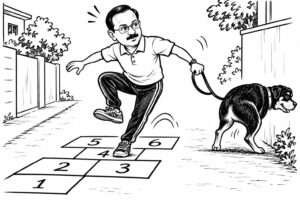
I was taking Sammy, our Rottweiler, out for her early-morning urge when I spotted some faint hopscotch boxes drawn by children in our lane. Sammy stopped to attend to an important piece of canine business. I looked around. Nobody appeared to be watching.
So, naturally, a man in his sixties did what any dignified adult would do – I hopped, then skipped, and then jumped.
For a few glorious seconds, I was back in school, negotiating the hopscotch squares with all the seriousness of an Olympic athlete.
And when I heard footsteps round the bend, I quickly grabbed Sammy’s leash and resumed walking, wondering if someone had seen me. If they did, I hope they assumed I was testing the pavement for structural defects.
Mind the gap and the pattern
Apparently, I am not alone in this strange little game. I recently stumbled upon an article in Times of India about people who deliberately step on alternate floor tiles. You know the routine: skip one, step on the next; left foot here, right foot there; and suddenly the entire shopping centre floor has become your personal obstacle course.
The interesting thing is that the brain seems to enjoy patterns. Repetition, symmetry and order catch our attention, and sometimes we turn them into tiny challenges without even realising it. Which explains a lot.
A tiled floor isn’t merely a tiled floor anymore. It is a chessboard. A row of paving stones isn’t a pavement. It is a test of coordination.
And a child’s hopscotch drawing isn’t children’s graffiti. It is apparently an irresistible invitation to a grown man walking a Rottweiler.
Monk would understand
This also reminds me of Monk, the wonderfully quirky detective played by Tony Shalhoub.
Adrian Monk could hardly walk past the world without trying to impose some kind of order on it. He noticed things most of us ignored, worried about things most of us never considered and had an almost heroic relationship with symmetry, cleanliness and things being just so.
Of course, there is a difference between Monk’s compulsions and my little hopscotch episode. His behaviour was tied to serious anxiety and OCD (obsessive-compulsive disorder); mine was tied to the fact that Sammy was temporarily occupied and nobody seemed to be looking. At least, I hope nobody was.
Adults never really grow up
We grow older, acquire responsibilities, pay EMIs, read newspapers, discuss politics, worry about cholesterol and pretend to make sense of Rahul Gandhi’s latest statement without actually rolling on the floor laughing.
But somewhere underneath all that adult seriousness is the child who still wants to jump over a puddle, walk on alternate tiles, balance along a pavement or see whether he can reach the next lamp post without touching a crack.
We simply become more discreet about it. Children play openly while adults wait for an empty corridor. And some of us wait for the dog to start peeing.
The next time you see a perfectly respectable adult walking strangely across a tiled floor, don’t be too quick to judge.
He may not have lost his balance. He may simply be playing hopscotch in his head. Or, like me, he may be praying that nobody saw him.

