



I am a tennis fanatic. At the risk of sounding immodest, I can claim to remember, until a few years ago, the winner of almost every Wimbledon event since the 1950s. The man responsible for my lifelong love for this sport was my brother-in-law, Kotamraju Venkata Krishnamurthy of Bapatla. We called him Bava.
Bava was a gifted sportsman who played tennis, table-tennis, hockey, and badminton with the seriousness of a professional athlete. An injury during a hockey match in Poona cut short his sporting ambitions. The cheery old man would have been 100 years plus, had he been around.
Of all the sports he played, he had great affinity for tennis. Bava was a great raconteur of countless sports anecdotes and was a walking tennis encyclopaedia.
Last week, when Alexander Zverev ‘Sascha’ won the US Open, my mind travelled back in time to when, as a little boy, I heard Bava talk about amazing trait of one ‘von Cramm’ – a World War era German tennis player and aristocrat.
Baron Gottfried von Cramm – that was the full name of the German tennis star – was known to have an excessive sense of justice and fair play. In a crucial Davis Cup final match that Germany played against the United States in 1935, von Cramm refused to accept a match point in his favour which would have guaranteed Germany the coveted Cup, but the man instead told the umpire that he had touched the ball with the tip of his racquet – which none had noticed! Can one even imagine such a self-denying gesture in sports these days?
The US grabbed the opportunity with both hands and won the tie. Did von Cramm regret it?
Far from it. He was believed to have said that he had taken to tennis because it was a gentleman’s game. ‘That was how I have been playing ever since I held my first racquet.’
He went on to win the French Open at Roland Garros in 1934 and 36, but was less fortunate at Wimbledon, where he finished as a runner-up three years in a row from 1935 to 37. He was a finalist at the US Open in 1937 and reached the semi-finals at the Australian Open the following year. Don Budge (US), the first to win all four Grand Slams in the same year (1938), and Fred Perry (UK), who won several Grand Slam singles titles (while simultaneously being the world table tennis champion), were his principal rivals. Gottfried’s career spanned the First and Second World Wars. In all, he had played in more than 100 Davis Cup matches and in the four majors.
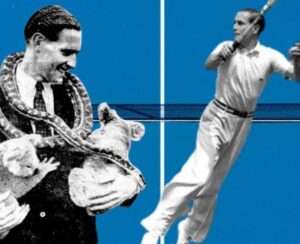
His achievements and riches aside, Gottfried had a troubled life. His first French Open title coincided with the arrival of Adolf Hitler as the Führer. Impressed by Gottfried’s charming personality, Hitler planned to present him as a model of Aryan supremacy. Von Cramm would have none of it, saying Hitler was but a mere ‘house painter.’ He had consistently rejected invitations to join the Nazi party.
Hitler put him in jail on charges of homosexuality and later packed him off to Russia as an ordinary soldier. He was released on the intervention of King Gustav of Sweden – an ardent tennis lover.
The baron spent his later years in Egypt and was said to be in various relationships with high society women. He was killed in a road accident in Cairo in 1976.
Von Cramm was inducted into the Tennis Hall of Fame in 1977, and a road leading to his favourite Ross Weiss tennis club in his native Grunewald in Berlin was named after him.
I will round off the piece with another interesting anecdote of my bava.
He and his friends in their forties journeyed from Bapatla to Madras to watch Frank Sedgman, Lew Hoad, Tony Trabert, ex-champions at Wimbledon, and Pancho Segura play exhibition matches.
A heavy shower overnight inundated the court. The play was all but cancelled. But a popular petrol company dewatered the court, poured hundreds of gallons of petrol, set it on fire, and rendered the court fit for play.
There are many such tennis stories that I heard from Bava. I belong to a generation that developed a love for global sports not by watching them on TV, but by following them through newspapers and radio. Until the 1980s, when Doordarshan started broadcasting a select few Grand Slam events, we only read about top players and matches but never watched them. It is stories such as the ones Bava told me that created a sense of magic around the sport and brought it to life.


