



India’s recent patenting of BAM-H24, a boron-rich energetic compound developed by scientists associated with ACRHEM, now DIA-CoE, at the University of Hyderabad under DRDO, has understandably attracted attention. But the significance of the development lies not in the broad claim that India has “cracked boron rocket fuel”, but in something more specific: an Indian team has patented a particular boron-rich molecule that could potentially address some of the longstanding safety and performance challenges associated with high-energy solid propellants.
Indian Patent No. 599900, filed on December 21, 2022 and granted on August 20, 2026, covers BAM-H24, including its synthesis, structural characterisation and energetic properties, as well as its proposed use as a solid rocket fuel, propellant additive or burn-rate accelerator. The inventors are Dr Muddamarri Hanumantha Rao and Prof Muralidharan Krishnamurthi.
Why does this matter?
Boron has long fascinated rocket scientists because of its exceptionally high theoretical energy density. Yet turning that theoretical advantage into dependable propulsion has proved extraordinarily difficult. Elemental boron tends to develop a protective oxide layer that delays ignition. Even after ignition, combustion can remain incomplete, while boron oxide and other condensed products can create slag, nozzle erosion and two-phase flow losses. These problems can erode the very performance advantage that makes boron attractive in the first place.
This is where BAM-H24 becomes interesting. Instead of relying on elemental boron powder, the Indian researchers have developed an ionic compound containing a dodecaborane anion and an organic diammonium cation. The reported attraction is the combination of high boron content with chemical and thermal stability and comparatively low sensitivity to impact and friction.
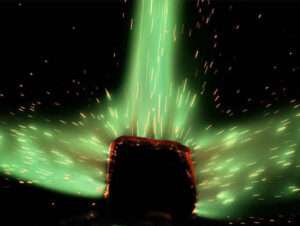
For missile propulsion, such characteristics could be valuable. Solid rocket motors place a premium not only on specific impulse and ignition behaviour but also on manufacturing safety, storage, transportation and shelf life. A high-energy ingredient that is less sensitive to accidental impact or friction could potentially improve the safety envelope of propellant manufacture and handling. If subsequent testing establishes a meaningful improvement in specific impulse, even a modest gain could translate into additional range, reduced motor mass or greater terminal velocity, depending on the application.
The implications for space launchers are more complicated. Large orbital vehicles demand extremely efficient combustion, while condensed combustion products and slag can undermine the advantages of boron-based formulations. For that reason, BAM-H24 should presently be regarded as a promising candidate for further propulsion research rather than an immediate replacement for established aluminium-based composite propellants.
The more intriguing possibility may be smaller, rapidly deployable solid-fuel launch systems, where storage stability, readiness and handling safety are especially important. A stable, low-sensitivity, high-energy ingredient could potentially fit such requirements if its laboratory characteristics survive the transition to practical motor technology.
This also explains why the United States and Russia have not simply “failed” to achieve boron-fuel supremacy. Their decades of research encountered the same fundamental chemistry and engineering barriers. Boron’s theoretical energy density is attractive, but reliability, combustion efficiency, slag formation, processing complexity and cost have historically favoured more mature aluminium-based systems.
The real test for BAM-H24 therefore begins after the patent. Independent measurements must establish its specific impulse, burn behaviour, combustion efficiency, compatibility with established binders, ageing characteristics, manufacturability and cost. Most importantly, it must demonstrate performance in progressively larger motor tests.
The patent is consequently a meaningful indigenous step in advanced-propellant research, but not yet a finished propulsion revolution. India has secured intellectual property around a promising new approach to an old problem. Whether BAM-H24 becomes a significant missile and space technology will ultimately be decided not by the patent title, but by what happens inside a rocket motor.


