



Whether you light a lamp or not is a personal decision. To adhere to a religious tradition, to distance yourself from it, or to practice it in your own way—in a democratic society, this is a matter of individual freedom. But when personal preference or the expression of political disagreement escalates to the public mockery of a religious symbol or cultural tradition, the question is no longer just about a lamp. The question is how much we respect the beliefs and cultural sensibilities of others while expressing our disagreement.
The lamp holds a profound significance in Indian culture. The entire spirit of Diwali is associated with light, hope, and the triumph of light over darkness. The tradition of lighting lamps in homes, temples, and on various auspicious occasions has been passed down through generations. The tradition of lighting lamps in the evening is also evident in many Indian families to this day. Therefore, for some, the lamp is not just an object made of oil, wick, and clay; it also symbolizes faith, auspiciousness, knowledge, and positive energy.
This sentiment is expressed in the famous Sanskrit prayer—”Deepo Jyotih Param Brahma, Deepo Jyotirjanardanah. Deepo Haratu Me Papam, Sandhyadeep Namostute.” Meaning, the light of the lamp is saluted as the ultimate light and it is prayed to dispel ignorance and negativity. This is why lighting a lamp in a Sanatani family is not just a simple household activity, but a ritual deeply rooted in religious and cultural beliefs.
Therefore, lighting a lamp should not be forced upon anyone, but it should also not be considered appropriate to mock the faith of the person lighting the lamp. Personal liberty means not only the freedom to choose oneself, but also the responsibility to respect the choices and beliefs of others. It is also important to note that when a religious symbol is associated with a political event, it is natural to question that event. One might ask what role a political event should play in public institutions, whether participation in it is voluntary, and to what extent the use of government resources is appropriate.
This is where it becomes important to distinguish between criticism of a political event and insulting a cultural symbol. If there is an objection to lighting lamps at an event, the question should be about the political nature of the event, its administrative role, expenditure, or mode of participation. Targeting the lamps themselves, the puja, or the Sanatan tradition takes the debate in a different direction. Similarly, if someone opposes a political event, it would not be appropriate to label them anti-Indian culture or anti-religion solely on this basis.
Today, social media has given everyone a platform to express their views. This has also brought a problem—the line between satire and criticism can often become blurred. While certain words or images may seem like simple political satire to some, the same content may be perceived as an insult to someone else’s beliefs. Therefore, social sensitivity is essential alongside social media freedom.
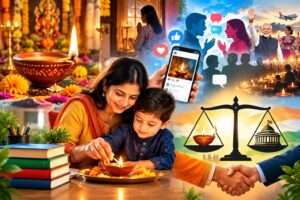
The tradition of blowing out candles on birthdays also comes to mind in this context. Today, cutting a cake and blowing out candles is widely practiced on birthdays. On the other hand, those who consider the lamp a symbol of auspiciousness and light in the Indian religious tradition view it differently. The cultural contexts of both traditions differ. Therefore, adopting one or avoiding the other should not be taken as an indication of a person’s patriotism or devotion to their culture.
Still, a question worth pondering is: are we as sensitive to the symbols associated with our own culture as we expect to be sensitive to other cultural symbols? If someone chooses not to light a lamp on Diwali, they are free to do so. But if someone else lights a lamp with complete devotion, why should their faith be ridiculed? Similarly, if someone participates in a political event by lighting a lamp, they should be criticized for the political aspect of the event, not their religious beliefs.
Political debates often cite birthday celebrations of former Prime Ministers or other leaders, and alleged government expenditures. To substantiate such allegations, the relevant year, expenditure, and official documents are essential. Accusing an individual or former government of misusing public funds without proof is unfair. Today’s political debate requires facts, not mere old allegations, to strengthen it.
The real question isn’t about a few rupees worth of oil and wick. The real question is what our priorities should be in public life and what our language should be. Should political differences become so sharp that even cultural symbols become targets? Is it right to equate religious belief with political support? Is a person who lights a lamp necessarily a supporter of a political ideology? And is a person who doesn’t light a lamp automatically anti-cultural? The answer to these questions is that a person’s faith and political preferences must be understood separately.
For some, the lamp represents worship, for others tradition, for others culture, and for others simply light. Interpretations may vary, but it’s possible to disagree without offending. The strength of our culture lies not just in the fact that we light lamps; its strength also lies in the fact that we foster dialogue between diverse opinions. Just as the flame of a lamp dispels darkness—in the same way, wisdom, restraint, and facts can dispel the darkness of public debate.
So, whether you light a lamp or not is your decision. Supporting or opposing a political event is also your right. But before mocking faith and hurting the sensibilities of others while protesting, consider this: Disagreement is the strength of democracy, but respect is its dignity.

