

Why a better inequality score is encouraging, but not the complete economic picture
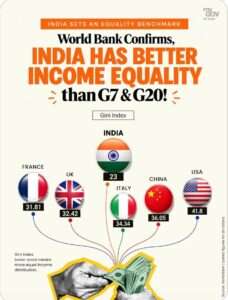
India’s reported Gini Index score of 23 has attracted considerable attention, placing the country among the more equal societies in the world according to the World Bank’s latest available data for 2023. It is an encouraging indicator, particularly for a country of India’s size, population and economic diversity. A lower Gini score indicates a more equal distribution of resources. On this measure, India appears to fare better than several major economies, including the United States, the United Kingdom, China, France and Italy.
But does this mean India has substantially overcome income inequality? Not quite. While the achievement deserves recognition, interpreting the figure without understanding how it is calculated could lead to an incomplete, even misleading, picture of India’s economic realities.
The Gini Index measures inequality on a scale ranging from zero, representing perfect equality, to 100, representing complete inequality. India’s relatively low score needs to be understood in the context of the methodology used. Unlike several developed economies that primarily calculate inequality using income distribution, India’s estimates are based largely on household consumption expenditure. In simple terms, the assessment looks at what households spend rather than precisely how much they earn.
This distinction is significant. Higher-income households generally save and invest a greater proportion of their earnings, whereas lower-income households tend to spend a much larger share of what they earn on everyday necessities. Consequently, differences in consumption expenditure are often less pronounced than differences in actual income. A consumption-based Gini can therefore present a more equal picture than an income-based assessment.
This is not to suggest that India’s methodology is incorrect. Consumption is a legitimate and important measure of living standards. However, comparing India’s consumption-based score directly with the income-based Gini scores of countries such as the US or China is not an entirely like-for-like exercise. The figures may be statistically valid within their respective methodologies, but the underlying measurements differ.
More importantly, a favourable consumption inequality score should not divert attention from the substantial disparities that remain in India’s income and wealth distribution.
The World Bank itself has highlighted the persistence of wage inequality. Its assessment indicates that median earnings among the top 10 per cent of workers are approximately 13 times those of the bottom 10 per cent. Such a gap is hardly insignificant in an economy aspiring to achieve inclusive and sustainable growth.
Independent research by the World Inequality Database (WID) presents an equally important dimension. Its estimates for 2022–23 indicate that India’s richest 1 per cent accounted for approximately 23.3 per cent of national income and held around 40.1 per cent of total wealth. The top 10 per cent commanded approximately 57.7 per cent of income and 65 per cent of wealth. These figures underline the extent to which economic assets and earnings remain concentrated at the upper end of society.
There is, therefore, a distinction between improving consumption equality and achieving broader economic equality. Access to subsidised food, housing, healthcare, sanitation, financial inclusion and welfare support can improve the consumption capacity of poorer households. Such interventions matter enormously. Equally, expanding infrastructure, digital connectivity, employment opportunities and direct benefit transfers can improve living standards and reduce economic vulnerability.
However, sustainable equality requires more than improving consumption. It demands productive employment, better educational opportunities, access to quality healthcare, skill development, entrepreneurship and a wider distribution of economic opportunities. Rural households, informal workers, small businesses and young job seekers must have a meaningful stake in economic growth.
The challenge is to ensure that India’s expanding economy creates opportunities beyond the traditional centres of wealth and privilege. Growth must translate into better wages, greater purchasing power and the ability to accumulate assets for ordinary households.
India’s Gini score of 23 is certainly a positive statistical development and deserves acknowledgement. But a single index cannot capture the entire complexity of a vast and diverse economy. The real test is not merely whether people are consuming more equally, but whether they are earning better, accumulating wealth and enjoying greater economic security.
India should celebrate the progress reflected in its Gini Index, but should not mistake a favourable statistic for the completion of its equality journey. The ultimate objective must be inclusive prosperity, where growth is not merely impressive in national accounts but meaningful in the lives of ordinary citizens.