



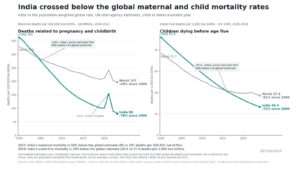
Bharat’s progress is often measured through GDP growth, infrastructure expansion, global influence and technological achievements. Yet, some of the most compelling indicators of national development are far less glamorous: how many mothers survive childbirth and how many children live beyond their fifth birthday. On these critical human development indicators, Bharat has achieved a remarkable transformation, moving from a position worse than the global average to one significantly better. The numbers tell a story that deserves wider recognition. According to United Nations estimates, Bharat’s maternal mortality ratio stood at 362 deaths per 100,000 live births in 2000, compared with the global average of 328. In other words, Bharat was performing worse than the world as a whole. By 2023, the country’s maternal mortality ratio had fallen dramatically to just 80, against the global estimate of 197. That represents a reduction of approximately 78 per cent, nearly twice the global decline of 40 per cent. More significantly, Bharat’s maternal mortality ratio is now about 59 per cent below the global average. The improvement in child survival is equally striking. In 2000, Bharat’s under-five mortality rate was 91.8 deaths per 1,000 live births, substantially higher than the global figure of 76.7. By 2024, India’s rate had dropped to 26.6, compared with 37.4 globally. This translates into a reduction of approximately 71 per cent for Bharat, against a worldwide decline of 51 per cent. A country that once lagged behind the global average has now moved nearly 29 per cent below it. These are not marginal improvements. They represent millions of mothers and children who have had a better chance of survival. The crossover in maternal mortality occurred in 2005, followed by under-five mortality in 2016. The trajectory also reflects the pandemic-related setback, reminding us that progress has not been entirely linear. Behind these numbers lies the gradual strengthening of Bharat’s public health infrastructure, institutional deliveries, maternal and neonatal healthcare, immunisation programmes, nutritional interventions and wider access to healthcare services. Initiatives such as the National Health Mission, Janani Suraksha Yojana, Mission Indradhanush and the expansion of primary healthcare have contributed to improving health outcomes. The Ayushman Bharat programme has further sought to widen access to healthcare and strengthen the delivery system.
These efforts, alongside state-level interventions and the work of frontline health workers, have helped change the country’s public health landscape. It would, however, be simplistic to attribute this transformation to any single government or programme. The data cover more than two decades and span multiple political administrations. Bharat’s progress is the cumulative outcome of sustained public investment, policy interventions, institutional improvements, scientific advances and the dedication of healthcare workers. Recognising this continuity is as important as acknowledging the achievements. Nor should these encouraging figures lead to complacency. An estimated maternal mortality ratio of 80 still means preventable deaths, while under-five mortality at 26.6 leaves considerable ground to cover. Regional disparities, malnutrition, inadequate healthcare facilities in remote areas, shortages of medical personnel and the quality of public health services remain serious challenges. The objective must be to bring these numbers down further, with every mother and child, irrespective of income or geography, receiving timely and quality healthcare. Equally important is the credibility of the data. These are UN modelled estimates accessed through the World Bank’s World Development Indicators, carrying uncertainty intervals. The crossover years refer to central estimates. The comparison is with the global average, not exclusively with developed Western nations. Such qualifications are necessary, but they do not diminish the significance of the broad trend. Bharat’s development story cannot be confined to stock market performance, GDP rankings, expressways or international diplomacy. Economic growth matters, but its ultimate purpose must be reflected in healthier, safer and longer lives. A nation truly rises when its mothers are more likely to survive childbirth and its children have a better chance of growing up. By that measure, Bharat’s journey over the past two decades is not merely encouraging; it is a substantial human development achievement. Bharat Rising is not just about becoming a bigger economy. It is about becoming a healthier nation.

