



As the great conflict of Kurukshetra raged with relentless intensity, Lord Krishna guided his chariot behind Dharmaraja Yudhishthira, accompanying him in the sacred mission of upholding righteousness. As they journeyed across the battlefield, the venerable sage Vedavyasa suddenly appeared before them and bestowed his blessings upon the son of Dharma. Gazing upon Yudhishthira with compassion and wisdom, the sage addressed him in soothing words. He reminded him that Karna had preserved the celestial Shakti weapon solely to destroy Arjuna. Had that irresistible missile been discharged against Arjuna, the consequences would have been devastating. Yet destiny had ordained otherwise. The allotted span of Ghatotkacha’s earthly life had reached its conclusion, and therefore the divine weapon found its mark in him. Though grievous in appearance, the event had secretly served the welfare of the Pandavas, sparing them immeasurable sorrow. Understanding the hidden workings of fate, Vyasa urged Yudhishthira to abandon grief, anger, and agitation.
The sage further exhorted him to stand firm in courage and righteousness. Supported by his brothers, allies, kinsmen, and faithful armies, he was to continue the struggle against the Kauravas with unwavering determination. Victory, prosperity, and auspiciousness always gravitate toward the side where Dharma prevails. Vyasa then revealed a prophecy destined to strengthen Yudhishthira’s heart. He declared that within five days victory would adorn the Pandavas, and the sovereignty and wealth of the earth would come into their possession. Such an outcome, he assured him, was beyond doubt. Having delivered these profound words, the great sage departed as suddenly as he had appeared.
Sanjaya narrated to Dhritarashtra how Yudhishthira, deeply comforted by the sage’s counsel, gathered his mind into steadfast composure. He summoned Dhrishtadyumna and entrusted him with a crucial task. Pointing to the fierce struggle unfolding around Dronacharya, he reminded the Panchala prince of the purpose for which he had been born. Emerging from the sacrificial fire performed by King Drupada, Dhrishtadyumna had been destined to bring about Drona’s downfall. Therefore, accompanied by Shikhandi and the foremost warriors of Panchala, he was commanded to confront the revered preceptor without hesitation. Yudhishthira assured him that victory was already inclining toward their side and urged him to proceed with resolute confidence.
Thereafter, Nakula and Sahadeva were also summoned. Yudhishthira instructed them to advance against Dronacharya alongside King Virata, King Drupada, Satyaki, the Kekaya rulers, and the sons of Kunti. Their united purpose was to bring an end to the formidable commander whose prowess continued to sustain the Kaurava cause. Obeying the command, the assembled heroes surged forward against the enemy ranks. Perceiving their intentions and accurately judging the evolving circumstances, Drona swiftly arranged his forces and devised fresh strategies for the impending encounter.
Yet beneath the outward grandeur of war, a different struggle was unfolding. The soldiers on both sides had fought continuously through exhausting days and nights. Hunger, thirst, fatigue, and sleeplessness had consumed their strength. The scorching heat of battle and the absence of rest had reduced mighty warriors to trembling shadows of themselves. Sanjaya described to Dhritarashtra the pitiable condition of the armies. Men carrying torches staggered with drooping limbs, while the flames they bore flickered weakly. Some warriors allowed their weapons to slip from their grasp. Others wandered in their chariots and vehicles, scarcely aware of where they were going. In their overwhelming exhaustion, many could no longer distinguish friend from foe and struck blindly in confusion. Duty alone compelled them to continue fighting despite the unbearable burden placed upon body and mind.
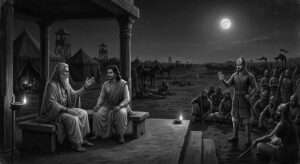
Observing this distressing spectacle, Arjuna’s compassionate heart was moved. Raising his voice so that it carried across the battlefield, he addressed both armies alike. He acknowledged their exhaustion and declared that warfare conducted in such a condition had lost its precision and purpose. He urged the warriors to cease hostilities temporarily, rest their weary bodies, and resume combat under the illumination of the moon. His words, born of wisdom and humanity, were welcomed by soldiers from both sides. The proposal received approval, and with the consent of Karna and Duhshasana, the Kaurava forces withdrew to rest. The Pandava army followed the same course.
The weary warriors praised Arjuna’s noble conduct. They spoke of his boundless kindness and his ability to understand the sufferings of all men, even amidst war. Blessings flowed from countless lips as they prayed for his prosperity and victory. Soon the battlefield, which moments earlier had thundered with violence, became a vast resting place. Warriors reclined wherever comfort could be found. Some slept upon the backs and heads of elephants; others rested beside their chariots or beneath their standards. The sight resembled children sleeping peacefully in the lap of a loving mother, their hardships forgotten in the embrace of temporary repose.
Meanwhile, the moon ascended majestically into the heavens. Its radiant disc dispelled the darkness and bathed the earth in gentle splendor. Tinged with subtle crimson hues, its beams spread across the eastern mountains like coral rising from the depths of the ocean. To some observers, the moon appeared as though Brahma himself were painting red lotuses upon the canvas of the sky. Others imagined it to be the reward earned by devoted chakora birds through their long yearning for moonlight. Its delicate rays danced upon the faces of sleeping warriors and reflected upon the cheeks of maidens far away, awakening thoughts of tenderness and beauty. Lotuses blossomed beneath its touch, and the entire world seemed transformed into a realm of serenity and enchantment.
As the moonlight filled every direction, the exhausted armies gradually awakened, refreshed and restored. Once again they prepared themselves for the terrible duties of war. At that time Duryodhana approached Dronacharya and praised his mastery of archery and supreme knowledge of warfare. Yet beneath his praise lay bitterness and suspicion. He lamented that despite Drona’s unmatched power, the Pandavas continued to survive. He suggested that the preceptor’s affection for his former disciples prevented him from employing his full strength. Though he admitted that this might not be Drona’s fault, he declared it to be his own misfortune.
These words deeply offended the noble Acharya. Anger flashed within him as he responded with stern dignity. He reminded Duryodhana of Arjuna’s incomparable achievements. Had Indra yielded before Arjuna during the burning of the Khandava forest merely because Arjuna was Drona’s disciple? Had Arjuna rescued Duryodhana from captivity among the Gandharvas because of such favoritism? Had he conquered the invincible Nivatakavachas and Kalakeyas through his teacher’s affection alone? Drona declared that Arjuna’s greatness was undeniable and independent of any personal relationship. Therefore, Duryodhana’s accusations were unjust and unworthy.
Stung by the rebuke, Duryodhana’s anger intensified. He retorted that if Drona truly did not wish to fight the Pandavas with full vigor, then he himself would confront Arjuna. Accompanied by Duhshasana, Karna, and Shakuni, he boasted that he would defeat the son of Pandu. Hearing these words, Drona laughed. His laughter carried both irony and pity. He told Duryodhana to proceed according to his own wishes and test his valor against Arjuna. The Acharya reminded him of the countless royal luxuries he had enjoyed throughout his life—fine garments, precious ornaments, sumptuous foods, and every comfort that earthly sovereignty could bestow. Having enjoyed all these blessings, he should now perform the duty of a warrior without fear. If fate decreed it, he would indeed meet his end at Arjuna’s hands.
The sharp exchange left a lasting impression upon all who witnessed it. Having spoken his mind, Dronacharya turned away without waiting for further reply. Swiftly he advanced toward the Panchala forces, intent upon fulfilling his duty on the battlefield. Thus, Sanjaya recounted to King Dhritarashtra the significant confrontation between Duryodhana and the supreme commander of the Kaurava army, a confrontation that revealed both the growing tensions within the Kaurava ranks and the inexorable approach of destiny.

