Lakshmanrao Upadhyayula
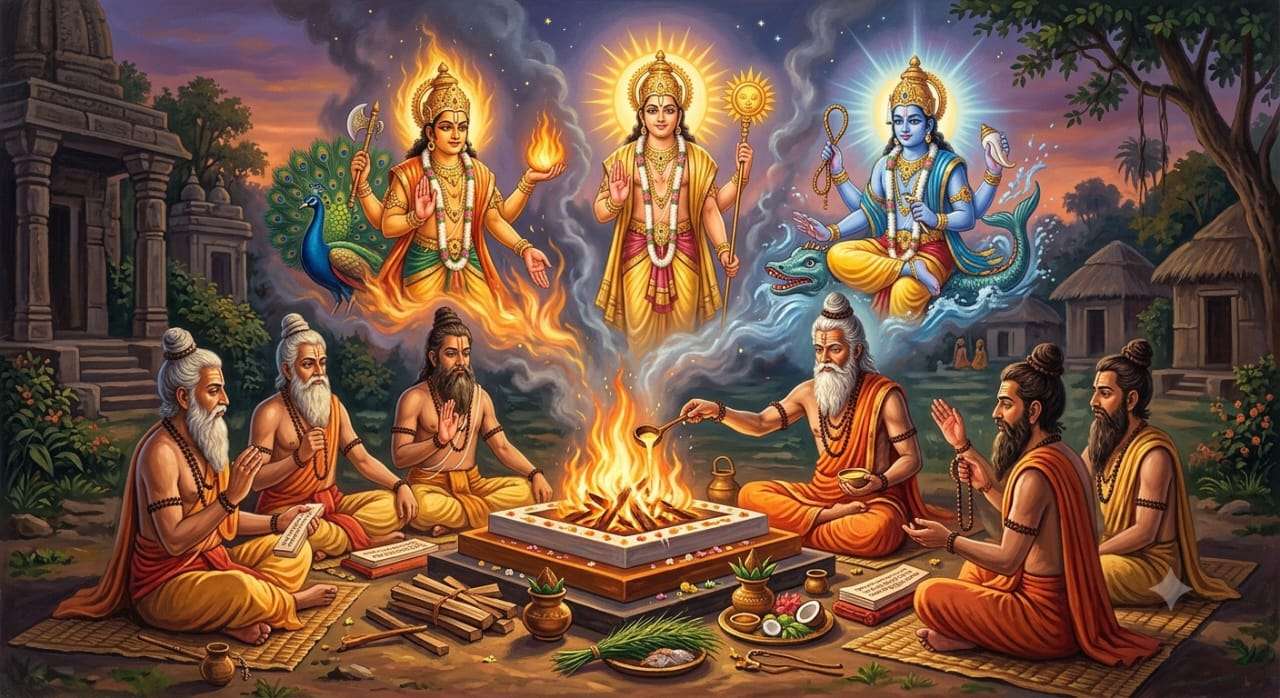
Among the luminous hymns of the Rigveda, there shines a profound composition revealed to the great sage Vishwamitra in the majestic metre known as Trishtubh. This metre, stately and resonant, is particularly suited to lofty invocations and philosophical contemplation. In these sacred verses, the sage invokes Agni, the divine Fire, as the first and indispensable presence in every yajna. Agni is not merely the physical flame kindled upon the altar; he is the radiant intelligence that links earth and heaven, matter and spirit, human aspiration and divine grace.
The hymn begins with the invocation of Samidhagni, the fire kindled by sacred fuel sticks. The sage addresses Agni with reverence: “Rise with a benevolent mind. Shine forth with dynamic radiance. Bestow upon us abundant wealth.” Here, the ritual act of igniting fire symbolizes the awakening of higher consciousness within the human heart. Just as latent energy is released when fuel meets flame, so the dormant spiritual power in man is kindled by disciplined thought, devotion, and sacred action.
Agni is then praised as the brilliant Hota, the divine priest who summons the gods to the sacrificial arena. In Vedic understanding, Agni is both messenger and mediator. He receives the offerings made by human beings and conveys them to the celestial powers. This conception reflects a remarkable scientific intuition: fire transforms gross matter into subtle energy, just as every act of sincere intention is transmuted into invisible spiritual force. Thus, Agni represents the universal principle of transformation.
The fire that burns upon the altar, nourished by holy grass and wooden sticks, is called Samidhagni. Through this visible flame, the worshippers invoke Mitra, Varuna, and Agni himself. These deities are worshipped thrice daily, signifying the sanctification of morning, noon, and evening. The ancient seers perceived yajna as the very cause of rain, fertility, and abundance. Their insight corresponds to ecological truth: sacrificial living, marked by gratitude and responsible action, sustains the cycles of nature upon which life depends.
Agni is declared to be the foremost among the gods and the bestower of rain and prosperity. To please him, the goddess Ila is invited to approach the altar. Ila represents inspired speech and the nourishing power of the Earth. Agni, as the master of ritual wisdom, is entreated to conduct the yajna according to cosmic law. When the sacred grass known as Barhis is spread, a subtle path is formed by which the bright oblations ascend to the celestial realms, symbolizing the elevation of human aspiration toward divine fulfilment.
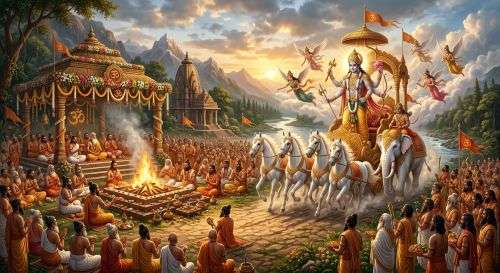
The sacrificial enclosure becomes a shining hall of holiness. The Hota-priest takes his seat, and the sanctified grass is spread in accordance with ancient ordinance. The gods who bless humanity by releasing life-giving waters are invited to attend the sacrifice. The sages envisioned these deities as descending in human-like forms, approachable and compassionate, ready to respond to sincere prayer offered for the welfare of all beings.
The worshipper then prays with full-hearted devotion, recognising day and night as dual manifestations of Agni. By day he shines as visible light; by night he glows as hidden warmth and inward awareness. This insight reflects the Vedic understanding that the same cosmic energy assumes many forms. The alternation of day and night, activity and rest, outer action and inward reflection, is governed by one eternal principle.
Mitra, Varuna, and Indra are invited to assume their most beneficent forms and bestow their blessings. Agni is praised as the dual Hota, functioning both as the visible priest on earth and the invisible priest in heaven. The ritvijas, the officiating priests who embody aspects of Agni, awaken and sustain the ritual fire with precision and reverence, illustrating the cooperation of human skill and divine inspiration.
The sacred goddesses Bharati, Ila, and Saraswati are then invoked. Bharati represents exalted expression, Ila sacred nourishment, and Saraswati flowing wisdom. Accompanied by their luminous retinues, they are invited to sit upon the holy grass before the altar. Their presence sanctifies speech, thought, and understanding, reminding the worshipper that every worthy act must be guided by clarity, nourishment, and wisdom.
Next, the divine artisan Tvastar is invoked. He is asked to bless the sacrificer with worthy progeny, courage, ritual skill, and the power of purification. In this prayer, the desire for a son signifies not merely biological continuation but the transmission of dharma, knowledge, and noble character to future generations. The sustaining continuity of lineage is regarded as a sacred trust.
The hymn also invokes Soma, whose divine essence nourishes devotion and immortal aspiration. Agni in the form of Vanaspati, the lord of vegetation and sacrificial wood, carries the offerings to the gods. Even the animal offerings mentioned in ancient symbolism are understood as representing the surrender of lower instincts into the purifying fire of consciousness. Thus, yajna becomes an inner discipline in which ignorance is transformed into wisdom.
Agni, the knower of the births of the gods, is once more requested to summon the deities and perform the sacrifice flawlessly. He is asked to shine ever more brilliantly. The swift chariot of Indra is envisioned as bringing the gods together, and upon the sacred seat of kusa grass sits Aditi, the boundless Mother of the gods and symbol of infinite consciousness.
At the culmination of the yajna, the sacred syllable “Svaha” is uttered, consecrating each offering. Through this sound, the eternal gods are delighted, and the intentions of the worshipper are released into the cosmic order. The Vedic seers understood that sound, energy, intention, and matter are profoundly interconnected. Their vision anticipated a scientific temperament that perceives the universe as an ordered and responsive system governed by subtle laws.
Thus, the Trishtubh hymn of Sage Vishwamitra stands as both a spiritual revelation and a philosophical masterpiece. It portrays yajna as a grand cooperation between humanity and the cosmos, where disciplined action, sacred speech, and enlightened understanding invoke the forces that sustain life. Agni, the divine Fire, burns at the centre of this vision as the eternal transformer, turning offerings into blessings, knowledge into wisdom, and human aspiration into divine realization.