Lakshmanrao Upadhayayula
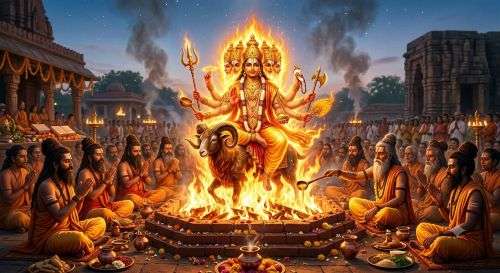
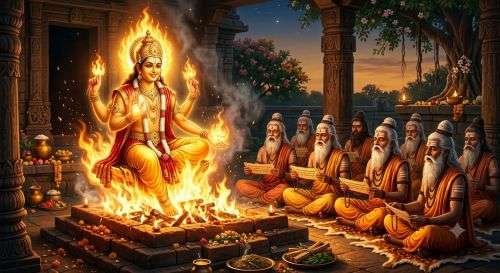
The seer Vāmadeva, one of the most revered sages of the Rigveda, invokes the divine presence of Agni through sacred hymns composed in the majestic Triṣṭubh Chandas. In the Vedic tradition, Agni is not merely the physical fire but the compassionate divine force that connects humanity with the celestial world. He is the carrier of prayers, the purifier of thoughts, and the sacred bridge between mortals and the gods. His presence symbolizes wisdom, sacrifice, and the awakening of higher consciousness. Every Vedic ritual begins with Agni because he prepares the path through which divine blessings reach humanity.
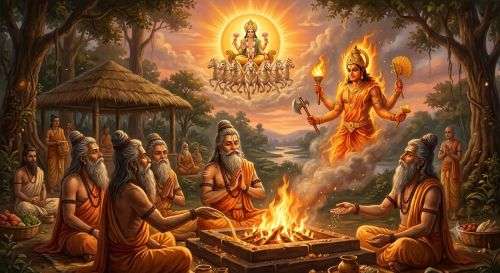
Before the first rays of dawn illuminate the eastern horizon, Agni advances as the herald of Uṣā, the radiant goddess of dawn. Just as the glow of fire announces the arrival of daylight, Agni dispels the darkness of ignorance and prepares creation for the awakening of life. This poetic imagery beautifully portrays the natural transition from night to day while also expressing the inner spiritual journey from confusion to enlightenment. The Vedic sages perceived this daily transformation as a sacred reminder that knowledge always triumphs over ignorance.
The divine twin horses yoked to the celestial chariot symbolize the irresistible movement of cosmic energy towards the homes of devoted worshippers. As Surya rises with incomparable brilliance, he inspires the Ritvijas, the officiating priests, and all seekers of truth to begin their sacred duties. Dawn is therefore not merely the beginning of another day but a divine invitation to perform righteous actions, uphold truth, and dedicate one’s work to the welfare of the universe. Every sunrise becomes a spiritual call to renew one’s commitment to dharma.
Savitṛ, the life-giving aspect of the Sun, stretches his luminous rays upward, awakening every corner of creation. The Rigvedic poets compare the powerful Sun to a mighty bull that raises dust while following the herd of cows to ensure the continuation of life. This magnificent metaphor represents strength, fertility, protection, and abundance. In the same manner, the rays of the Sun spread across the heavens, energizing the atmosphere and initiating the rhythm of the universe. As daylight unfolds, Varuṇa, Mitra, and numerous celestial powers symbolically assume their respective cosmic responsibilities, maintaining harmony, justice, order, and natural balance throughout creation.
The Vedic seers envisioned the creators of the universe as divine powers tirelessly engaged in sustaining the cosmic order without abandoning their eternal responsibilities. For the welfare of all beings, they established Surya as the visible embodiment of divine light, ensuring that darkness never permanently prevails. This profound idea reflects the Vedic conviction that the universe is governed by disciplined order rather than chaos. Every celestial movement serves a meaningful purpose, contributing to the well-being of all existence.
Surya is celebrated as the all-knowing witness of every living being. Nothing escapes his illuminating presence. His seven horses, traditionally called Hari, symbolize the seven rays of light, the seven colours of the visible spectrum, the seven days that regulate human life, and the harmonious rhythm underlying the cosmos. These symbolic interpretations remarkably resonate with modern scientific understanding that sunlight consists of multiple wavelengths forming the spectrum observed through dispersion. Thus, the poetic language of the Vedas reflects an extraordinary intuitive appreciation of natural phenomena.
The radiant Sun spreads countless delicate threads of light across the universe, weaving together the visible world with warmth, energy, and life. These fine rays nourish plants through photosynthesis, regulate seasonal cycles, sustain ecosystems, and govern the biological rhythms of all living creatures. As darkness retreats before the advancing light, ignorance also symbolically yields to knowledge. The Vedic sages recognized that the Sun’s energy is the foundation upon which earthly life depends, revealing an astonishing harmony between spiritual symbolism and scientific observation.
The swift horses drawing the chariot of Surya represent the incredible speed with which sunlight travels across space. The poetic description of darkness being peeled away like a skin conveys the irresistible victory of illumination over obscurity. Every sunrise demonstrates the eternal rhythm of renewal, reminding humanity that despair and confusion are temporary, while truth and wisdom continually re-emerge with unfailing certainty.
The visible deity Surya remains beyond the control of any earthly or celestial power. Neither kings nor warriors nor even mighty divine beings can restrain his ordained course across the heavens. His upward movement reflects the invincible law of the cosmos, operating with perfect precision and unwavering regularity. Standing like a majestic pillar supporting the celestial vault, Surya symbolizes permanence, stability, and the sustaining power of universal order. This image also echoes the scientific reality of the Sun as the gravitational centre that governs the planetary family and makes life on Earth possible.
The sage concludes by suggesting that only those who contemplate these profound truths can truly understand the unity of nature, divinity, and existence. The Vedic hymns invite humanity to look beyond the visible Sun and recognize the eternal principle of light that shines within every living being. They encourage the pursuit of knowledge through observation, contemplation, and disciplined inquiry, harmonizing spiritual wisdom with rational understanding. In this timeless vision, the Sun is not merely an object in the sky but the living symbol of truth, consciousness, energy, and the eternal rhythm that sustains the universe across all ages.