


Sanjaya spoke to King Dhritarashtra in a voice burdened with the weight of the dreadful spectacle unfolding before his eyes. “O King, the mighty warriors, drenched in streams of blood yet unwavering in their resolve, appeared like forests of blossoming palāśa trees advancing across the earth. Their crimson forms transformed the battlefield into a strange garden where courage bloomed amidst destruction. Severed arms, still adorned with glittering bracelets and weapons firmly clasped in their grasp, fell from the sky like venomous cobras hissing as they descended. Heads crowned with shining diadems and ornamented with radiant earrings floated upon rivers of blood like great red lotuses resting upon the tranquil waters of a vast lake. The gigantic elephants, struck down by irresistible weapons, lay scattered across the field like lofty mountains shattered by the thunderbolt of Indra. The severed thighs of warriors and the massive trunks of fallen elephants were so soaked in blood that one could scarcely distinguish one from the other. The battlefield presented a vision both horrifying and strangely magnificent, where terror itself had assumed the form of sublime beauty.”
Sanjaya continued, “O King, whatever words I utter to describe the fury of that conflict remain utterly inadequate. Human speech cannot contain the measure of such devastation. The earth had become a dreadful altar of sacrifice. Brains spilled upon the ground mingled with dust and blood, forming dreadful mire beneath the feet of warriors, while shattered bones lay scattered like grains of white sand upon a crimson shore. The royal yak-tail fans, once symbols of sovereignty and honour, floated upon rivers of blood like graceful white swans gliding across scarlet waters, lending an eerie elegance to the dreadful scene. Chariots, broken by ceaseless combat, drifted through torrents of blood like boats upon a flooded river, while fearless warriors moved unrestrained through the crimson currents with weapons raised, seeking either victory or glorious death.”
“When the battlefield became the supreme testing ground of courage, endurance, and martial excellence, Bhīma and Arjuna shattered one of our foremost divisions with relentless showers of razor-edged arrows. Unable to withstand their irresistible assault, your warriors fled in every direction. The thunderous echoes of Bhīma’s Pauṇḍra conch and Arjuna’s divine Devadatta resounded across the heavens, filling the hearts of your soldiers with fear while inspiring the sons of Pāṇḍu with renewed determination. Thereafter, Dṛṣṭadyumna and Śikhaṇḍi advanced, placing King Yudhiṣṭhira at the forefront of the formation, while Nakula and Sahadeva followed closely behind with disciplined ranks. Their united advance scattered the weakened forces of your son like dry leaves swept away by a mighty tempest.”
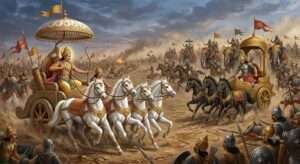
“Observing the desperate condition of the Kaurava army, the illustrious King Śalya addressed his charioteer with unwavering confidence. ‘Behold,’ he declared, ‘the chariot drawn by spotless white horses, shaded beneath the royal white umbrella. There stands Yudhiṣṭhira. Drive me swiftly towards him. We must halt this overwhelming advance before it consumes our entire army. Let every warrior assembled here witness my courage and the greatness of my arms. Today the world shall know the measure of my valour.'”
“His voice rose with irresistible confidence. ‘Drive without hesitation. In battle I possess the strength to challenge even the immortals. These sons of Pāṇḍu cannot withstand the force of my weapons. Observe the power that resides in these arms. Before this day ends, you shall witness my mastery, my skill, and the full measure of my prowess.'”
“Obeying his command, the charioteer drove the magnificent chariot directly toward Yudhiṣṭhira and the advancing Pāṇḍava host. Filled with heroic enthusiasm, Śalya intercepted their progress and stood immovable before them, just as a mighty embankment restrains the furious waves of the ocean. His fearless example rekindled the spirit of the Kaurava warriors, who returned to battle with renewed ferocity and ruthless determination.”
“In another quarter of the battlefield, Chitrasena, the valiant son of Karṇa, charged fiercely against Nakula. Their encounter blazed with extraordinary intensity as countless arrows crossed the sky like flashes of lightning. Chitrasena shattered Nakula’s bow, pierced his forehead with sharp shafts, and swiftly destroyed his standard, horses, and charioteer. Deprived of his chariot, Nakula seized his sword and shield and rushed fearlessly upon his adversary. Chitrasena hurled a mighty spear, but Nakula caught it with astonishing dexterity and cast it back with tremendous force. Then, displaying unmatched agility, Nakula leapt upon Chitrasena’s chariot and with one irresistible stroke severed his head, adorned with glittering jewels, radiant earrings, and a magnificent crown. The lifeless head fell to the earth, and the Pāṇḍava army erupted in triumphant shouts that echoed across the field.”
“Burning with grief and anger, Chitrasena’s brothers, Satyasena and Suśarma, advanced together to avenge their fallen kinsman. Having mounted another chariot, Nakula once again took up his bow. Both mighty warriors simultaneously severed his weapon with powerful shafts. Without the slightest delay, Nakula seized another bow, slew the horses of Satyasena, shattered his bow, and pierced both brothers repeatedly with swift and deadly arrows. Though grievously wounded, they refused to retreat and continued the contest with fierce determination.”
“Sanjaya continued, ‘O King, Suśarma, filled with pride, once more shattered Nakula’s bow and brought down his standard. Satyasena covered him with an unending shower of arrows. Yet Nakula calmly cut down every missile that approached him and answered with three deadly shafts that deeply wounded each of his opponents. Enraged beyond restraint, the two brothers slew Nakula’s charioteer and launched a furious assault from every side.'”
“Bereft of chariot and bow, his body pierced with countless arrows, Nakula appeared like a wrathful serpent gliding across the battlefield with its venomous tongue extended. Undaunted by his desperate condition, he seized the divine śakti weapon and hurled it with irresistible force, striking down Satyasena instantly. Witnessing his brother’s fall, Suśarma became consumed with fury and released a relentless torrent of arrows. At that critical moment, Śrutasoma, the heroic son of Bhīma, arrived and lifted Nakula upon his own chariot.”
“Standing beside Śrutasoma, Nakula renewed the battle with undiminished spirit. Together they overwhelmed Suśarma with volleys of arrows. Suśarma answered with twenty-five keen shafts that struck Nakula with great force. Yet the son of Mādrī remained steadfast. Drawing a crescent-shaped arrow to its full length, he released it with flawless precision. The blazing missile flew like the decree of destiny itself and severed Suśarma’s head, which fell upon the blood-soaked earth, bringing an end to another mighty warrior.”
Thus Sanjaya, faithful in his duty, continued to narrate before King Dhritarashtra the immeasurable glories, dreadful sacrifices, heroic valour, and heartbreaking destruction that unfolded upon the sacred plains of Kurukṣetra, where destiny itself was being written with blood, courage, and the unyielding resolve of kings and warriors.

