


As the long and terrible war approached its final phase, Śrī Krishna, the unfailing guide of righteousness, addressed Dharmaraja Yudhishthira with solemn wisdom. “If anyone other than you confronts King Śalya,” he said, “he will shatter your armies within a few days. You alone possess the strength, patience, and divine fortune to overcome him. Therefore, rise tomorrow with unwavering resolve and destroy the mighty ruler of Madra. Let not affection cloud your judgment because he is your maternal uncle. A king must uphold the eternal code of duty above the bonds of blood. Cast aside all hesitation, embrace the courage born of righteousness, and strike down the enemy who now stands as the final shield of the Kaurava throne. We have already crossed the formidable barriers of Bhīṣma, Droṇa, and Karṇa. Now the fall of Śalya will break the remaining strength of the Kuru kingdom and hasten the end of this devastating conflict.”
Receiving these words with folded hands, Dharmaraja bowed before Krishna and replied with profound humility, “Venerable Madhava, your counsel shall be my command. I shall faithfully carry out your instructions. During Sanjaya’s embassy of peace, Śalya had openly pledged the full measure of his strength to uphold the cause of the Kauravas. Today, destiny demands that I confront him, not as my uncle, but as the commander of an opposing army. I shall fight him in obedience to dharma and in accordance with your divine guidance.”
Having thus resolved his mind, Dharmaraja respectfully requested Krishna to retire and take the rest he deserved after the exhausting labors of war. Bhīma, Arjuna, Nakula, and Sahadeva also returned to their respective camps to restore their strength for the decisive day that awaited them. Yet, even in the stillness of the night, Yudhishthira’s thoughts remained fixed upon Śalya. He understood that the coming battle would not merely determine the fate of a warrior, but would decide the destiny of kingdoms. Meanwhile, throughout both camps, weary soldiers found brief comfort in sleep, gathering fresh strength before another sunrise destined to witness unparalleled heroism and sorrow.
Sanjaya resumed his narration before the blind monarch Dhṛtarāṣṭra. “O King,” he said, “when Karṇa fell on the seventeenth day, I hastened to your presence and conveyed that heartbreaking news. At your command, before the first rays of dawn touched the earth, I returned to the Kaurava camp. There I witnessed your son Duryodhana dispatching swift messengers to summon every surviving king, prince, commander, and division of his army. They answered his call with martial determination, assembling their remaining forces for one final effort to preserve the Kuru throne.”
Soon the vast fourfold army—elephants, chariots, cavalry, and infantry—stood magnificently arrayed on the field. War bugles echoed across the plains. Mighty kettledrums thundered with relentless force. Horns, trumpets, and countless conches filled the heavens with resounding cries that stirred every warrior’s heart. Soldiers proclaimed their vows of victory with voices that seemed to rise beyond the clouds. The rolling wheels of countless chariots, the pounding hooves of swift horses, the earth-shaking tread of mighty elephants, and the disciplined march of innumerable foot soldiers blended into a single overwhelming roar. The very earth trembled beneath their advance, while the heavens answered with reverberations resembling the furious waves of an ocean crashing against itself under the irresistible pull of the full moon.
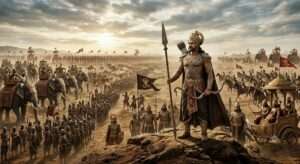
At the center of this formidable host stood King Śalya, flanked by Śakuni, Kṛtavarmā, Aśvatthāma, and Duryodhana together with his surviving brothers. Before advancing, the leaders assembled and declared a solemn covenant before the assembled warriors. “Never again,” they proclaimed, “shall any one of us confront the Pandavas alone. United shall we fight, united shall we stand, and united shall we either conquer or perish. Whoever abandons this sacred pledge or seeks independent glory shall incur sins equal to the five gravest transgressions—stealing gold, drinking intoxicating liquor, slaying a learned Brāhmaṇa, violating the sanctity of the preceptor’s wife, and destroying innocent life.” Having sworn this fearful oath, every warrior proudly took his place behind Śalya, who now led the final march of the Kaurava host.
According to the ancient science of warfare, the elephant divisions advanced at the forefront. Towering like moving mountains, the colossal beasts carried armored warriors upon their backs. The golden bells suspended from their necks rang with deep and harmonious music, blending with the whispering wind like the gentle humming of countless bees in flowering groves. Cool streams of water flowed from their trunks, settling the clouds of dust raised beneath their massive feet. Their thunderous trumpeting, mingled with the ringing of ornaments, rolled through the sky like the voice of gathering storms. Their gigantic forms appeared to touch the heavens themselves, as though the mountains had descended to demonstrate their majesty upon the battlefield. Their slow and majestic movement resembled mighty rain clouds drifting across the firmament, while every step shook both earth and sky with irresistible force.
Behind them marched the splendid cavalry. Noble steeds advanced with graceful rhythm, their disciplined strides revealing months of careful training. The bells fastened upon their harnesses chimed together in melodious harmony, filling the atmosphere with energy and anticipation. Their gleaming coats, fluttering manes, and swift movements reflected the brilliance of the rising sun, presenting a spectacle of unmatched martial elegance.
Sanjaya continued, “O King Dhṛtarāṣṭra, the soldiers marched with astonishing confidence. They displayed neither fear nor hesitation. Their faces shone with eager smiles, as though they were proceeding to a joyous wedding procession rather than to a field of death. Their polished weapons flashed like streams of lightning. Gem-studded banners fluttered proudly above their ranks. Brilliant quivers rested upon their shoulders, while jeweled ornaments sparkled with dazzling radiance. Every gesture proclaimed courage, every glance challenged the enemy, and every heart burned with the desire to win everlasting fame.”
The infantry followed with unyielding determination. Their broad chests, powerful arms, and iron sinews revealed years of relentless discipline. Armed with carefully chosen weapons suited to every form of combat, they advanced like an army of living fortresses. Their disciplined formations reflected not merely physical strength but the unwavering resolve to secure victory or embrace a glorious death. Thus the mighty Kaurava army reached the sacred battlefield with tremendous force and terrifying grandeur.
At the same moment, the armies of the Pandavas also arrived, fully prepared for the decisive struggle that would determine the fate of Bhārata. The vast plain once again became the meeting place of destiny, where righteousness and ambition prepared for their final confrontation beneath the watchful eyes of heaven.
Overwhelmed by grief and uncertainty, King Dhṛtarāṣṭra interrupted Sanjaya’s narration. “You have already brought me the sorrowful tidings of Bhīṣma, Droṇa, and Karṇa. Are you now about to recount the fall of Śalya and the defeat of my son Duryodhana as well? Tell me without concealment. How did Dharmaraja slay the mighty King of Madra? How did Bhīmasena bring down Duryodhana? Describe every event of this dreadful battle with precision, leaving nothing untold.”
Sanjaya looked upon the aged monarch with compassion and answered gently, “O King, grief has already carried you beyond the depths of despair. Now summon the courage worthy of your lineage. Listen with a steady heart to the unfolding events of this great war. I shall faithfully recount every deed of valor, every turning of destiny, and every matter of consequence that brought the Kurukṣetra war to its inevitable conclusion, where the judgments of time, righteousness, and divine will stood revealed before all mankind.”

