



King Dhritarashtra, your sons had already witnessed the fall of the mightiest pillars of their strength. They had seen Bhishma, the grandsire of the Kurus, pierced by Arjuna’s arrows; they had watched the invincible Drona lay down his life; they had also beheld the mighty Karna, whose valor they believed unmatched, collapse upon the battlefield beneath Arjuna’s irresistible shafts. Yet greed clouds wisdom, and false hope refuses to yield before truth. Though Duryodhana had become helpless and pitiable, he continued to cloak his despair with the illusion of inexhaustible strength, imagining that fortune still stood firmly beside him. Such is the nature of unchecked ambition, which persuades the heart to believe what reality has already denied.
When your sons approached King Shalya, they sought comfort from one who had himself witnessed Karna’s downfall. He had seen Bhima advancing like a hundred roaring lions, scattering mighty warriors in every direction. In that dreadful moment, even seasoned heroes had retreated to preserve their lives. Yet Shalya, concealing the lessons of the battlefield beneath the armor of confidence, assured the Kauravas that he alone would destroy the Pandavas. His words restored their fading spirits, though destiny had already written a different conclusion.
Shalya, assuming the supreme command of the Kaurava army, arranged the formidable Sarvatobhadra Vyuha, a battle formation designed to resist assaults from every direction. At its forefront stood Shalya himself, supported by the surviving sons of Karna, eager to avenge their father’s death. On the right flank stood Kripacharya with the fierce Saka and Yavana warriors, while the left was guarded by Kritavarma and the valiant Trigarta heroes. At the rear stood Ashwatthama, surrounded by the disciplined Kamboja forces. In the very heart of the formation stood Duryodhana with the remaining Kuru warriors, protected in front by a massive division of elephants. Shakuni occupied the highest strategic position with a complete fourfold army of chariots, elephants, cavalry, and infantry. Every division was placed with calculated precision, and the commander displayed the enthusiasm of a seasoned master preparing for the final trial of arms.
The Pandavas, discerning every movement of their adversaries, answered with the Trimukha Vyuha, the three-faced battle formation. At the forefront of each division stood Satyaki, Shikhandi, and Dhrishtadyumna, each prepared to shatter the enemy’s advance. Above them, like radiant stars illuminating the heavens, stood Bhima, Arjuna, and King Yudhishthira, inspiring confidence throughout their ranks. As their eyes fell upon the golden-yellow banner of Shalya fluttering proudly above the Kaurava host, they directed their forces toward him with unwavering resolve, knowing that the fate of the day rested upon his defeat.
Overwhelmed with anxiety, King Dhritarashtra asked Sanjaya to describe the strength of both armies before the battle commenced. Sanjaya replied with calm precision that the Kauravas still possessed eleven thousand chariots, ten thousand seven hundred elephants, two hundred thousand horses, and nearly three crores of infantry. The Pandavas, though smaller in number, commanded six thousand chariots, three thousand elephants, one hundred thousand horses, and nearly one crore of soldiers. Though unequal in size, the spirit of victory does not always dwell with numerical strength, for righteousness often lends courage beyond calculation.
Meanwhile, the two mighty hosts advanced toward one another with firm determination to conquer or perish. At that solemn hour, the Sun himself appeared to ascend Mount Meru as though eager to witness whether the warriors would still honor the sacred laws of battle. Clothed in a deep crimson radiance, he rose majestically in the eastern sky, filling the heavens with enchanting brilliance. His golden rays gently touched the lofty heads of elephants, the fluttering banners upon towering standards, and the sandalwood marks adorning the foreheads of countless warriors, transforming the battlefield into a scene of solemn splendor before its inevitable destruction.
The Pandavas, inwardly aware of the destiny that awaited them, beheld the beauty of the morning with peaceful hearts, blooming like lotuses opening beneath the first rays of the sun. Their confidence rested not upon pride but upon the certainty of righteousness. The Kauravas, however, swollen with arrogance and blinded by ambition, perceived neither the serenity of the dawn nor the silent testimony of nature. Their minds were consumed by thoughts of conquest, unable to hear the gentle voice of destiny already whispering the end of their glory.
As both armies finally confronted one another, kettledrums thundered across the plains, tabors and cymbals resounded, horns echoed through the valleys, and mighty conches pierced the very heavens. The clash of swords scattered fiery sparks into the air, mingled with clouds of dust and smoke. Countless weapons descended upon the earth like rocky hills falling from the mountains. Chariot struck against chariot, elephant met elephant, horse charged horse, and infantry collided with infantry, each warrior displaying remarkable skill, strength, discipline, and precision. The battle swiftly grew into a terrifying spectacle beyond ordinary imagination.
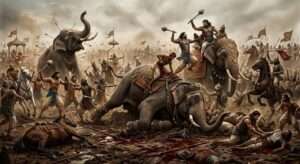
The deafening cries of elephants, horses, and warriors rose with such intensity that they seemed capable of shattering the sky itself. Swift arrows tore into the mighty elephants, causing streams of blood to flow across the battlefield until even the chariots appeared to float upon crimson rivers. Great elephant divisions crashed into chariot formations, crushing horses, charioteers, warriors, and vehicles beneath their enormous weight. The uncontrollable fury of these colossal beasts spread fear and confusion through both armies alike.
Charging with irresistible force, the elephants trampled countless horsemen and steeds beneath their feet. The spectacle became one of dreadful horror, where a single warrior slew many, and many together overwhelmed one. The battlefield transformed into a grim theatre where the primal instincts of survival eclipsed compassion. In many places, the sacred code of righteous warfare was forgotten as hatred replaced honor. Warriors attacked with relentless malice; elephants crushed cavalry, horses trampled infantry, and every living creature became an instrument of destruction.
Royal umbrellas, white yak-tail fans, and wandering herds of riderless horses drifted across the blood-soaked plain like flocks of celestial swans descending from the heavens. The twanging of mighty bows, the rumbling wheels of racing chariots, the pounding hooves of charging horses, the ringing bells fastened upon elephants and steeds, and the ceaseless clash of weapons blended into one immeasurable roar. Swept along by the rushing winds, that fearful symphony spread through the worlds, awakening an indescribable dread among all who heard it.
Amid this overwhelming spectacle, Sanjaya continued his narration with remarkable composure and poetic grace. His words neither concealed the severity of the conflict nor exaggerated its horrors. Instead, he painted the battlefield with measured eloquence, gently easing the anxious heart of the blind king. By balancing vivid description with thoughtful restraint, Sanjaya transformed a scene of unimaginable destruction into a narrative of profound wisdom, allowing Dhritarashtra to receive the bitter truth without being overwhelmed by unbearable grief

