



Sanjaya said, “O King Dhritarashtra, after the sons of Kunti had concluded their deliberations and departed for their respective camps, I remained concealed among the bushes. When silence settled upon the battlefield, I came forth and beheld your son Duryodhana. His body was covered with dust, his hair lay scattered across his face, and tears welled in his eyes. He stood motionless, gazing into the distance, his lips tightly pressed between his teeth, heaving deep sighs as he reflected upon the strange turns of destiny.”
With a voice burdened by grief, Duryodhana said, “I once ruled a vast empire stretching in all four directions. The administration of my kingdom rested securely in the capable hands of Bhishma and Drona. Revered kings and mighty princes adorned my court, and eleven Akshauhinis marched proudly beneath my command. Yet behold me now, lying helpless upon the earth. Such indeed is the decree of destiny. None born upon this world can cross its irresistible command.”
He continued, “Go and tell our people that Bhima violated the sacred code of mace combat. He defeated me by striking below the waist, an act forbidden by every principle of righteous warfare. He shall bear the burden of that dishonour forever before the world. The same world must also remember how Bhishma, Drona, Bhurishrava, and Karna met their deaths through questionable means. Let mankind judge whether such a victory deserves celebration or lasting glory.”
His eyes burned with wounded pride as he added, “Bhima did not stop with breaking my thighs. He struck my head with his foot while I lay fallen. When fortune smiles upon a man, insults may be tolerated, but to humiliate a defeated warrior in such a manner wounds the very soul of Kshatriya honour. Will noble men not condemn such cruelty? Will not the learned, who understand the ethics of battle, denounce this disgraceful conduct?”
Gathering his fading strength, Duryodhana spoke of his own reign. “During my rule, friends, relatives, and dependents prospered under my protection. The Brahmins were honoured and enriched. Magnificent sacrifices and sacred yajnas were performed to the satisfaction of all. I lived in power, glory, and prosperity. Even in defeat, I never sought refuge in my enemies, nor did I surrender my self-respect. I fought bravely until my final breath. Having fallen in battle at Samantapanchaka with the courage of a warrior, I know that the gates of heaven stand open before me.”
He paused before continuing with bitterness. “The sons of Pandu have repeatedly abandoned righteousness. Whether it was striking sleeping warriors, using deceit, poisoning foes, or burning homes, they have repeatedly crossed the limits of justice. Their outward display of Dharma is but an armour concealing falsehood. Even if they hold out their hearts in apparent sincerity, they should never be trusted. Sanjaya, carry these words faithfully to Kripacharya, Kritavarma, and Ashwatthama. Remind them that Bhishma, Drona, and Karna were slain through methods that violated the highest principles of virtue. Let them remember these wrongs.”
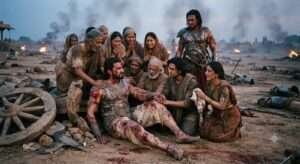
As Duryodhana uttered these words, villagers who had ventured onto the battlefield approached him in sorrow. Looking upon them, he recounted the deaths of Bhishma, Drona, Karna, and countless kinsmen. He wept deeply for Lakshmana Kumara and his other beloved sons. Speaking with quiet resignation, he declared his wish to ascend to the higher worlds and join those who had gone before him. The people were also informed of the grief awaiting his queens, his aged parents, and his sister Duhshala. Overcome with sorrow, they departed, lamenting the tragic fate of their fallen king.
Soon the news reached Ashwatthama, Kripacharya, and Kritavarma. Without delay, they hastened to the battlefield with a few surviving commanders. Sanjaya continued, “O King, your son resembled a mighty tree uprooted by a furious storm, a great elephant brought down by the hunter’s arrows, an ocean dried by the consuming fires of dissolution, or the moon fallen from the heavens upon the earth. Though consumed by unbearable agony, he welcomed his loyal companions with trembling hands and eyes overflowing with tears.”
Ashwatthama sat beside him and cried, “O King, you who were once surrounded by countless monarchs now lie abandoned and alone. Fate has cast you down from the highest throne to the dust of the battlefield. Where are the vast armies that marched at your command? Where are your commanders, your royal umbrellas, your white chowries, and your splendid attendants? Why is dust upon your face instead of the fragrance of royal perfumes? Why have Bhishma and Drona, who guarded you like your own eyes, departed? Why are Vikarna and Dushasana no longer by your side? Have they all abandoned you? Tell me, my king, where has Goddess Lakshmi gone? Upon whom has she now bestowed her favour? Truly, fortune deserts even the mightiest in a single moment.”
After listening patiently, Duryodhana gathered his remaining strength and replied in a calm but feeble voice. “O noble Ashwatthama, this condition was ordained by destiny long ago. Joy and sorrow revolve like the turning of a wheel. A wise man understands their ceaseless alternation. Therefore grieve not beyond measure.”
Turning towards Ashwatthama, Kripacharya, and Kritavarma, he continued, “Whatever dangers confront you, never lose courage. Continue the battle with unwavering resolve. Friends, brothers, sons, relatives, and armies have all perished. To survive alone while abandoning honour is no true victory. My strength has been shattered, not by righteous combat, but by the violation of the sacred code of war. Yet I count myself fortunate that I have seen your faces before departing this world instead of falling unnoticed into the hands of my enemies.”
With solemn conviction he added, “Though I knew well the immeasurable greatness of Lord Vishnu, I entered this war placing my trust in your strength and valour. You fought according to your courage and fulfilled your duty with honour. When destiny itself turns hostile, what power does man possess to resist it? Therefore cast aside your grief and remain steadfast.”
Duryodhana then narrated every detail of Bhima’s violation of the laws of mace combat—the crushing blow upon his thighs and the insult of the kick upon his head. As Ashwatthama listened, his face reddened with fury. His lips quivered with suppressed rage, and his eyes blazed like burning coals fixed upon his dying king. The fire of vengeance, which had lain hidden beneath the ashes of defeat, suddenly sprang to life within his heart.
Though death stood at his threshold, Duryodhana’s mind remained captive to resentment and revenge. His words, born of wounded pride and distorted judgment, achieved their intended purpose. They transformed the grief of his surviving commanders into consuming wrath and prepared the ground for the terrible events that were soon to unfold. Thus Sanjaya concluded this sorrowful account before King Dhritarashtra, revealing how the dying monarch’s final testament became the spark that ignited one last chapter of vengeance in the great war.

