



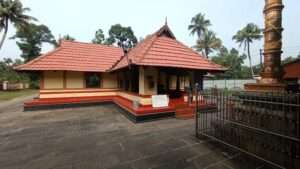
Mathampilly Sree Vamana Murthy Temple is an ancient temple at Chelamattom in Ernakulam district of Kerala. The presiding deity is Lord Vamana, the fifth incarnation of Lord Vishnu. It is especially significant because Vamana is worshipped here as the main deity, making this one of Kerala’s relatively rare Vamana temples.
The temple is traditionally believed to be more than 1,300 years old. However, no publicly available inscription or archaeological record has been found to establish the exact age of the present structure. The 1,300-year antiquity should therefore be presented as a traditional belief. The wider Chelamattom region also has an ancient Vamana worship tradition.
The main deity is Sri Vamana Murthy, the Brahmachari form of Lord Vishnu. Vamana is traditionally shown as a young dwarf Brahmin carrying an umbrella and water pot. Though appearing small and humble, he later assumes the gigantic Trivikrama form and covers the universe in three steps.
Vamana is particularly important in Kerala because his story is inseparably connected with King Mahabali and the origin of Onam.
Mathampilly follows the traditional Kerala temple style, with the sanctum and surrounding structures designed primarily for ritual worship. Its relatively simple character, traditional construction and absence of a monumental gopuram give it the atmosphere of an old village shrine rather than a grand temple complex.
Mathampilly lies within the ancient sacred landscape of Chelamattom on the banks of the Periyar river. The official history of the nearby Chelamattom Sree Krishna Swamy Temple records a tradition of three Vishnu avatars being worshipped in this area — Vamana, Narasimha and Krishna. According to this tradition, the earliest simple shrine was dedicated to Vamanamurthy, followed later by shrines associated with Narasimha and Krishna.
The region is also known for the nearby Sree Krishna Swamy Temple, traditionally called Dakshina Kashi, and for its connection with ancestral rites. Thus, Vamana worship forms an important early layer in the religious history of Chelamattom.
The main legend of Vamana begins with King Mahabali, the grandson of Prahlada. A powerful and generous ruler, Mahabali became famous for his prosperity, charity, and commitment to keeping his word.
Concerned about his growing power, the Devas sought Lord Vishnu’s help. Vishnu appeared before Mahabali as the young Brahmin Vamana and asked for only three paces of land. Mahabali readily agreed, considering the request very small for a king of his wealth.
Vamana then revealed his cosmic form as Trivikrama. With his first step he covered the earth, and with his second he covered the heavens. With nowhere left for the third step, Mahabali offered his own head. Vishnu placed his foot upon him and sent him to the netherworld, but pleased with his devotion and truthfulness, permitted him to return once every year to visit his beloved people.
This annual return of Mahabali is celebrated as Onam, with Thiruvonam being its most important day. The Mathampilly temple is particularly meaningful because Vamana himself is the presiding deity.
Adding another fascinating layer to the Vamana tradition of Chelamattom is a local legend associated with Sri Adi Shankaracharya. It is said that during his travels, Shankaracharya reached the opposite bank of the Periyar River and encountered a dwarf-like boy who helped him cross the river in a small boat. The boy is traditionally identified with Lord Vamana. This story is associated with the old Vamana shrine at Chelamattom and adds another fascinating dimension to the region’s ancient Vamana tradition.
Onam is the most significant festival associated with the Vamana tradition of the temple. During Onam, devotees remember the divine meeting of Vamana and Mahabali and the annual return of the great king to his people. The festival celebrates humility, generosity, truthfulness and devotion.
The celebrations of Onam become especially meaningful at a temple dedicated to Vamana, as he is the very incarnation of Lord Vishnu at the heart of the Mahabali legend.


