Why Volvo CE is going gung-ho on India’s race to become the world’s largest infrastructure market
Shrikant Rao
Conventional wisdom in global boardrooms says you play it safe when tariffs bite, supply chains shift, and geopolitical tensions redraw the map. You hunker down, protect margins, and wait for the “old normal” to return. Spending time at Volvo CE’s sprawling equipment display at a recent trade show, it is clear Volvo Construction Equipment (Volvo CE) in India—backed by its headquarters in Eskilstuna, Sweden—just tore that cautious playbook into confetti and went full throttle on growth.
Walk through the exhibition space, and you see more than yellow steel; you see a clear statement of intent. Mounted as the company’s largest-ever product display in the country, the pavilion showcased nearly 50 percent of Volvo CE’s entire national portfolio across two clearly segmented zones: heavy-duty Mining on one flank, anchored by the EC480, L150, and a brand-new 65-ton excavator, and Construction, Infrastructure, and Industrial applications on the other, featuring the EC215, EC220, EC300, SD110, DD90, and the L120 Electric Wheel Loader.
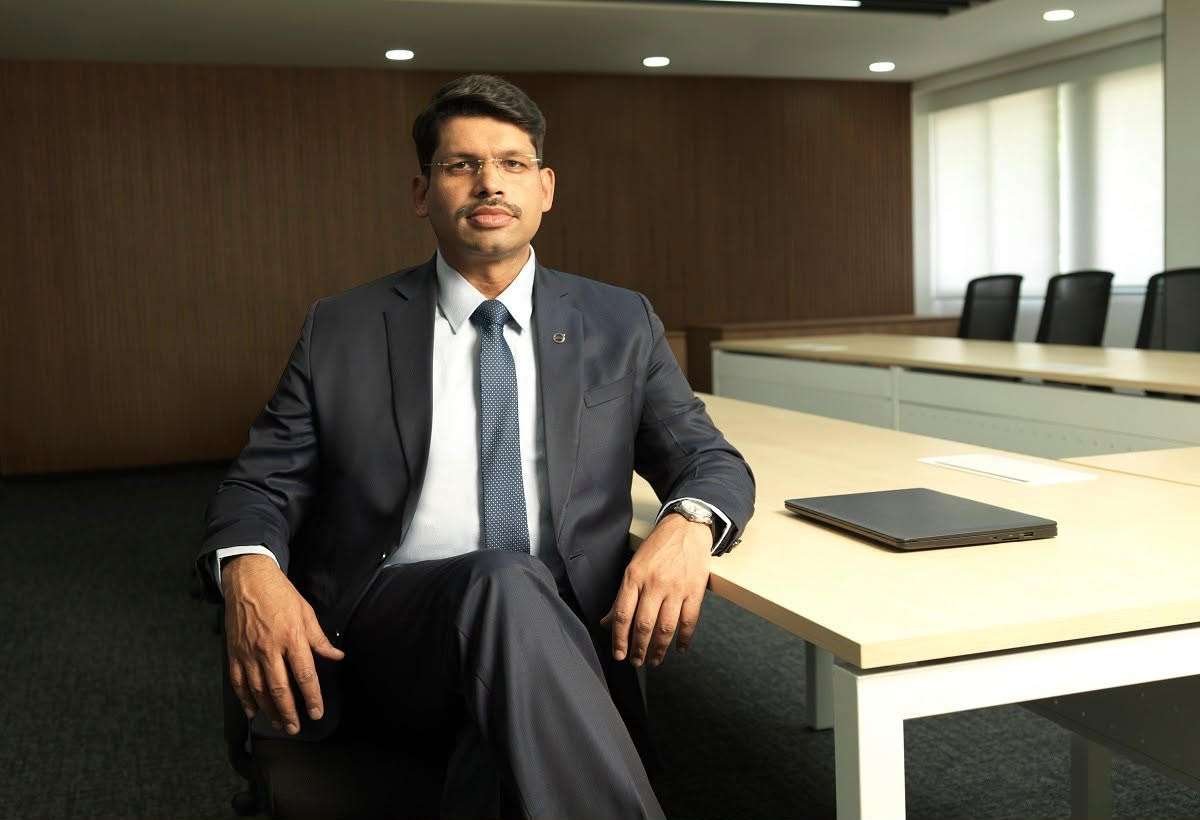
Stepping off the bustling floor and into the pavilion’s boardroom, where I sat down to interview Dimitrov Krishnan, Managing Director, Volvo CE India, the focus shifted from heavy-metal spectacle to long-term purpose. On the boardroom screen played the newly unveiled “Aaj Banayein Kal” (“Let’s Build Tomorrow, Today”) campaign. Building on the momentum of 2024’s “Karo Zyada Ki Umeed” push for the EC210E—a machine that attracted a high share of first-time Volvo buyers—this pre-launched film had already garnered over five million views on social media since its recent debut. It shifted the spotlight from a single machine to a broader call to action for every stakeholder in the infrastructure value chain, from OEMs to policymakers.
A resonant voiceover traced the aspirations of young Indians across the country: a young girl from Guwahati aspiring to become a governor, Pintu from Peepli dreaming of becoming a pilot, Deepa from Dhanbad aiming to be a doctor, Jiya from Jorhat envisioning herself as a judge, and Bharat from Bhuj set on becoming a builder. The narrative reminded viewers that India’s dreams are never small, though sometimes the roads leading to them fall short—and that when earth is moved, foundations are laid, and bridges rise, those distant horizons draw closer.
Against that resonant backdrop inside the boardroom, Krishnan laid out why the Eskilstuna-headquartered company is charging ahead with gung-ho conviction through global uncertainty.
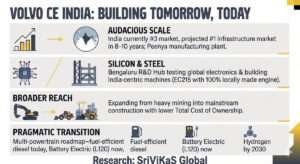
Audacious Scale
While cautious analysts debate how fast emerging markets can expand, Krishnan’s answer to whether Volvo CE wants to be a larger market, a manufacturing base, or a broader engineering and technological center was straightforward: all of the above. Backed by its established Peenya manufacturing plant in Bengaluru—which produces machines for both domestic jobsites and international markets—the company is already turning that ambition into industrial reality.
“Volvo CE in India is aiming to become all of those, not just one,” Krishnan declared. “The Volvo Group has been in India for nearly 28 years, actively participating in building the country while utilizing India as a base for our global operations. Today, India is already the third-largest construction equipment market, and it holds the clear potential to become the largest infrastructure market in the world.”
For anyone wondering if “potential” is corporate shorthand for the distant future, Krishnan put a clear timeline on that trajectory.
“It will certainly happen over the next eight to ten years,” he stated flatly. “The sheer volume of infrastructure that needs to be built in India—alongside the leap in quality required to realize our developed nation status—is massive. There is no other country with a comparable scale of requirement. Consequently, our focus on India will continue to expand across every dimension: manufacturing footprints, R&D capabilities, distribution, local sourcing, and localization.”
Strategic Agility
Global supply chain strategists frequently point to geopolitical volatility as a reason to pause investments. Krishnan views it as a catalyst for structural agility.
“That is completely accurate, both for the Volvo Group and the wider industry,” he agreed when asked if the sector is moving toward a regionally distributed manufacturing model while engineering and technology remain globally connected. “Geopolitical shifts, global conflicts—including the Iran war and the earlier impact of the Ukraine war—and tariff regimes have permanently altered the operating landscape; business is not returning to the old normal. To navigate this unpredictable environment, agility is one of the most critical values any company can possess—agility in decision-making, supply chains, manufacturing footprints, and R&D. While we are localizing manufacturing and sourcing close to our customers, our products are developed on global platforms where distributed engineering teams operate as an interconnected global network.”
Silicon & Steel
Far from being just an assembly operation for imported designs, India’s engineering ecosystem plays an integral role in Volvo CE’s global product development. Following rollouts like the EC230—co-engineered across Bengaluru, Changwon, Shanghai, and Eskilstuna—India’s technology hub is deeply embedded in testing and validating the company’s global fleet.
“In India, we operate the Bengaluru Technology Center for Volvo Construction Equipment, and we are actively investing to expand our R&D capabilities there,” Krishnan explained. “Globally, virtually every product designed and developed by Volvo CE carries an element of Bengaluru engineering, as our teams test and verify all electronic systems. As the industry transitions toward electromobility and increasingly complex electronics, our Bengaluru facility—backed by large testing centers and advanced laboratories—plays a vital role.”
Does that make Bengaluru the sole center of the construction equipment world? Krishnan addressed the question with measured realism, showing how global competencies complement local priorities.
“I cannot say that because our capabilities are distributed around the world depending on the products and competencies we have,” he noted. “However, the first and primary focus of investing in our R&D center in India is to build products for India—our strategy here centers on India-centric products. When you develop products for India, they are also suitable for many countries and markets with similar conditions, so in that sense it will aid our broader activities as well. And we will always make our specific contribution to our global products using the technology capabilities we have already built.”
Local Engineering
Operating in India involves distinct demands—from dust, rugged terrain, and variable fuel quality to operator practices, service intervals, uptime, and lifecycle economics. Here, localization goes well beyond supply chain resilience; it directly shapes machine design to protect fleet uptime and lower Total Cost of Ownership (TCO).
“When we speak of India-centric products, it is about India-centricity from a customer-need point of view,” Krishnan emphasized. “Indian customers have very specific product requirements based on how they use the equipment. We discuss matters in detail with our end customers and try to figure out what makes sense for them in their applications, because the way products are used in Indian conditions differs from the rest of the world. That focus is further supported by localization to become more resilient and to address the impact of currency devaluation alongside other resilience needs we build into our capabilities. Ultimately, however, the primary driver is customer needs.”
Take the EC215 excavator displayed out in the construction zone—a long-crawler, heavier-undercarriage machine tailored to handle demanding applications while addressing the twin priorities of Indian contractors.
“They are quite different,” Krishnan said of Indian engineering assumptions versus mature markets. “Indian customers’ primary focus is cost efficiency, which has two angles: the cost of the product and the cost of operation. We focus on both. For example, our EC215 comes fitted with the VCE V494 engine, an electronic engine manufactured 100 percent in India that is very fuel-efficient while remaining cost-efficient. Coupled with the latest Volvo technology in the positive hydraulic system, together it makes for a true winner. That is our focus, and multiple products share that potential as we work on several projects today to gain market share by bringing more and more market-suitable products to customers.”
Broader Reach
Historically, Volvo CE built its reputation in India at the top end of the market, particularly in heavy mining. Today, supported by a wide dealer network, flexible financing options such as Equipment-as-a-Service, and heavy-duty launches like the newly unveiled 65-ton Volvo EC650 mining excavator paired with the wide-bodied Volvo FMX 500 dump truck—a combination engineered for matched pass-loading cycles that shave seconds off turnaround times and lower cost-per-ton—the company is actively broadening its appeal across mainstream infrastructure segments.
“Our entire brand campaign is about being on the consideration list of every customer in India,” Krishnan stated. “We believe Volvo can add value to all customers, not just premium ones. The premium feel of the brand is of course very much present because there is significant value associated with that premium—the value of safety, quality, and sustainability. These are core values of our company built into every detail, from the paint to the steel to the engine capability. How we leverage that in the market is central, and we want to be relatable to customers by offering specific value-adds. Our engineering approach now is to build products that truly fit Indian customers’ buying criteria while still upholding our core values of quality, safety, and environmental care, so we can earn a place in every customer’s buying consideration set.”
Iron & Algorithms
As software and telematics reshape heavy machinery, Krishnan emphasized that digital intelligence enhances—rather than replaces—traditional mechanical durability.
“When you have a machine that needs to move earth, core mechanical engineering, hydraulics, and structural strength will always matter,” he pointed out. “You have to build strong, reliable, durable products, and those come from mechanical engineering and the capabilities we develop. At the same time, the efficiency and experience aspects of the products rely heavily on electronics and software, and improving cost per ton is equally important. True value comes from a strong marriage of these newer technologies with the strength of our mechanical core. Neither is more important than the other; both are essential. Data will play an increasingly larger role—it already does. We launched telematics solutions back in 2010 and have used electronic engines since 2003, so we have worked with these technologies for a long time. Now we are educating and working with our customers so they can also leverage the data we generate.”
Pragmatic Transition
With the L120 Electric Wheel Loader featured prominently outside in the lineup, the conversation turned to how quickly alternative powertrains will scale in India. At a corporate policy level, the Volvo Group—validated by the Science Based Targets initiative (SBTi)—follows a three-pronged zero-emission technology roadmap spanning battery-electric machines, hydrogen fuel cells, and renewable-fueled combustion engines. Under that global policy framework, Volvo CE has committed to cutting operational emissions by 50 percent and reducing absolute emissions from the use of sold products by 30 percent by 2030, on the path toward achieving net-zero value chain emissions by 2040. Grounded in India’s on-site realities, Krishnan outlined how that global decarbonization mandate translates into a practical, phased transition on the ground.
“Battery electric vehicles are coming and will become relevant in the Indian context, not least because fuel costs have risen substantially, especially due to the crisis in West Asia,” Krishnan observed. “Many clients whom we previously had to approach and educate about electric machinery are now coming to us and asking about it directly. Consequently, the trend toward battery electric—particularly on wheeled machines such as wheel loaders, payloaders, and trucks—will grow. That is an immediate step.”
At the same time, he noted why charging infrastructure for heavy machinery differs fundamentally from passenger vehicles.
“In construction equipment, charging infrastructure does not have to be public the way it is in the automotive sector, where multiple people share infrastructure and vehicles move point-to-point in public spaces,” he explained. “In construction and infrastructure, projects operate within a limited space—such as a mine or an enclosed industrial plant. The charging ecosystem needs to be custom-built for the equipment working on-site anyway; public charging will not work. Furthermore, the energy intensity and usage of construction equipment are very high—machines may need to be charged twice a day, whereas an automotive vehicle might charge once every three days, and heavy trucks may require a substantial network—perhaps at least ten thousand trucks—before charging becomes commercially viable.”
Looking further ahead, hydrogen is also part of the roadmap. “In the years ahead, hydrogen internal combustion engines will also make a major impact, though there the challenges involve fuel availability—hydrogen must be made accessible—and ensuring the technology is thoroughly tested and proven. By 2030, we should see hydrogen starting to play a meaningful role.”
And when asked whether diesel remains a “necessary bad habit” during this transition, Krishnan offered a clear, practical perspective on its role alongside cleaner technologies.
“It is not a bad habit—it is a necessary need for building infrastructure, so it is not about a bad habit at all,” he replied. “Modern engines are far more fuel-efficient; take our EC210E, for example, where we reduced fuel consumption by 25 percent, which of course lowers the environmental impact as well. Diesel engines are here to stay and are not going away anytime soon. Over the next ten to fifteen years, they will remain a vital part of the equipment mix supporting India’s infrastructure growth.”
Stepping out of the quiet boardroom and back onto the floor where the 65-ton diesel EC650 and the battery-electric L120 loader anchored opposite flanks of the display, one takeaway stood out clearly: while global markets navigate uncertainty, Volvo CE is moving ahead with decisive momentum—investing across diesel efficiency, electrification, and local engineering to build the machines and infrastructure of tomorrow, today.