



For decades, Europe prided itself on its liberal outlook, religious tolerance, multiculturalism and magnanimity towards people seeking refuge from conflict and persecution. These are admirable democratic values. However, somewhere along the way, sections of its political establishment appear to have confused tolerance with political timidity, humanitarian responsibility with an obligation to overlook failures of integration, and religious freedom with unquestioning acceptance of ideologies that may challenge the very democratic values that protect them. If Europe’s reported move to address demographic anxieties, tighten immigration policies and safeguard its cultural identity reflects a genuine policy reassessment, it deserves serious consideration rather than automatic condemnation. Every sovereign nation has the right to determine who enters its territory, under what conditions, and what obligations newcomers must fulfil towards their adopted homeland. The issue is not whether Europe should welcome people belonging to different faiths. It should. The real question is whether immigration and religious freedom can coexist with the preservation of national identity, social cohesion and constitutional values. They certainly can, but only when integration is a two-way responsibility. Europe’s generosity, particularly towards refugees and migrants fleeing troubled regions, has often been held up as an example of humanitarian magnanimity. Yet, generosity cannot become a licence for anyone to undermine the host country’s laws, institutions or social harmony. Nor should democratic governments hesitate to confront religious extremism merely because doing so might invite accusations of intolerance. There are legitimate concerns about the growth of hardline religious ideologies, the influence of radical organisations and attempts by extremist groups to establish political or social dominance in the name of faith. Allegations about ambitions to make Islam the world’s leading religious force by 2035, however, require credible evidence and cannot be treated as an established collective agenda of Muslims. Europe’s responsibility is to identify and confront demonstrable extremist networks, irrespective of their religious identity.
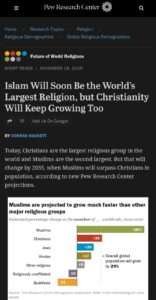
Equally, the decline in Christian religious observance and changing population patterns in parts of Europe cannot automatically be interpreted as the displacement of Christianity by Islam. Demographic change is influenced by several factors, including birth rates, secularisation, migration and individual choices. Nevertheless, citizens are perfectly entitled to debate the pace and consequences of such changes without being branded xenophobic or religiously intolerant. What is particularly worrying is the possibility of a dangerous counter-reaction. History has repeatedly demonstrated how religious insecurity, political opportunism and cultural anxieties can produce radical movements. The Crusades may belong to another era, but the psychology of religious confrontation has not disappeared. If governments fail to address genuine public concerns through democratic institutions, extremist groups on both sides could exploit the resulting resentment. Europe must not allow its present anxieties to become tomorrow’s religious battlefields. The answer, therefore, is neither appeasement of religious fundamentalism nor the emergence of an equally intolerant Christian nationalist backlash. It is firm governance, responsible immigration, meaningful integration, uncompromising enforcement of secular constitutional principles and equal treatment of every religious community. Every faith has the right to exist, practise, propagate peacefully and coexist with others. None has the right to claim supremacy, impose its beliefs upon others or pursue political domination through intimidation. Religious conviction should inspire humanity, not territorial ambition; compassion, not conquest; and harmony, not hatred. Europe may have taken too long to recognise that tolerance without accountability can become a vulnerability. If its present awakening results in balanced, lawful and non-discriminatory policies, it is certainly welcome. Better late than never. But Europe must remember one fundamental lesson: a civilisation is not protected by replacing one form of religious intolerance with another. It is protected by defending the freedom, dignity and rights of everyone who respects its laws. Better late than never, Europe appears to be recognising the dangers of complacency.

