



Situated in the historic town of Yelandur in Karnataka’s Chamarajanagar district, Sri Gaurishwara Swamy Temple is a centuries-old temple dedicated to Lord Shiva and Goddess Parvathambe (Gowri Devi).
The temple is renowned for its magnificent stone carvings, unique Bale Mantapa and the ancient traditions associated with Goddess Gowri. It represents the rich religious and architectural heritage of the former Hadinadu region.
The present temple structure dates back to approximately 500–525 years, having been constructed around the beginning of the 16th century during the Vijayanagara period.
Historical accounts associate its construction with Singadepa Devabhupala, a ruler of Hadinadu.
In 1654 CE, Muddaraja, another ruler of Hadinadu, made significant additions to the temple, including its remarkable entrance Mantapa and Panchalinga temples.
The presiding deity is Lord Gaurishwara, worshipped in the form of a Shiva Linga.
Goddess Parvathambe, an embodiment of Goddess Gowri or Parvati, is worshipped in a separate sanctum within the temple complex.
The name Gaurishwara signifies Lord Shiva as the divine consort of Goddess Gowri, symbolising the inseparable union of Shiva and Shakti.
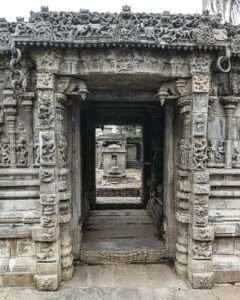
The temple is a beautiful example of Vijayanagara-period architecture, featuring intricate stone sculptures and distinctive architectural elements.
Its most celebrated feature is the Bale Mantapa, an entrance pavilion adorned with extraordinary stone chains resembling bangles. These delicately carved chains appear to hang freely and demonstrate the exceptional craftsmanship of the sculptors.
Unlike many prominent South Indian temples, the entrance does not feature a towering Gopuram.
The main sanctum is situated below the surrounding ground level and is approached through steps.
The temple complex also contains five Shiva Linga sanctums traditionally associated with Ekambareshwara, Jambukeshwara, Arunachaleshwara, Kalahastishwara and Chidambareshwara, representing five celebrated forms of Lord Shiva.
Yelandur, historically known as Hadinadu, was an important regional centre under local chiefs associated with the Vijayanagara Empire.
The temple received patronage from the Hadinadu rulers, who contributed to its construction and expansion.
The sculptures and inscriptions associated with the temple reflect the artistic excellence and religious devotion of the region’s rulers.
Over the centuries, the temple has remained an important place of worship, preserving the traditions of Lord Gaurishwara and Goddess Parvathambe.
Centuries ago, the region surrounding present-day Yelandur was known as Hadinadu. During the Vijayanagara period, this region was governed by local chiefs who were devoted patrons of temples and religious traditions.
Around 1500 CE, Singadepa Devabhupala, a chief of Hadinadu, constructed a magnificent temple dedicated to Lord Shiva, worshipped here as Sri Gaurishwara, the divine consort of Goddess Gowri.
The temple became a sacred centre of Shiva worship, with Goddess Parvathambe receiving devotion in her own sanctum. Generations later, in 1654 CE, Muddaraja, another Hadinadu ruler, enriched the temple by constructing the beautiful Bale Mantapa and the five Shiva Linga sanctums.
An especially cherished tradition is associated with Goddess Parvathambe. According to the account shared by the temple’s hereditary priest, unmarried young women visit the Goddess carrying a saree. They offer it for her blessings and subsequently wear the blessed saree themselves, seeking her grace for a happy and harmonious married life.
This tradition reflects the enduring faith of devotees in Goddess Gowri as the divine mother and embodiment of auspiciousness.
Even today, the ancient stone carvings, sacred Shiva Linga and sanctum of Goddess Parvathambe preserve the spiritual heritage of Hadinadu and the devotion of generations who worshipped here.
Gowri Hunnime, observed particularly in parts of North Karnataka, is associated with devotion to Goddess Gowri, the divine consort of Lord Shiva.
Goddess Gowri represents auspiciousness, marital harmony, devotion and family prosperity. Women traditionally worship her, seeking blessings for the well-being and happiness of their families.
The occasion coincides with Kartika Pournami, a sacred full-moon day associated with Lord Shiva’s victory over Tripurasura, commemorated as Tripurari Pournami.
The worship of Lord Gaurishwara and Goddess Parvathambe beautifully represents the divine union of Shiva and Shakti, making this temple especially meaningful for the occasion.
Mahashivaratri is an important occasion for worshipping Lord Gaurishwara.
The temple also observes traditional annual festivities around Deepavali, along with regular Shiva worship and special prayers on auspicious days.
Devotees worship Goddess Parvathambe seeking blessings for marriage, marital harmony and family welfare.


