


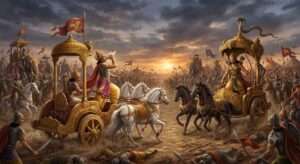
Ghatotkacha’s fall on the battlefield produced a spectacle that bewildered even the wisest among the warriors. While the Pandava ranks were overwhelmed with grief at the death of Bhima’s mighty son, Sri Krishna stood radiant with joy. To Arjuna, whose heart was burdened with sorrow and whose mind struggled to comprehend this strange response, the moment seemed an unfathomable paradox. Gazing upon Krishna with wonder, he confessed that ordinary men could scarcely penetrate the depths of thought that governed the minds of great souls. He therefore waited with reverent curiosity to hear the reason behind such unexpected delight amid tragedy.
Krishna then unfolded a truth concealed beneath the visible events of war. He explained that as long as Karna possessed the celestial weapon known as Shakti, bestowed upon him by Indra, a shadow of concern had remained in his heart. That divine missile was no ordinary weapon; it carried the power to slay even the greatest of heroes and could be employed only once before returning to its heavenly source. Had Karna launched it against Arjuna, neither Krishna’s Sudarshana Chakra nor Arjuna’s Gandiva would have been sufficient to neutralize its ordained force. In that dreadful circumstance, Karna might have secured a victory impossible to reverse. Therefore, when the weapon was expended against Ghatotkacha, Krishna saw not merely the death of a warrior but the preservation of Arjuna’s life and the safeguarding of the larger purpose of dharma.
Krishna further reflected upon the extraordinary stature of Karna. He reminded Arjuna that Karna was not an ordinary mortal but a warrior endowed with divine gifts from birth. His natural armor and celestial earrings rendered him nearly invincible. When Indra, seeking to protect his son Arjuna, approached Karna disguised as a Brahmin and requested those sacred protections, Karna severed them from his own body and offered them without hesitation. Such a sacrifice astonished even the king of the gods. Because he cut away his own flesh to fulfill his vow of generosity, he became renowned as Vaikartana. Had Karna retained those divine protections, there would have been scarcely anyone among gods, men, or celestial beings capable of facing him in battle. By relinquishing them, he descended from near invulnerability into the realm of ordinary mortality, and now, with the Shakti weapon also gone, the path toward his defeat had become possible.
Krishna then revealed a dimension of providence often hidden from human understanding. He reminded Arjuna that long before the Kurukshetra war, several formidable figures had been removed from the world through different circumstances. Ekalavya, Sisupala, and Jarasandha had each perished according to destinies shaped by divine wisdom. Had they remained alive and united under Duryodhana’s banner, the balance of power would have shifted dangerously against the Pandavas. This observation illuminates a recurring principle within the Mahabharata: events that appear disconnected in time often converge toward a larger divine design. What human beings perceive as isolated incidents are frequently threads woven into a tapestry visible only to the Supreme.
Krishna’s words concerning Ghatotkacha carried an even deeper complexity. He acknowledged the immense strength inherited by the Rakshasa prince from his lineage, a lineage connected to formidable beings such as Hidimba, Kirmira, and Bakasura. Though Ghatotkacha fought heroically for the Pandavas and rendered invaluable service, Krishna viewed all beings through the lens of cosmic order rather than personal attachment. He suggested that whenever any being, regardless of allegiance, became an obstacle to the establishment of righteousness, divine justice would eventually address that obstacle. Thus Krishna’s joy was not rooted in cruelty toward Ghatotkacha but in the fulfillment of a strategic necessity that preserved the future of dharma. This distinction reveals one of the profound tensions within the epic: divine action often transcends the emotional expectations of ordinary morality.
As Krishna concluded, he urged Arjuna to abandon grief and embrace the duty demanded by the hour. The Pandava army was exhausted, while the Kaurava forces had gained renewed confidence after Ghatotkacha’s death. The battlefield therefore required not lamentation but decisive action. Arjuna was called to blaze forth like a consuming fire, restoring courage to his allies and striking fear into the hearts of the enemy.
Meanwhile, Sanjaya narrated these developments to King Dhritarashtra. The blind monarch listened with astonishment and growing despair. If the Shakti weapon possessed such incomparable power, he wondered, why had Karna failed to reserve it for Arjuna? Had Arjuna fallen beneath its force, the spirit of the Pandavas would have been broken, and victory might have passed into Kaurava hands. Dhritarashtra lamented that neither his sons nor their counselors appeared capable of sustaining a long-term vision. To him, the loss of the weapon against Ghatotkacha seemed a catastrophic waste of opportunity.
Sanjaya’s response revealed the subtle influence of destiny operating through human decisions. He explained that night after night Duryodhana, Dushasana, and others urged Karna to employ the Shakti against Arjuna. Karna himself repeatedly declared that he would do so on the following day. Yet each dawn brought forgetfulness, distraction, or changing circumstances. At dusk, after returning from battle, the weapon would once again enter their discussions. This strange pattern repeated itself until the opportunity vanished forever. Sanjaya recognized in this phenomenon not mere chance but divine intervention. Human beings may devise strategies and formulate intentions, yet there are moments when a higher will silently governs the outcome.
The mystery became clearer when Krishna later disclosed the truth to Satyaki. He openly stated that he had repeatedly caused Karna and his allies to forget their intention of using the Shakti against Arjuna. For Krishna, Arjuna’s preservation was essential to the fulfillment of a sacred mission. He declared before all present that Arjuna’s life was dearer to him than sovereignty over the three worlds. The burden of protecting Arjuna had deprived him of peace for many nights, and now, with the destruction of the Shakti, that burden had finally been lifted. These words reveal the extraordinary bond between Krishna and Arjuna, a relationship transcending friendship and reflecting the intimate union between the Divine Guide and the devoted soul.
Dhritarashtra heard this account with deep unease. He recognized that misfortune seemed to pursue his sons relentlessly. A weapon capable of altering the course of history had vanished against a single warrior, and with it disappeared one of the Kauravas’ greatest hopes. The king’s reflections oscillated between frustration and resignation, exposing the tragic reality that he often perceived the truth only after opportunities had passed beyond recovery.
Within the Pandava camp, grief spread heavily through the heart of Yudhishthira. The death of Ghatotkacha struck him with profound sorrow. Tears flowed from his eyes, his body trembled with weakness, and his spirit seemed crushed beneath the weight of loss. Krishna hastened to him and gently reminded him that a leader could not surrender to despair. The morale of the army depended upon his composure. Victory demanded courage, discipline, and steadfastness even in the midst of personal anguish.
Yudhishthira acknowledged the wisdom of Krishna’s counsel, yet his heart could not easily abandon its grief. He recalled the unwavering loyalty of Ghatotkacha during the years of exile. In the forests of Kamyaka and upon the heights of Gandhamadana, the Rakshasa prince had repeatedly come to the aid of the Pandavas. His devotion had been sincere, his service unforgettable. Yudhishthira confessed that he cherished Ghatotkacha with an affection rivaling that which he felt even for his own brothers. Such memories intensified the pain of separation.
Gradually, however, sorrow transformed into righteous anger. Yudhishthira’s thoughts turned toward Karna, whom he regarded as the architect of many of the Pandavas’ sufferings. He remembered Karna’s role in the tragic death of Abhimanyu, whose bow had been shattered before the young hero was overwhelmed by numerous warriors. The chain of calamities stretching from Abhimanyu’s fall to Ghatotkacha’s death now appeared to converge upon Karna. Filled with determination, Yudhishthira declared that only Karna’s death could bring peace to his troubled heart.
Seized by this resolve, he rose suddenly, sounded his conch, seized his bow, and ordered his charioteer to drive toward Karna. In his anger he even proposed separate offensives against both Karna and Drona, seeking retribution for the suffering inflicted upon the Pandavas. Observing this unexpected development, Krishna immediately urged Arjuna to follow. A king driven by grief and wrath could easily place himself in mortal danger. Therefore Krishna swiftly guided Arjuna’s chariot after Yudhishthira, ensuring that the unfolding events remained aligned with destiny’s greater design.
Thus Sanjaya continued his narration, unveiling before Dhritarashtra not merely the movements of armies but the hidden currents of human emotion and divine purpose. The blind king’s mind swung ceaselessly between hope and despair, wisdom and ignorance, righteousness and attachment. Through his divine vision, Sanjaya perceived that the war was far more than a contest of weapons. It was a vast drama in which destiny, free will, devotion, pride, grief, and divine intervention intertwined. The death of Ghatotkacha, the loss of the Shakti weapon, Krishna’s joy, Arjuna’s confusion, Yudhishthira’s sorrow, and Dhritarashtra’s anxiety were all threads within a grand design leading inexorably toward the triumph of dharma and the revelation of truths greater than any warrior could fully comprehend.

