


Phadke Shri Ganapati Temple is a historic Ganapati temple located at Phadkewadi, Vitthalbhai Patel Marg, in Girgaon, Mumbai, Maharashtra. It is one of the old Ganapati temples of South Mumbai and is known for its beautiful marble Ganapati idol, the unique Ganesh Panchayatana arrangement, and its long connection with the Phadke family. The temple continues to be an active place of worship and attracts devotees throughout the year.
The present temple was established around 1890, making it approximately 136 years old as of 2026. It is therefore a historic temple of Mumbai. The main Ganapati idol was brought from Baroda and installed when the temple was established.
The main deity is Lord Ganesha, seated on a lotus. The marble idol has a left-curved trunk and is beautifully decorated with a crown and traditional ornaments. Riddhi and Siddhi are placed beside Ganesha, representing prosperity and spiritual accomplishment. A silver Mushaka, the traditional vehicle of Ganesha, is also worshipped in front of the sanctum.
One of the special features of the temple is its Ganesh Panchayatana arrangement. Along with Ganesha, the shrine contains deities associated with Shiva, Vishnu, Surya and Mahalakshmi. The temple also has a marble Trimukhi Dattatreya idol.
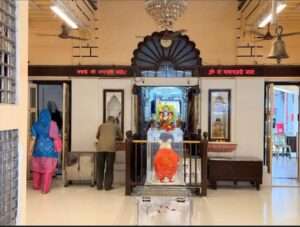
The temple is a two-storey historic structure built on a raised platform. It has an entrance courtyard, verandah, assembly hall and sanctum. The main Ganapati idol is installed inside the sanctum under an ornate silver makhar, with a silver throne and lotus decoration. The doorway of the sanctum also has detailed silver work.
The temple’s interior includes marble flooring and traditional chandeliers, while the upper portion is crowned by a domed shikhara with a large kalasha. The combination of the historic structure, silver craftsmanship and the Panchayatana arrangement gives the temple a distinctive character among Mumbai’s older urban shrines.
The history of the temple is closely connected with Govind Gangadhar Phadke, who came to Mumbai from Awas in the Alibag region. In 1867, he purchased a large property in the area that later became known as Phadkewadi. After his death, his wife, Yashodabai, decided to dedicate the family’s property to Lord Ganesha instead of adopting an heir.
She developed part of the property as a garden known as Govindbagh and decided to establish a Ganapati temple there. The temple was completed around 1890, and a marble Ganapati idol was brought from Baroda and installed in the new shrine. The temple subsequently became an important centre of Ganapati worship in the Girgaon area.
The religious and charitable work associated with the Phadke family continued through the Yashodabai Govind Gangadhar Phadke Charitable Trust, which was formally established in 1922. Over the years, the trust and temple have supported various charitable, educational, and social activities.
The main Sthalapurana of Phadke Ganapati is closely connected with the life and devotion of Yashodabai Phadke. After the death of her husband, she faced the question of what should happen to the family’s property and legacy. According to the temple tradition, she decided that instead of keeping the property only for the family, it should be dedicated to Lord Ganesha and used for a religious and charitable purpose.
Yashodabai therefore developed the family property into Govindbagh and arranged for a dedicated shrine to be built for Lord Ganesha. The installation of the marble Ganapati from Baroda gave the newly established temple its central sacred identity. The temple consequently became associated with the idea that wealth and property should be offered back to the divine and used for the welfare of society.
The Panchayatana tradition of the temple also gives the shrine a wider spiritual significance. Ganesha occupies the central position while Shiva, Vishnu, Surya and Mahalakshmi represent other important aspects of Hindu worship. Devotees can therefore worship several major forms of the divine within the same temple complex.
The temple’s Trimukhi Dattatreya is another notable part of its sacred tradition. Dattatreya is traditionally represented with three faces, symbolising the combined aspects of Brahma, Vishnu and Shiva.
Over more than a century, the temple has remained a living place of worship for the people of Girgaon and surrounding parts of Mumbai.
The most important celebration is Maghi Ganeshotsav, which includes Ganesh Janmotsav, religious discourses, kirtans and cultural programmes. The temple also receives many devotees on Ganesh Chaturthi, Sankashti Chaturthi and Angaraki Sankashti. Other important observances include Gauri Puja, Tulsi Vivah and Mahashivaratri, when special prayers and rituals are performed. During the major festivals, the temple is decorated with flowers and lights, and devotees gather to seek the blessings of Phadke Shri Ganapati.


