Lakshmanrao Upadhyayula
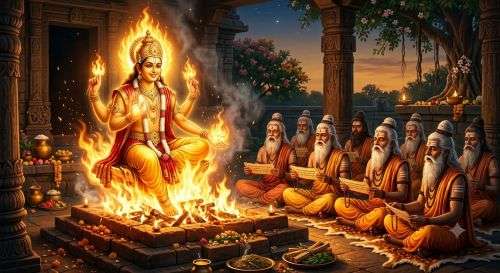
The seer Vishwamitra, illumined by divine insight, offered this majestic hymn to Vaiśvānara Agni in the stately cadence of the Jagatī metre of the Rigveda. In this sacred vision, Agni is not merely the physical fire kindled upon the altar, but the Universal Being who dwells in all worlds and in all creatures. The word Vaiśvānara signifies “the Fire belonging to all humanity,” the divine radiance that shines in the heavens as the sun, in the atmosphere as lightning, upon earth as sacrificial flame, and within living beings as the power of digestion, intelligence, and aspiration. Thus, Agni is both cosmic energy and spiritual consciousness, linking the visible and the invisible realms.
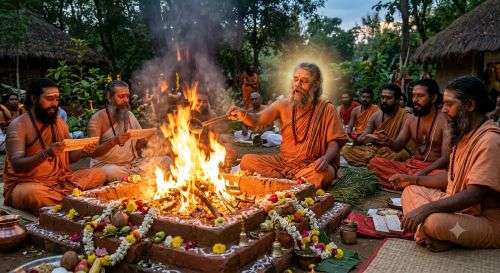
The wise chanters of Vedic hymns, seeking the righteous path, strengthened themselves by invoking this Universal Fire. Their chants were not mere songs, but vibrational offerings that harmonized the human mind with cosmic order. In the yajña dedicated to Vaiśvānara, melodious mantras arose like waves of light, carrying human devotion to the celestial spheres. Agni, the immortal Hotā, accepted the oblations and conveyed them to the gods. For this reason, the Sanātana yajña can never be diminished by ridicule or neglect. It is an eternal process embedded in the structure of existence itself, a sacred exchange in which humanity offers gratitude and receives nourishment, wisdom, and protection.
Agni is the visible priest, ever present before the worshipper. He moves freely between earth and heaven as the divine messenger, carrying prayers upward and bringing blessings downward. The Vedic sages perceived in this movement a profound truth: all transformation requires an intermediary force. Fire transforms matter into energy, and prayer transforms intention into realization. In scientific terms, Agni symbolizes the principle of energy conversion; in spiritual terms, he represents the power that translates aspiration into divine communion.
Inspired by the gods, Agni is established in the heart of the yajamāna, the patron of the sacrifice. He is seated with reverence in the sacred hall and adorns the ritual space with purity and brilliance. Like a banner unfurled before an army, Agni stands as the emblem of yajña itself. Through courageous and disciplined action, enlightened men worship him. The priests perform rituals suited to his nature, and Agni, in turn, blesses the sacrificer with comfort, prosperity, and spiritual upliftment. This reciprocal relationship reveals the Vedic understanding that the universe responds to sincere effort with corresponding grace.
Agni is called the father of yajña because every sacred act begins and culminates in him. He bestows strength upon the priests and wisdom upon the Ṛtvijas, the officiating seers who guide the sacrifice. He is the operative principle that makes yajña effective. Whether as the terrestrial flame (pārthiva agni), the atmospheric lightning (vaidyuta agni), or the solar fire shining in the heavens, Agni permeates the cosmos. The Vedic sages recognized that these diverse forms are manifestations of one underlying energy, revealing an astonishing scientific intuition of the unity of natural forces.
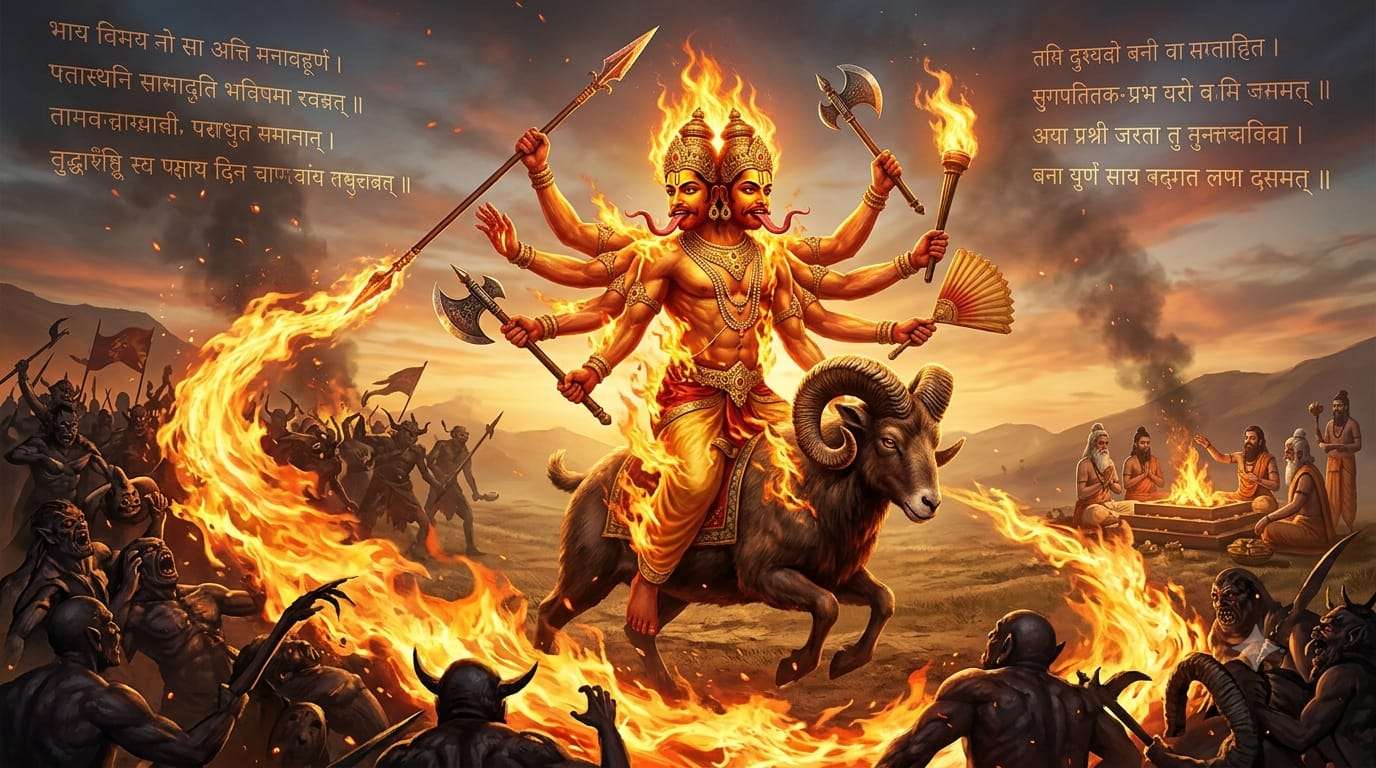
Vaiśvānara Agni is described as radiant, golden-hued, and all-knowing. He dwells mysteriously in the midst of the waters, suggesting the latent energy hidden within creation. He rides a beautiful chariot and generates joy wherever he appears. Swift, strong, omnipresent, and sovereign, he was established by the gods in the mortal world so that human beings might participate in the divine order. In the language of spiritual symbolism, Agni is the light of awareness present within every heart. In the language of science, he is the dynamic principle underlying metabolism, electricity, radiation, and life itself.
The gods, together with the Ṛtvijas, worship Agni through countless forms of yajña. As leader and protector, he destroys hostile forces both outward and inward. He alone traverses the gulf between heaven and earth, making him the indispensable mediator of all sacred communication. The devotees pray to him for worthy sons, long life, and enduring prosperity. They ask him to propitiate the gods, release life-giving rains, and produce abundant grain. Here the Vedic vision reveals its ecological wisdom: human reverence, natural harmony, and agricultural abundance are intimately connected.
Ever vigilant, Agni presides over righteous rituals and ensures that every offering reaches its proper destination. Dear to the gods and beloved by men, he provides food and sustenance to the patron. As lord of humanity, he is greater than the greatest, yet he enters each home as an impartial and honored guest. Master of his own luminous intelligence, he is cherished by the Ṛtvijas as the living memory of sacrifice, preserving the continuity of sacred tradition across generations.
Leaders seeking growth and prosperity offer salutations to Agni with praise and devotion. Bright, charming, and self-manifesting, he reveals his power through all peoples and all rituals. He is the ruler of many and the indwelling presence in every household fire. The Vedic sages declare that by their hymns they magnify his splendor, yet in truth it is Agni who illumines their minds and empowers their words.
The worshipper addresses Vaiśvānara with reverence: “O Wise and Omniscient One, I praise the brilliance that proceeds from you.” At birth, Agni expanded heaven and earth and permeated all worlds and elements. This poetic declaration expresses a profound cosmological insight: the universe unfolds through the action of primordial energy. Modern science describes creation as the expansion of energy into matter and structure; the Vedic seers perceived this mystery through the symbol of Agni, the first-born light from which all forms emerge.
Those who perform rituals with faith discover in Vaiśvānara an inexhaustible treasure. Material prosperity, intellectual clarity, and spiritual realization flow from his worship. He is the heroic force who honors his parents, Heaven and Earth, and sustains the harmony between them. As the universal fire, he reminds humanity that every act of selfless offering contributes to the balance of the cosmos.
Thus, Vaiśvānara Agni stands as one of the most profound symbols of Vedic wisdom. He is at once the sacrificial flame, the cosmic energy, the light of consciousness, and the transformative power within all existence. Through devotion to him, the seeker learns that the universe itself is a perpetual yajña, in which every breath is an offering, every noble thought a mantra, and every selfless action a spark of the eternal fire.