Upadhyayula Lakshman Rao
The sage Puruchhepa, in the measured cadence of Antyeṣṭi chandas within the Rigveda, raises a solemn and potent invocation to Indra, the supreme wielder of strength and protector of cosmic and mortal order. With clarity of purpose and firmness of faith, he proclaims Indra as the unfailing guardian of his devotees, beseeching him to grant the शक्ति by which even the mightiest adversaries may be faced without fear. The prayer reflects not mere dependence but a profound confidence that, under Indra’s संरक्षण, the encircling forces of hostility may be dispelled and dissolved.
The patron who offers the sacred soma, that divine elixir of inspiration and vitality, is described as one aligned with righteous action and noble intent. By presenting oblations and invoking Indra with devotion, the patron participates in a sacred exchange that harmonizes human effort with divine शक्ति. The ritual morning prayers at daybreak signify not only the beginning of the temporal day but also the awakening of inner consciousness. In this light, Indra emerges as the granter of celestial realms, the one who elevates the worthy while casting down the forces that oppose dharma.
Indra is envisioned as omniscient and venerable, trusted by those who understand the deeper currents of existence. He is not a deity of a select few but the universal शक्ति, accessible to all who invoke him with sincerity. His bestowal of riches is not confined to material abundance alone but extends to honor, vitality, and enduring renown. The gifts he grants are said to shine with a brilliance that endures beyond the fleeting nature of worldly possessions, reflecting a higher order of prosperity rooted in divine grace.
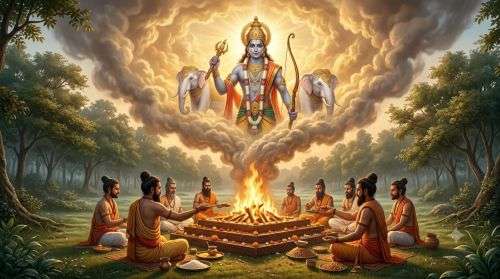
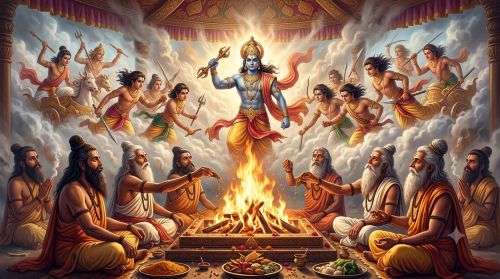
The priests, acting as mediators between the visible and invisible realms, prepare the sacrificial altars with precision and reverence. Through yajñas, they construct a subtle bridge between earth and heaven, offering purified oblations as carriers of intent and devotion. Indra, though dwelling in the celestial expanse, is perceived in the radiant form of the sun traversing the skies, illuminating all beings. His governance over rain reveals a proto-scientific awareness of natural cycles, where divine agency is interwoven with environmental processes, sustaining life through the nourishment of waters and the वृद्धि of cattle wealth.
The hymn recalls the ancient deed wherein Indra, for the lineage of the Angirasa sages, cleft the obstructing clouds and released the hidden herds of cows. This act symbolizes both a physical and metaphysical liberation—the breaking of barriers that withhold abundance and knowledge. His engagement in battle on behalf of the righteous illustrates the eternal संघर्ष between order and chaos, where Indra stands as the champion who secures victory for those aligned with truth.
The offering of soma is again emphasized as a means to invigorate Indra’s शक्ति, urging him to subdue those who oppose sacred rites and disrupt the moral fabric. These adversaries are not merely external foes but also represent forces of ignorance and disorder. Indra’s actions, consistent across time, are worthy of continual worship, as they uphold the balance necessary for both cosmic stability and societal harmony.
Indra’s valor and courage resound across the worlds, his chivalrous deeds celebrated by patrons who seek his favor. Through their offerings and disciplined rituals, they align themselves with his शक्ति, invoking his presence to overcome adversity. In protecting those who seek nourishment and sustenance, Indra fulfills the role of a divine sustainer, ensuring that the pathways to prosperity and well-being remain open.
The rituals performed by the patrons are not mere ceremonial acts but deliberate efforts to open the gates of higher realms, to render the divine forces favourable. In this vision, the gods are intimately connected with natural phenomena, particularly the clouds and rains, indicating an early synthesis of spirituality with observational understanding of nature. Indra, as the अग्रणी in battle, stands before the forces of destruction, ensuring that those who rise against the righteous are struck down.
The imagery of the vajra, Indra’s thunderbolt, embodies both mythic grandeur and a striking precision akin to natural forces of बिजली. Though unseen from afar, it unfailingly reaches its लक्ष्य, symbolizing the unseen yet inevitable operation of cosmic law. Wherever adversaries may conceal themselves, this शक्ति draws them forth and brings about their end. Thus, the hymn concludes with a profound assertion of faith—that divine शक्ति, guided by righteousness, penetrates all concealment and restores order, reflecting both spiritual depth and an intuitive grasp of the forces governing the