



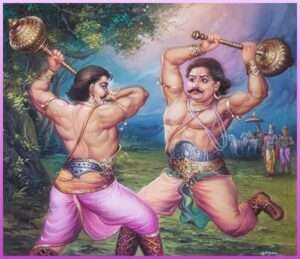
The encounter between Duryodhana and Bheemasena resembled the violent collision of two mountains driven against one another by the wrath of the elements. Their maces circled and clashed, their roars rose above the tumult of armies, and the earth itself seemed to tremble beneath their advancing steps. In the midst of that dreadful contest, Chitrasena, swift and resolute, discharged a shower of arrows upon Bheemasena. Stung by their sting and burning with fury, the mighty son of Vayu whirled his colossal mace and hurled it with irresistible force. The weapon sped through the sky, sparkling like a meteor, roaring as though it carried the storm within it, its flight marked by terrible precision.
The warriors on the field beheld the blazing missile with terror. Fearing lest it descend upon them and crush them into the dust, they scattered in all directions, each man seeking the preservation of his own life, forgetting even Duryodhana in that supreme instinct of survival. For in moments when death hovers near, the love of life rises above loyalty and pride. Chitrasena, however, did not falter. Leaping down from his chariot with sword and shield in hand, he stood prepared; yet the mace descended upon his chariot with devastating power, smashing it utterly, destroying steeds and charioteer alike. Vikarna hastened forward and bore him away upon his own car.
Meanwhile, Bhishma struck down the steeds of Dharmaraja and pierced his hands and legs with sharp arrows, causing him grievous pain. In retaliation, Dharmaraja hurled a mighty Shakti at the grandsire, but Bhishma, calm and invincible, shattered it in mid-air. Swiftly Dharmaraja mounted the chariot of Nakula and Sahadeva. Bhishma, relentless in his onslaught, afflicted the sons of Madri with piercing shafts. Seeing his brothers oppressed, Dharmaraja felt a moment’s sorrow, yet that sorrow transformed into renewed ardour for battle, and he rallied his forces against the venerable warrior.
Surrounded by foes as a lion encircled by herds of beasts, Bhishma stood firm and unshaken. With effortless mastery he severed heads that fell like ripe fruits from trees shaken by wind. Moving through the ranks as though everywhere at once, he cut down warriors with dreadful ease, and the Pandavas stood astonished at his swiftness and destructive might. Sikhandi confronted him with skillful archery, but Bhishma, unwilling to engage him, turned instead upon the forces of the Srinjayas. Satyaki and Dhrishtadyumna stirred great turbulence among the Kuru ranks. Vinda and Anuvinda swiftly attacked and slew the steeds of Dhrishtadyumna, who then mounted Satyaki’s chariot. Dharmaraja gathered his strength and drove Vinda and Anuvinda away.
Then Duryodhana, the king, gestured fiercely and urged his warriors forward, himself entering the fray. Bhishma, Duryodhana, and his brothers, together with their allies, pressed hard upon Dharmaraja. Arjuna charged against Bhishma, but Drona rained arrows upon Arjuna and fought with blazing vigor. The preceptor seemed like a consuming fire amid dry forests. Sanjaya spoke to the blind king, saying that the army fought enthusiastically in support of Drona. Dharmaraja loudly encouraged his warriors, who fought with unyielding spirit in their appointed stations.
As the sun waned, its crimson rays mingled with the streams of blood that flowed across the field. Corpses floated amid mud and flesh, borne along by ghastly currents. Jackals, wolves, and other wild creatures tore at the fallen; birds of prey circled and descended; strange and fearsome beings feasted without restraint. The cries of foxes and the shrill sounds of night insects made the battlefield appear like a dreadful vision of hell upon earth. Amid this horror, Arjuna shattered the chariots and steeds of the Trigarta kings, while Bheema scattered the Saindhava and his supporting monarchs. Victorious and proud, he stood before Dharmaraja, who then commanded that the battle cease for the day. Each host withdrew to its camp, and Duryodhana with his companions sought Bhishma before retiring.
At dawn the armies assembled once more with renewed eagerness for combat. Bhishma formed the Kurma Vyuha, the tortoise-shaped array. Dharmaraja instructed Dhrishtadyumna to devise a fitting counter, and he arranged the Srungataka formation, shaped like horns poised to pierce. War drums, kettle drums, conches, horns, and trumpets resounded between earth and sky. The armies advanced; weapons clashed, striking sparks without smoke; dust rose from the hooves of horses and elephants, only to be subdued by showers of blood.
Bhishma, roaring like a lion at the forefront of the Kuru host, seemed unconquerable. The Pandavas faltered before his advance, yet Bheema alone confronted him with equal ferocity. He slew Bhishma’s charioteer, and the frightened horses bore the grandsire’s chariot backward, causing dismay among the Kaurava ranks. The Pandava forces gained courage and surged ahead. Then Sunabha, bold and resolute, challenged Bheema. Engaging in single combat with the slayer of Bakasura, he fought valiantly; but Bheema, advancing like Death incarnate, severed his head with a single arrow and laughed in fierce triumph.
Seeing Sunabha fallen, seven of Dhritarashtra’s sons rushed upon Bheema in reckless fury. The son of Kunti, blazing with wrath, stood immovable as an eagle poised in the sky. He slew Adityakesa with a spear, Pandit with a dagger, Kundadhara with a crescent-tipped arrow, Visalaksha with sharp shafts, and Maharatha with a long, piercing dart, destroying all seven with relentless power. The dreadful spectacle broke the spirit of the remaining Kaurava princes, and they fled for safety. Thus Bheema fulfilled the vow he had sworn after the humiliation of the dice game, and the moral warnings once spoken by Vidura appeared now as living truth. Kings stood astonished at his death-dealing stride.
Sanjaya declared to Dhritarashtra that this devastation was the fruit of his failure to restrain his sons from wickedness. Duryodhana, overwhelmed with grief and rage, gathered his soldiers and hastened to Bhishma. With choked voice and sorrowful heart he addressed the grandsire: “O revered elder, Bheema rages like a consuming fire, slaying my brothers without mercy, while you stand as a witness and do not save them. Do you not grieve their fall? I perceive no vengeance in you for their deaths. Have you remained neutral, wishing that all my kin perish? Do you intend that the rest should die while you withhold your might?”
Thus Duryodhana, blinded by anguish, reproached the chief of his army and the ancient guardian of the Kuru line, even as destiny moved steadily toward its inexorable end.

