Vinay Rao
Another Sunday, another round of legal notices flying across the Hyderabad Cricket Association’s (HCA) Apex Council. But this week’s paperwork appears far more consequential than the usual factional sparring. It raises a larger question: how far can an Association continue testing the limits of a Court that has already spelt out, in black and white, who is ultimately in charge?
What the Court Actually Entrusted to the SMC
Justice Nagesh Bheemapaka’s judgment in Safilguda Cricket Club v. State of Telangana (24 April 2026) was not a mere advisory. It vested the Single Member Committee (SMC), headed by Justice P. Naveen Rao (Retd.), with an extensive eight-point mandate covering league administration, player selection, coaching, infrastructure and institutional reforms.
More importantly, the Court made compliance unequivocal. The Apex Council was directed to obtain the SMC’s approval for all its decisions. Any obstruction, the Court cautioned, would be viewed seriously. The SMC’s decisions were declared final and binding, subject only to the supervision of the High Court.
In simple terms, the conduct of the Annual General Meeting (AGM) is no longer merely an internal bye-law issue—it now falls squarely within the Court’s supervisory framework.
When Bye-Laws Meet Judicial Oversight
Under HCA’s own Rules and Regulations, convening the AGM and maintaining custody of its minutes are functions vested in the Secretary—not the President. That position has remained part of the Association’s governing framework throughout the present disputes.
What the Safilguda judgment effectively does is add another layer of oversight. The exercise of those bye-law powers is now subject to the SMC’s approval and the High Court’s directions.
Consequently, any attempt to convene an AGM without following the prescribed procedure, or to create parallel records or minutes outside the Secretary’s statutory custody, may no longer be viewed merely as an internal procedural irregularity. It potentially raises questions regarding compliance with judicial directions.
An Interim President on a 45-Day Clock
Another aspect that deserves attention is the position of the Acting President.
He did not assume the office through a fresh election. The Court has clarified that the Vice-President stepped into the role by operation of the Association’s rules following the elected President’s arrest and subsequent suspension—issues that continue to remain before the Court.

The same judicial order also directed that elections to the post of President be completed within 45 days.
That timeline inevitably means the Acting President’s tenure is temporary by design. Yet, during this interim period, there have been repeated attempts to convene an AGM despite objections regarding procedural compliance.
Whether such urgency is justified is a matter on which opinions may differ.
Within HCA circles, there are also whispers that the Acting President seldom acts independently and instead functions under the influence of others interested in the forthcoming elections. Those assertions remain entirely unverified and are referred to here only as rumours, not as statements of fact. Nevertheless, an interim office-bearer racing against a judicially prescribed timeline, particularly with elections approaching and conflict-of-interest questions already being discussed within cricket circles, is unlikely to escape scrutiny.
Why the Secretary Finally Knocked on the Court’s Door
Secretary Manney Jeevan Reddy’s contempt petition (CC No. 36640 of 2026), filed against Sardar Daljeet Singh and others, appears to stem from more than routine factional rivalry.
Viewed from the pleadings, it reflects the Secretary’s allegation that meetings were sought to be convened and records or minutes generated in a manner inconsistent with the responsibilities assigned to his office and contrary to the framework laid down by the High Court.
Whether those allegations are ultimately established will, of course, be determined by the Court.
The Scoreboard Few Are Discussing
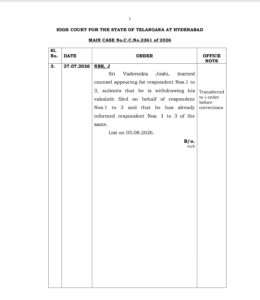
Another noticeable feature is the pattern emerging from the contempt proceedings.
Joint Secretary Thamidisetty Basava Raju is presently facing two separate contempt proceedings. Treasurer Dr. Konda Anil Kumar is also facing contempt proceedings.
Whether or not that pattern ultimately proves significant is for the Court to decide. However, it is difficult to ignore that the judicial spotlight has repeatedly fallen on the same office-bearers.
The Bigger Picture
Strip away the personalities and the legal position appears relatively straightforward.
The SMC’s authority presently governs the functioning of the Apex Council, including matters relating to the AGM. The Association’s bye-laws continue to operate, but within the framework established by the High Court—not independent of it.
An interim President working against a 45-day deadline, disputes over AGM procedure and official records, and multiple contempt proceedings involving members of the Apex Council are not necessarily isolated episodes. They increasingly appear to form different chapters of the same institutional story.
Until that legal reality is fully acknowledged, the HCA risks remaining in the news for courtroom battles rather than cricket.
(This write-up is based on the judgment in W.P. No. 21904 of 2025, publicly available court records, and discussions within HCA circles. Any references to motives, influence or internal political alignments are expressly identified as rumour or opinion and remain unverified. The contempt proceedings referred to are sub judice, and nothing contained herein should be construed as expressing any finding regarding the guilt or liability of any individual.)