MS Shanker
Is the Congress, once the undisputed national political force that ruled Bharat for decades, gradually losing its identity as a truly national party? The question may sound provocative, but recent political developments suggest that it can no longer be dismissed merely as political rhetoric.
What should particularly worry the Congress is not just the growing challenge from the BJP-led NDA. It is the fact that some of its own allies and prospective partners appear increasingly unwilling to accept the Congress’s positions unquestioningly.
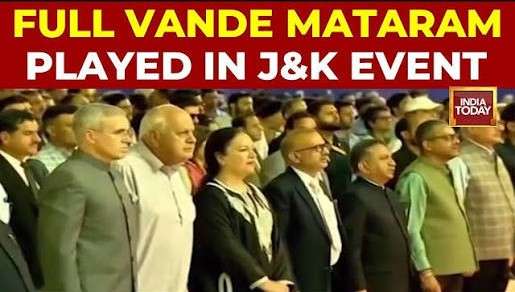
The latest developments involving Jammu and Kashmir Chief Minister Omar Abdullah and Tamil Nadu Chief Minister C. Joseph Vijay are instructive. Omar Abdullah and National Conference president Farooq Abdullah standing respectfully through the full rendition of Vande Mataram has acquired significance because it contrasts with the Congress’s stated preference for the version adopted following its 1937 position. Congress general secretary K.C. Venugopal has questioned the appropriateness of the full version in the context of India’s pluralist ethos.
Whatever one’s position on the controversy, the larger political message is unmistakable: an ally is not necessarily prepared to inherit every ideological position of the Congress.
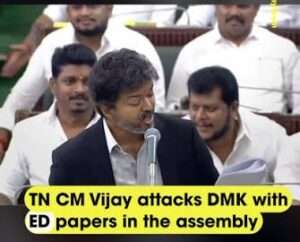
The same emerging friction can be seen in Tamil Nadu. Chief Minister C. Joseph Vijay has taken on the DMK with unusual ferocity, invoking the Sarkaria Commission and Enforcement Directorate material while making serious allegations against successive generations of DMK leadership. The DMK has naturally rejected the allegations and the political battle is far from over. But the significance lies elsewhere—the opposition space itself is becoming increasingly competitive, with regional players asserting their own political identities rather than merely functioning as appendages of a Congress-led national narrative.
And then comes the question of leadership.
Congress leaders have been emphatic that Rahul Gandhi will be the face of the INDIA bloc for the 2029 Lok Sabha election. Yet CPI(M) general secretary M.A. Baby has now publicly described the projection of Rahul Gandhi as a pre-poll Prime Ministerial candidate as premature, stressing that the INDIA bloc has taken no such decision.
That is not a trivial disagreement. It goes to the heart of the Congress’s claim to lead a national opposition coalition.
The Congress may legitimately argue that it is the largest constituent of the opposition and therefore entitled to seek leadership. But an alliance is not the same thing as a Congress extension. Regional parties have their own constituencies, political compulsions, ideological positions and ambitions. If they increasingly begin telling the Congress where they stand, the old assumption of Congress primacy inevitably comes under question.
This is where the Congress perhaps needs to look into the political mirror.
For a party that routinely accuses the Modi-led NDA government of destroying constitutional institutions, weakening democratic checks and compromising independent national institutions, its own historical record cannot simply be removed from the national memory.
The Emergency of 1975 remains perhaps the most uncomfortable chapter in that history. Fundamental rights were suspended, political opponents were jailed, press freedoms were severely curtailed and constitutional changes were undertaken to strengthen the executive. The 42nd Constitutional Amendment, enacted during the Emergency, dramatically altered the constitutional balance before subsequent governments rolled back several of its controversial provisions.
Then there was Operation Blue Star and the decision to send the Army into the Golden Temple complex in 1984—one of the most painful and consequential decisions in independent India’s history.
None of these historical episodes can be used to justify wrongdoing by any subsequent government. But equally, they cannot be conveniently forgotten when the Congress presents itself as the permanent custodian of constitutional morality and institutional independence.
That is the real danger for the Congress.
Opposition is indispensable to democracy. But opposition to everything cannot become a substitute for an alternative political vision.
When every disagreement becomes an assault on democracy, every institutional decision becomes evidence of conspiracy, every constitutional authority becomes suspect and every government initiative is rejected almost by reflex, voters may eventually begin asking a simple question: What does the Congress actually stand for, beyond opposing Narendra Modi?
That question could prove more damaging than any attack from the BJP.
The Congress’s historical strength came from its ability to accommodate contradictions—from the Left to the Right, from regional aspirations to national interests, from social conservatives to modernisers. It was precisely that expansive political character that once made it the country’s natural national party.
But if that broad national umbrella gradually gives way to perpetual confrontation, ideological rigidity and dependence upon regional parties that themselves refuse to follow the Congress line, the party could find itself losing not merely elections but its political identity.
The warning signs are already visible. Even within the INDIA ecosystem, the Congress’s claim to unquestioned leadership is being tested. Its allies are increasingly willing to disagree publicly, assert independent positions and pursue their own political narratives.
The Congress therefore needs to ask itself a difficult question before asking the country to answer one for it:
Is it still fighting to become a national alternative—or is it slowly becoming just another constituent of a collection of regional political forces?
If it continues down the present path, history may eventually force the party to confront an uncomfortable irony: the party that once dominated the national political landscape could itself become a case study in how a national party loses relevance by forgetting what made it national in the first place.
The scare may not be electoral defeat alone.
It may be the gradual erosion of the Congress’s claim to represent Bharat as a national political force.
And that is a mirror its own allies increasingly appear willing to hold up before it.