
Vijay Gajera
Is the United States deliberately weakening its own allies and confronting Russia as part of a larger strategy to contain China? Or is the world witnessing a more complicated struggle in which Washington, Moscow, Beijing and Europe are all pursuing competing interests?
The answer may lie somewhere between the two extremes. But one fact is increasingly difficult to ignore: the geopolitical architecture that dominated the post-Cold War era is undergoing a profound transformation.
The Eurasian Question
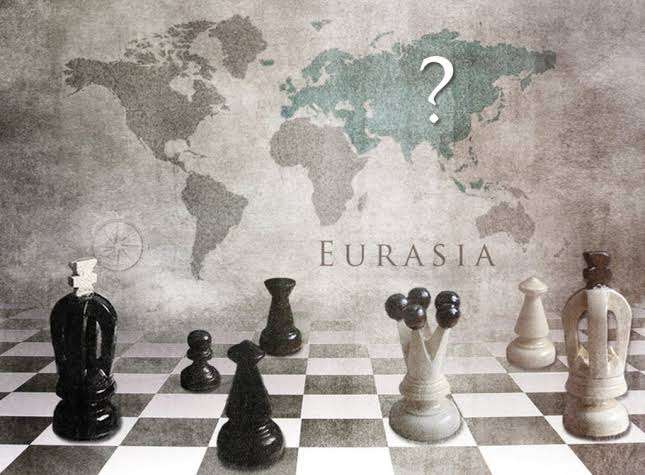
For decades, a central concern of Western strategy has been the possibility of a powerful Eurasian bloc emerging from the combined economic strengths of Europe, Russia and China. Europe possesses capital, technology and sophisticated markets; Russia has enormous energy and mineral resources; China has manufacturing scale, infrastructure and an expanding technological base.
The argument advanced by some geopolitical analysts is that Washington’s strategy has therefore been to prevent these strengths from converging into a unified continental power.
Seen through that lens, the Ukraine conflict becomes more than a war between Russia and Ukraine. It becomes part of a wider contest over Europe’s security architecture, Russia’s place in the international system and China’s access to strategic resources.
But this interpretation should not be mistaken for an established American blueprint. Washington has publicly framed its Russia policy around supporting Ukraine and deterring further aggression, while its China policy centres on strategic competition, technology, trade and military deterrence.
Europe’s Energy Shock
The European dimension, however, is undeniable.
Before the Ukraine war, Russian pipeline gas was deeply embedded in Europe’s industrial economy, particularly Germany’s. Since 2022, that relationship has been dramatically dismantled. EU dependence on Russian gas fell from 45% of imports at the beginning of the war to about 12% in 2025, while the bloc has adopted legislation to eliminate Russian gas imports altogether.
The vacuum has been filled by a combination of LNG, alternative suppliers, renewables and energy conservation. The United States has consequently become a major energy supplier to Europe.
Critics see this as evidence of Washington benefiting commercially from Europe’s strategic vulnerability. The counterargument is that Europe itself chose diversification after Russia’s invasion because dependence on a geopolitical rival was considered a security risk.
The more important question is whether Europe can replace Russian energy without sacrificing industrial competitiveness.
Russia: Adversary or Strategic Rear Guard?
Russia has simultaneously moved closer to China.
Western sanctions have sharply reduced Moscow’s economic links with Europe, while China has become an increasingly important market, supplier and financial partner. Analysts at Brookings and the Council on Foreign Relations describe the relationship as strategically significant, while also stressing that it contains mistrust and competing interests.
This creates an extraordinary paradox.
The strategy intended to isolate Russia from the West has also accelerated its economic and strategic orientation towards China. Russia’s energy resources increasingly provide China with an alternative to vulnerable maritime supply routes.
Whether Washington actually intended this outcome is debatable. Its strategic consequence is not.
China and the Larger Contest
China is the only American competitor with the economic scale, manufacturing capacity, technological ambitions and military potential to challenge US influence across multiple regions simultaneously.
Containing China therefore increasingly involves more than tariffs or semiconductor restrictions. It encompasses alliances in the Indo-Pacific, control of critical technologies, maritime security, supply chains, energy routes and competition for influence across the Global South.
Yet the pressure is producing a counter-reaction.
Russia and China have deepened cooperation, while BRICS expansion and experiments with local-currency settlements indicate that several emerging economies want greater room to manoeuvre outside a system overwhelmingly centred on the dollar and Western financial institutions.
That does not mean the dollar is about to collapse. It does mean the assumption that the existing financial order will remain unchallenged cannot be taken for granted.
The Financial Vulnerability
America’s greatest strategic challenge may ultimately be domestic rather than military.
US federal debt is already extraordinarily high, and the Congressional Budget Office projects debt held by the public to rise from about 99% of GDP at the end of 2025 to 120% by 2036. Net interest outlays are projected to more than double, from roughly $1 trillion in 2026 to $2.1 trillion in 2036.
These numbers do not prove an impending financial collapse. They do, however, demonstrate that fiscal sustainability is becoming a central component of American power.
The Unintended Endgame
This is where the great geopolitical chessboard becomes unpredictable.
A strategy designed to prevent a Eurasian alignment may actually encourage one. Sanctions intended to isolate Russia can push Moscow closer to Beijing. Energy diversification can strengthen American LNG exports while simultaneously forcing Europe to reconsider its industrial model. Efforts to preserve dollar dominance can encourage other countries to develop alternative payment mechanisms.
The emerging world is therefore not necessarily one in which America suddenly loses its power. It is one in which American power increasingly faces competitors, alternatives and constraints.
The real “endgame” may consequently not be the collapse of an empire, but the end of an era of uncontested dominance.
And that distinction matters.
The 21st-century contest may ultimately be less about who replaces America and more about whether Washington, Beijing, Moscow, Europe and the rising Global South can coexist in a world where no single power can dictate the rules alone.