



The debate over whether a strengthening rupee is a boon or a bane cannot be settled through simplistic economic arguments. A stronger currency may bring immediate relief to certain sections of the economy, but it can also create challenges for others. The real question is not whether the rupee is gaining ground against the US dollar, but whether that appreciation reflects Bharat’s improving economic fundamentals or merely temporary currency-market dynamics.
There is little doubt that an appreciating rupee offers tangible advantages. Bharat, heavily dependent on imports of crude oil, natural gas, electronics, machinery and industrial raw materials, stands to benefit from a stronger domestic currency. Imports become cheaper in rupee terms, potentially reducing input costs for industries, easing imported inflation and providing some relief to household budgets. However, the extent to which these savings reach consumers depends on global commodity prices, domestic taxes, distribution costs and the speed of price adjustments.
The benefits extend beyond the domestic market. Bharatiya students pursuing education overseas could find tuition fees, accommodation and other dollar-denominated expenses relatively cheaper. Families servicing foreign-currency education loans and businesses repaying dollar-denominated debt would also require fewer rupees to meet their obligations. Overseas travel becomes more affordable, while Bharatiya companies dependent on imported technology and equipment gain some breathing space. These are genuine economic advantages, not merely accounting gains.
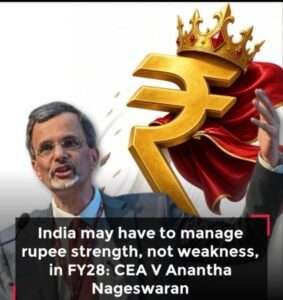
But the other side of the equation cannot be ignored. Bharat’s export-oriented industries could find themselves on the receiving end of an appreciating currency. Information technology services, pharmaceuticals, textiles, engineering goods and other exporters earning revenues in dollars receive fewer rupees when those earnings are converted. Unless productivity improves or export prices are adjusted, their margins could come under pressure. A stronger rupee could also make Bharatiya products relatively expensive in international markets, particularly when competitors operate with weaker currencies.
The consequences are equally significant for domestic manufacturers. Cheaper imports can intensify competition for Bharatiya producers, especially smaller enterprises that may not have the economies of scale or technological advantages to withstand price pressures. At a time when India is seeking to strengthen domestic manufacturing, expand exports and establish itself as a global production hub, an excessively rapid appreciation could complicate these ambitions.
There are implications for households and investors as well. Non-resident Bharatiyas sending money home would receive fewer rupees for every dollar remitted. Similarly, the rupee value of existing unhedged dollar-denominated savings and overseas investments would decline when converted into domestic currency. What benefits an importer could therefore hurt an exporter or a family dependent on overseas remittances.
More importantly, currency appreciation must be understood in its economic context. If the rupee strengthens because of sustained foreign investment, improved productivity, stronger exports, healthy capital inflows and greater confidence in India’s economic prospects, it can reflect genuine underlying strength. However, if the movement is driven primarily by temporary dollar weakness, speculative flows or short-term market interventions, celebrating it as an achievement would be premature.
The Reserve Bank of India, too, has a delicate balancing act. Its responsibility is not to defend an arbitrary exchange-rate level but to maintain orderly market conditions, contain excessive volatility and safeguard broader financial stability. Both sharp depreciation and uncontrolled appreciation can disrupt businesses that depend on predictable currency movements.
Bharat must therefore avoid confusing currency appreciation with economic progress. A competitive exchange rate, rather than an artificially strong one, is important for a country aspiring to become a manufacturing and export powerhouse. Equally, allowing excessive volatility to undermine investor confidence or increase the cost of essential imports would be counterproductive.
The ultimate test of a strong rupee is whether it strengthens the Indian economy as a whole. A currency should reflect economic resilience, not become a trophy for political or financial celebration. A stronger rupee is welcome when it is backed by stronger fundamentals; otherwise, it could well turn into a costly illusion of prosperity.


