Lakshmanrao Upadhyayula
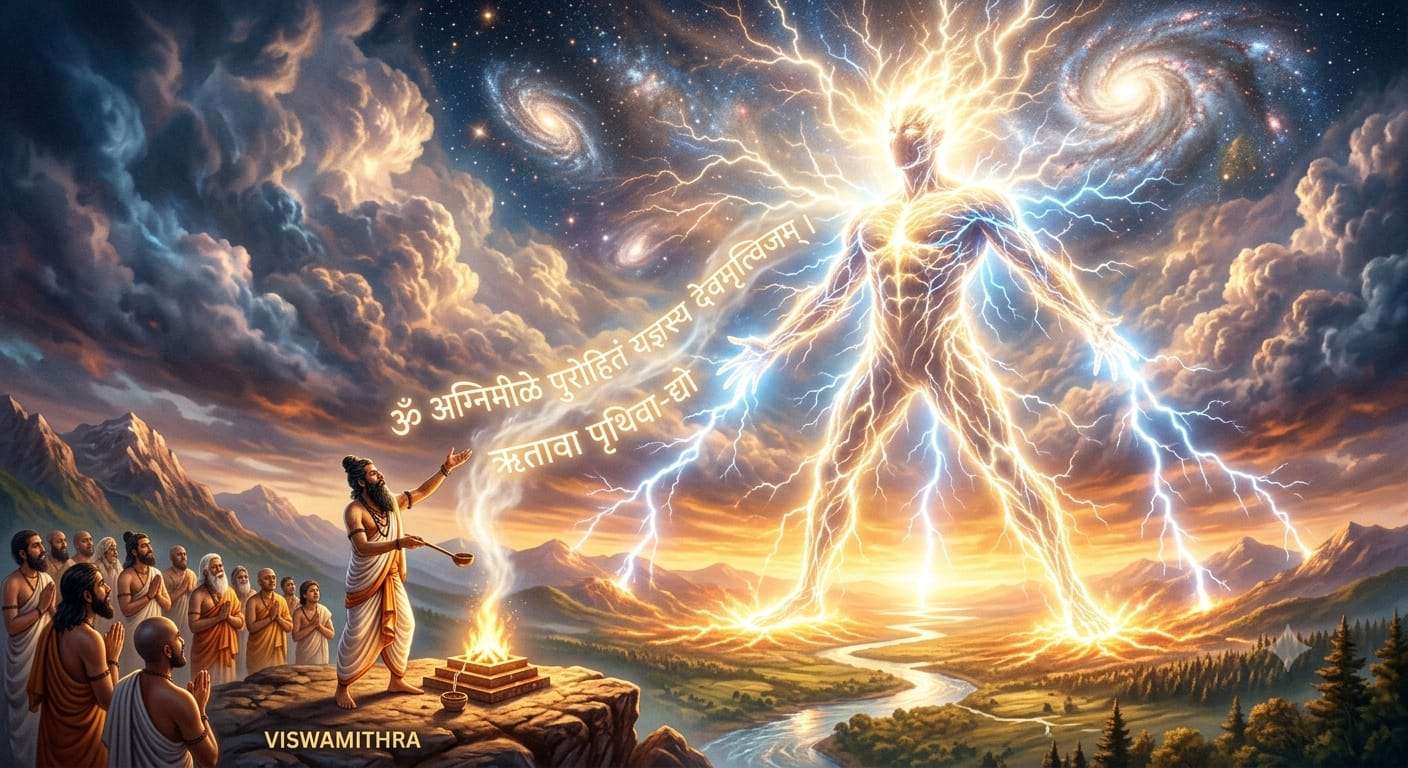
The revered sage Vishwamitra, while immersed in profound contemplation, invoked Agni through the majestic cadence of Tristup Chandas found in the sacred hymns of the Rigveda. In these exalted revelations, Agni appears not merely as physical fire, but as the eternal principle of illumination, sacrifice, transformation, and cosmic intelligence. The seer perceived Agni as the sustaining force of creation, whose radiant energies rise upward in perfect order, spreading brilliance across the worlds. His white posterior symbolised purity and transcendence, while his flaming rays penetrated heaven and earth, the divine parents from whom his manifestation emerged. These rays entered the seven sacred rivers, signifying the diffusion of life, vitality, and spiritual consciousness throughout existence.
The heavens and the earth, regarded as the eternal parents of Agni, expanded themselves in every direction to uphold the sacred rhythm of yajna. Through their harmonious cooperation, sacrifice continued without obstruction, preserving the order of the universe. The cosmic powers themselves bestowed long life upon Agni, for he was the immortal flame dwelling within all beings. The celestial cow, symbolic of divine abundance and nourishing wisdom, together with the swift horse representing dynamic energy, became sacred offerings to Agni, the granter of boons. The rivers, flowing with luminous waters, were understood as his dwelling places, for the Vedic vision recognised the inseparable relationship between fire, water, atmosphere, and life itself. This insight reflected an early scientific temperament in which the forces of nature were observed as interconnected manifestations of one universal principle.
Agni desired to abide eternally within the house of truth, where righteousness and sacred order prevail. From him arose the flames that illuminate both ritual and consciousness. The sages declared that whether through the sacred cow or through the four stages of speech, Agni alone receives the innermost offering of expression. Among these stages, the middle utterance emerging from the depths of the throat represented the subtle vibration through which divine knowledge becomes manifest. Such observations reveal the Vedic understanding of sound, breath, resonance, and articulation as powerful channels of spiritual energy. Speech itself was treated as sacred science, and Agni was recognised as the witness and purifier of every uttered mantra.
Agni stood supreme among all treasures, radiant beyond measure, lord of inexhaustible brilliance. He moved upon the symbolic boats that restrain the senses, indicating mastery over the restless movements of the mind. His white exterior reflected purity, while his energies expanded endlessly through all directions of space. The rivers flowed freely carrying waters that sustained life, and these waters themselves adorned Agni, for heat and moisture together preserve creation. The Vedic seers intuitively perceived the cyclical harmony of nature, understanding that fire generates clouds, clouds produce rain, rain nourishes rivers, and rivers sustain all living beings. Thus Agni was not merely destructive flame, but the regulator of ecological balance and cosmic continuity.
Majestic Agni, the youthful son of Tvashta, remained untouched by decay and old age. By his will the universe was sustained in orderly movement. Just as a devoted man approaches his beloved with affection and constancy, Agni entered the rivers and united with their currents. He illumined heaven and earth alike, filling all realms with splendour. Though immensely powerful, Agni remained non-violent and benevolent toward those who approached him with sincerity. People sought refuge beneath his protective grace and lived according to his command, guided by truth and discipline. Their hymns resounded across heaven and earth, bringing them prosperity, intellect, beauty, and inner refinement. Through Agni they discovered not only material welfare but also spiritual elevation and moral harmony.
The vast heaven and earth themselves were absorbed by Agni, who encompassed the greatest of all existences within his divine essence. Patrons of yajna praised him in elevated tones, and their resonant prayers reached the sacred fire like waves ascending toward the infinite. Agni, the comforter of humanity and irrigator through waters, spread his brilliance throughout the darkness of night and among the assembled priests. The five Athvaryu priests and the seven Hota priests guarded the beloved seat of Agni with unwavering dedication. Their rituals reflected extraordinary organisation, discipline, and knowledge of sacred procedure. The hosts of gods visited the holy precincts where divine rites were performed by pure-hearted priests, and they approached the eastern side to partake of the Soma elixir, symbol of immortal delight and spiritual ecstasy. Renewed with perpetual youthfulness, the gods rejoiced in the rain-like flow of Soma, which nourished both cosmic and inner vitality.
The divine forms of the twin manifestations of Agni were adorned by the sage Vishwamitra himself, whose spiritual insight transformed ritual into living revelation. The seven Hotas rejoiced in Soma and protected the sanctity of yajna through sacred hymns. The creators of hymns were not mere poets but guardians of cosmic order, preserving wisdom through sound and memory. The brilliant priest proclaimed fearlessly that Agni alone is truth, the eternal messenger between humanity and the divine worlds. Blazing with countless hues, Agni appeared as the radiant envoy of the gods, surpassing all in splendour and power. His exotic colours reflected the many forms of energy visible in flame, from golden radiance to deep crimson glow, symbolising the diversity of creation itself. Like a mighty bull roaming vast fields, the sacred fire moved majestically across limitless expanses, bringing joy, wisdom, and fulfilment to devotees.
Agni invited the venerable gods, along with heaven and earth, to participate in the sacred yajna. At the arrival of Usha, the ritual awakened through nourishment, vitality, and auspicious beginnings. The stirrings of human activity and the melodious chirping of birds welcomed the dawn with natural reverence. The Ushas became resplendent and prosperous as they advanced the movement of Agni across the worlds. His majestic gait captivated the hearts of devotees and burned away the sins and impurities of those who sponsored the sacrifice. In this imagery, dawn symbolised awakening consciousness, while Agni represented the inner fire that dispels ignorance. The harmony between nature, ritual, and human aspiration reflected the deeply integrated worldview of Vedic civilisation.
For the priests devoted to sacred action, the earth herself, compared to a nourishing milky cow, provided sustenance and sacred ground for righteous works. The worshippers prayed for noble offspring who would strengthen the lineage with virtue, wisdom, courage, and spiritual dignity. Such prayers were not confined to personal desire alone, but reflected the Vedic aspiration for continuity of dharma across generations. Thus the hymns of Vishwamitra revealed Agni as cosmic energy, moral guide, divine messenger, scientific principle, and spiritual light united in one eternal reality. Through fire, sound, water, dawn, sacrifice, and disciplined knowledge, the Vedic sages perceived the universe as an interconnected sacred order sustained by truth, harmony, and divine intelligence.