BG Srinivas
Nearly a thousand years ago, in the heart of Chola India, a hospital had a defined capacity, a named physician, designated staff, a pharmacy with a prescribed inventory and even a budget for keeping a lamp burning through the night. This was no vague claim about the medical wisdom of ancient Bharat. It was an institution whose functioning was recorded in remarkable detail on stone.
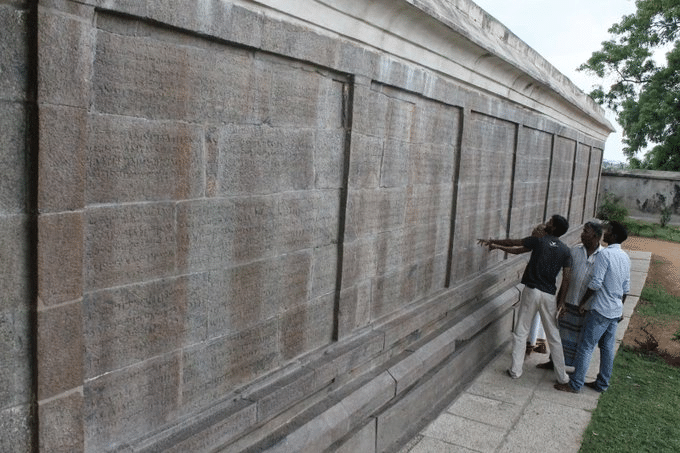
The evidence survives at the Venkatesa Perumal Temple in Tirumukkudal, near Kanchipuram, Tamil Nadu. During the 11th century, the temple complex housed not just a place of worship but also a Vedic college, a hostel and a hospital known as Virasolan. Its administrative arrangements were documented in an inscription associated with the Chola ruler Virarajendra.
Indian epigraphist K. V. Subrahmanya Ayyar discovered and copied the inscription during his field season of 1915–16. The sheer scale of the writing was extraordinary: it covered approximately 540 square feet, with one section extending across 55 feet. More than a thousand years later, this record offers a window into the organisation of healthcare and institutional life under the Cholas.
The hospital had provision for 15 in-patients. Its physician, Kodandaraman Asvatthama-Bhattan of Alappakkam, was responsible for prescribing medicines not only to hospital patients but also to teachers and students of the Vedic college and people attached to the temple institutions.
Healthcare involved a team. A practitioner who performed surgical operations was paid separately. Two personnel collected medicinal herbs, supplied firewood and assisted in preparing medicines. Two nurses looked after patients and administered their medication. A barber, too, received payment, reflecting the range of services provided within the establishment.
Even food was accounted for. Rice for the 15 in-patients had a separate allocation, while the pharmacy maintained an annual inventory of medicines and ingredients. Oils and medicated ghees were measured in specified quantities. Four preparations were listed at 2,000 units each, while 40 kasu were set aside for medicines and their preparation requirements. The account also referred to ghee intended to be stored underground for an aged medicinal preparation.
These details make the inscription particularly valuable. It does not merely establish that medical treatment existed in medieval South India. It records the practical arrangements through which a hospital operated: patient capacity, professional responsibilities, staff remuneration, food provisions and the procurement and storage of medicines.
Perhaps the most revealing detail is also the easiest to overlook. The hospital budget included oil for a lamp that was to burn through the night. The provision was calculated for a year of 360 days. Behind that small accounting entry lies a simple but powerful insight: healthcare required attention beyond the doctor’s prescription. Patients needed care at night, supplies had to be maintained, and recurring expenses had to be anticipated.
The inscription therefore preserves more than a list of medicines and payments. It documents an organised institution in which responsibilities and resources were recorded with considerable specificity. It also reminds us that the history of medicine in Bharat can be explored through primary evidence, rather than broad claims about the achievements of the past.
The Chola-era hospital at Tirumukkudal deserves attention not because every aspect of its system can be equated with modern healthcare, but because its inscription offers tangible evidence of how a medical establishment functioned nearly a millennium ago.
Stone has preserved what time might otherwise have erased: the physician’s name, the nurses’ duties, the patients’ provisions and the oil for a lamp burning through the night.
That is Vintage Bharat—history illuminated by evidence, one inscription at a time.
Source: K. V. Subrahmanya Ayyar, “The Tirumukkudal Inscription of Virarajendra,” Epigraphia Indica, Vol. XXI, No. 38, pp. 220, 223–225, 249–250.
Photographs: R. Muthusamy, Know Your Heritage, Tirumukkudal field-trip photographs (2014); Epigraphia Indica, Vol. XXI, pp. 249–250. Highlights added to the reproduced inscription report for reference.