



Dronacharya stood upon the battlefield, yet his spirit had already begun to withdraw from the fury of war. The grievous tidings concerning the death of his beloved son weighed heavily upon his heart, clouding his judgment and draining the vigor that had once made him invincible. While the world witnessed only a warrior standing amidst the clash of arms, none could fully comprehend the tempest raging within his soul. Such is the delicate thread of mortal existence: each person knows only a fragment of the greater design, while the Divine alone beholds the whole tapestry and remains silent.
Dhrishtadyumna, unaware of the depth of Drona’s inner turmoil, prepared himself to accomplish the very purpose for which he had been born. Ever since his emergence from the sacred sacrificial fire, he had carried a singular destiny—to bring about the death of Dronacharya. His heart burned not only with the fire of destiny but also with resentment over the humiliation suffered by his father, King Drupada, who had once been captured by Drona and presented as a token of discipleship. From that sacrificial rite had arisen both Draupadi, destined for Arjuna, and Dhrishtadyumna, destined for Drona’s destruction. Seeing the revered preceptor submerged in sorrow, Dhrishtadyumna believed that fate itself had delivered the long-awaited opportunity into his hands.
With renewed fury he showered Drona with a relentless rain of arrows. Though burdened by grief, Dronacharya instinctively responded like the master warrior he had always been. His conscience no longer desired combat, yet the warrior within compelled him to defend himself. The celestial weapons that once answered his command no longer arose in his memory, but his unmatched skill with ordinary arms remained undiminished. He shattered Dhrishtadyumna’s arrows in midair, destroyed his chariot, slew his horses and charioteer, broke his bow, pierced his banner, and reduced his standard to fragments.
Deprived of his chariot, Dhrishtadyumna rushed forward with a mighty mace, only to see it shattered by Drona’s counterstroke. Undeterred, he seized a sword and shield and leapt onto Drona’s chariot. There he slew the horses and struck down the charioteer. Yet Drona quickly destroyed his sword and shield and pierced his body with countless shafts. The Panchala prince found himself overwhelmed beneath the devastating skill of the aged master.
At that moment, Satyaki, though engaged against the formidable combination of Kripacharya, Karna, and Kritavarma, noticed Dhrishtadyumna’s peril. He discharged arrows in support of his ally. Bhima also rushed to the rescue, lifting the wounded prince onto his chariot and carrying him away from immediate danger. Drona watched their departure without pursuit. A strange calm descended upon him. “I did not seek battle,” he reflected. “Yet battle came seeking me. The obstacle has passed.” His mind, weary from conflict, gradually turned inward toward meditation.
Sanjaya then narrated to King Dhritarashtra the final chapter of Drona’s greatness. For four days and one night the preceptor had fought with unparalleled ferocity, extending his extraordinary resistance beyond the limits of ordinary endurance. In his final hours alone, he annihilated thousands of warriors, reducing mighty formations to dust and scattering shattered chariots, fallen elephants, and heaps of slain soldiers across the field. Like a raging forest fire consuming everything in its path, he blazed with terrible splendor.
Yet victory brought him no peace. Though his prowess remained unmatched, his heart was burdened by lingering sorrow. Looking upon Karna and the assembled Kaurava heroes, he spoke words filled with detachment. He reminded them how often they had urged war and mocked restraint. He declared that he had fought to the utmost of his ability and no longer desired the bow or the battlefield. Having fulfilled his duty, he resolved to abandon worldly struggle and seek higher realms. With those words, he laid aside his weapons and seated himself in profound meditation upon his chariot.
As Drona entered deep yogic absorption, a radiant brilliance began to emanate from his body. Seeing what appeared to be an unguarded opportunity, Dhrishtadyumna seized his sword and rushed forward on foot. Cries of anguish arose from soldiers on both sides. Unknown to them, Dronacharya had already withdrawn his consciousness from the mortal frame. Through the power of yoga, he cast aside the body and ascended toward higher worlds in a form of celestial splendor. This extraordinary vision was perceived only by a select few: Lord Krishna, Arjuna, Yudhishthira, Kripacharya, and Sanjaya.
The heavens rejoiced as the noble soul ascended. But Dhrishtadyumna, consumed by destiny and vengeance, knew nothing of this transcendental departure. Reaching the lifeless body, he seized Drona by the hair and raised his sword. Arjuna ran forward, shouting that such an act must not be committed. Yudhishthira also condemned the deed. Yet Dhrishtadyumna, driven by relentless purpose, ignored their pleas and severed the head of the fallen preceptor, casting both head and body upon the ground.
Sanjaya sorrowfully informed Dhritarashtra that this tragic end was the bitter fruit of accumulated hatred and ambition. The venerable master who had instructed princes in every science of warfare met his earthly end at the hands of the very warrior born for that purpose. The Pandava forces erupted in triumph, while the Kaurava army was overcome with despair. Unable to withstand the renewed assault, their ranks broke apart and fled in every direction. Duryodhana, Dushasana, Karna, Kripacharya, Kritavarma, and Shakuni stood behind their elephant and cavalry divisions, watching the collapse of their forces with profound disappointment.
Meanwhile, Ashwatthama, engaged elsewhere in fierce combat, noticed the disorder spreading throughout the Kaurava ranks. Approaching Duryodhana, he questioned the cause of the army’s panic and the unusual sorrow visible upon the faces of the great warriors. Why had courage vanished? Why had enthusiasm faded? Duryodhana remained silent, his voice choked by grief. Kripacharya, though equally devastated, gathered his strength and carefully recounted every event that had transpired.
He described Drona’s unmatched destruction of the Panchala and Pandava armies, the deceptive announcement regarding Ashwatthama’s death, Bhima’s slaying of the elephant bearing that name, and Yudhishthira’s ambiguous words that led Drona to believe his son had perished. Unable to endure such sorrow, Drona had laid down his weapons. Then Dhrishtadyumna had mounted his chariot, seized him by the hair, and severed his head while he sat absorbed in meditation. Kripacharya also emphasized that Arjuna and Yudhishthira had attempted to prevent the act, but their efforts had failed.
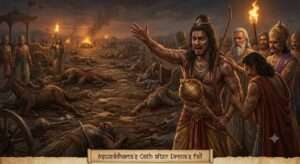
Hearing this account, Ashwatthama’s eyes filled with tears. Grief surged through his heart, yet he remained composed. He acknowledged that death was inevitable in war and that battle itself was not dishonorable. Nevertheless, the humiliation inflicted upon his father tormented him beyond measure. The image of a revered sage-warrior being dragged by the hair and slain in such a manner ignited a consuming fire within him. He regarded the deed not merely as an attack upon Drona but as an insult to his own honor, strength, and manhood.
Addressing Duryodhana, he declared that Yudhishthira’s deception had been the true cause of the disaster. His father had been compelled to abandon his weapons through falsehood, and justice demanded retribution. Ashwatthama lamented that despite possessing celestial weapons and immense power, he had been absent when his father met such an end. The thought filled him with shame and self-disgust.
Then, with fierce determination, he pronounced a terrible vow. He swore that he would unleash divine astras upon the Pandavas and their allies. He would force even Krishna and the sons of Pandu to recoil beneath the fury of his weapons. Elephant corps, cavalry divisions, and mighty warriors would fall beneath his storm of arrows. Even celestial beings, should they come to aid the Pandavas, would feel the impact of his wrath. His grief transformed into resolve, and his sorrow became the fuel for vengeance.
Thus Sanjaya narrated to Dhritarashtra not merely the death of Dronacharya but the birth of a new and dreadful chapter in the war. The blind monarch expected an outpouring of grief from Ashwatthama, yet what emerged instead was the unyielding spirit of a warrior bound by loyalty, honor, and the relentless code of battle. From the ashes of a father’s fall arose a son’s terrible oath, and the battlefield prepared itself for yet another storm of destiny.

