Lakshmanrao Upadhyayula
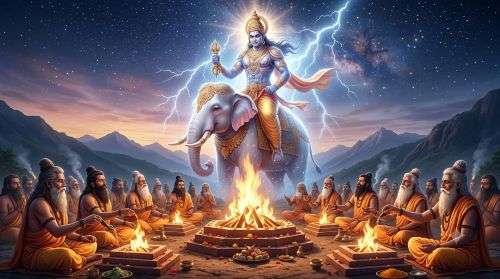
Among the ancient hymns of the Rigveda, the sage Vāmadeva offers profound prayers to Lord Indra in the majestic Virāṭ and Triṣṭubh metres. These hymns are not merely poetic invocations but luminous expressions of Vedic philosophy, where nature, divinity, and human aspiration are woven into a single cosmic fabric. Indra emerges as the embodiment of courage, wisdom, righteous authority, and the sustaining power that preserves harmony in the universe. Every verse reflects both spiritual reverence and an early scientific observation of the natural world, demonstrating the extraordinary vision of the Vedic seers.
The hymn begins with an exaltation of Indra’s immeasurable greatness. The earth bears witness to his strength, while the heavens proclaim his boundless power. His most celebrated achievement is the destruction of Vṛtra, the mighty force that obstructed the life-giving waters. By striking Vṛtra with the invincible Vajra, Indra released the imprisoned rivers, restoring fertility, prosperity, and life to the world. Spiritually, this victory symbolizes the removal of ignorance and stagnation from the human mind. Scientifically, it reflects an ancient understanding that rainfall, flowing rivers, and water cycles are indispensable for sustaining civilization and ecological balance.
The hymns describe the awe that accompanied Indra’s birth. His divine energy caused both heaven and earth to tremble, illustrating the emergence of a supreme cosmic force entrusted with preserving universal order. Such descriptions signify not fear alone but the immense transformative power that accompanies creation itself. The Vedic poets recognized that every great force of nature inspires both reverence and responsibility.
Indra commands the clouds to nourish the earth with rain. Under his authority, the heavens release waters that quench the thirst of every living being and transform barren lands into fertile fields. These verses beautifully reveal the Vedic appreciation of the hydrological cycle. Rainfall is not viewed merely as a meteorological event but as the sacred bond connecting heaven, earth, plants, animals, and humanity. Indra thus becomes the divine custodian of environmental harmony.
The hymns glorify Indra as the unconquerable warrior who shatters mountains with the brilliance of his Vajra. Empowered by Soma, he defeats Vṛtra and liberates the restrained waters, allowing them to rush freely across the earth. While this is celebrated as a divine victory, it also symbolizes the triumph of energy over inertia, truth over falsehood, and life over destruction. The release of rivers represents the continuous renewal upon which all civilizations depend.
The sages proclaim that Indra alone deserves their sincere hymns. His Vajra remains invincible, and his glory shines eternally in the heavens. The radiant Prajāpatis, who brought him into existence, cherished him as their illustrious son. His creation itself was auspicious, for his divine mission was to uphold righteousness and safeguard creation. As the foremost among the gods, Indra is repeatedly invited by countless worshippers, illustrating his universal accessibility and compassionate nature.
Indra is celebrated as the remover of fear, the faithful companion of humanity, and the possessor of inexhaustible riches. Soma, his sacred delight, strengthens his divine resolve and symbolizes spiritual exhilaration rather than mere physical vitality. The patrons and priests approach him with truthfulness, recognizing that sincerity and righteousness alone attract divine grace. This reflects the Vedic conviction that moral integrity is the highest offering in every sacrifice.
As Lord of wealth and protector of cattle, Indra sustains both economic prosperity and social stability. In Vedic society, cattle symbolized nourishment, agriculture, and communal wellbeing. His blessings extended beyond material possessions to include security, abundance, and social harmony. His primordial birth signifies that the sustaining principles of strength and justice have existed since the very beginning of creation.
The hymns praise Indra for reassuring people terrorized by Vṛtra’s oppression. By eliminating destructive forces, he enriches the earth with fertile waters and restores confidence among all beings. His victories over fierce enemies represent the perpetual struggle against forces that hinder human progress. Indra is therefore remembered as the fulfiller of noble aspirations, the possessor of auspicious power, and the generous giver of food and prosperity.
His supremacy in battle is repeatedly affirmed. Even the most organized armies cannot withstand his irresistible strength when righteousness is on his side. Yet his victories are never celebrated merely for conquest; they establish justice, restore order, and protect the innocent. The offerings presented during sacred yajñas symbolize humanity’s gratitude for divine protection and cosmic stability.
The companionship of Indra is regarded as one of life’s highest blessings. He triumphs over hostile forces, retrieves stolen cattle, and restores wealth to its rightful custodians. Whenever his righteous anger is awakened, both animate and inanimate creation tremble before the irresistible force of divine justice. Such descriptions emphasize that moral law governs both nature and society.
The hymns further celebrate Indra’s victories over demons and hostile powers. He acquires their wealth, herds of horses, and symbols of sovereignty, not through greed but by restoring resources to those who uphold righteousness. His leadership reflects the Vedic ideal of governance, where power is exercised for protection, prosperity, and the welfare of all living beings.
The sages contemplate the immeasurable strength inherited by Indra from his divine parents. Dwelling with Prajāpati, he participates in sustaining the visible universe and repeatedly strengthens the worlds under divine guidance. This imagery reflects the Vedic understanding that cosmic order is maintained through cooperation between creative intelligence and dynamic energy, rather than through isolated acts of power.
Indra is compared to the roaring wind accompanying rain-bearing clouds. His majestic arrival brings hope to the poor and abundance to those in need. The heavens glitter like celestial jewels, reflecting the splendour of divine creation. These poetic images reveal a deep appreciation of atmospheric phenomena, demonstrating how the Vedic seers transformed natural observations into spiritual symbolism without diminishing either.
The hymns also portray Indra as the remover of accumulated sins and the generous benefactor of priests devoted to sacred knowledge. His influence restrains destructive forces rushing toward conflict and preserves harmony. References to space as the source of radiance and the repository of waters reveal remarkably perceptive reflections on the celestial realm. The dark rain clouds that anoint Indra resemble the ritual anointing of Agni with Soma, beautifully linking cosmic processes with sacred ceremonies.
Ancient narratives within the hymn recount sages whose devotion to Indra brought divine blessings, worthy descendants, and reconciliation during conflict. Such episodes teach that divine intervention favours those who pursue wisdom, discipline, and righteousness. These stories also preserve valuable cultural memories woven into the larger spiritual landscape of the Rigveda.
The priests openly express their aspirations for cattle, horses, noble families, and enduring prosperity. Such prayers reveal that Vedic spirituality did not reject worldly life but sought to sanctify it through righteous conduct and grateful devotion. Prosperity was meaningful only when accompanied by virtue, generosity, and social responsibility.
Indra is lovingly addressed as the protector of all beings, the beloved of his consort, and the guardian of those who prepare Soma with devotion. His glory rivals that of the Prajāpatis, and he is praised as the finest ruler whose governance ensures justice, nourishment, and collective wellbeing. Even the ancestors are remembered under his benevolent protection, linking past, present, and future within one sacred continuum.
The devotees seek not merely material rewards but lasting friendship with Indra. They pray that he remain their protector, guide, and cherished companion. Though hardships may arise, their faith remains steadfast as they gather within the sacred precincts of the yajña to offer hymns filled with gratitude and hope. Their unwavering devotion illustrates the Vedic ideal of perseverance through trust in divine order.
Strengthened by the sincere prayers of the sages, Indra is invoked to destroy numerous enemies. Those who seek refuge in him become unconquerable before both mortal warriors and celestial adversaries. Such declarations symbolize the inner strength attained through unwavering faith, righteous conduct, and disciplined spiritual practice.
The concluding verses honour Indra as the beloved recipient of perfectly chanted Vedic hymns expressed through numerous metrical forms. As the sustainer of humanity, he is invited to accept these newly composed prayers and to bless his worshippers with food, chariots, swift horses, prosperity, and enduring happiness. Just as rivers are filled by life-giving waters, the devotees pray that their lives may overflow with wisdom, abundance, courage, and divine grace. The hymn thus stands as a magnificent synthesis of spiritual insight, ecological awareness, ethical leadership, and poetic excellence, revealing the timeless genius of the Rigvedic seers.