



“तच्चक्षुर्देवहितं शुक्रमुच्चरत्। पश्येम शरदः शतं जीवेम शरदः शतम्। शृणुयाम शरदः शतं प्रब्रवाम शरदः शतम्। अदीनाः स्याम शरदः शतम्। भूयश्च शरदः शतात्॥”
This profound Vedic prayer embodies humanity’s timeless aspiration to live not merely for a hundred years, but to experience those years with clarity of perception, strength of mind, dignity of character, wisdom of speech, and an enduring commitment to the welfare of all. It expresses a vision of existence in which longevity acquires significance only when accompanied by awareness, responsibility, and the capacity to contribute meaningfully to the world. The prayer is therefore not simply a wish for a long life; it is an invocation for a life illuminated by knowledge, sustained by inner strength, and directed towards a higher purpose.
The aspiration to see, hear, speak, and live for a hundred years contains an entire philosophy of human development. Sight represents more than the functioning of the eyes; it signifies the ability to recognise truth beyond appearances. Hearing implies more than the reception of sound; it represents openness to knowledge, experience, and the wisdom of others. Speech becomes meaningful when it communicates truth with compassion and responsibility. Longevity, in turn, becomes a blessing when the passage of time deepens understanding rather than merely adding years to existence. The prayer thus invites humanity to consider a fundamental question: what is the purpose of living longer if life does not become wiser, more compassionate, and more beneficial to society?
The Upanishadic tradition develops this question into a profound inquiry into the relationship between the individual, the universe, and the ultimate ground of existence. It does not merely preserve the external forms of Vedic ritual; it explores their inner meaning. The sacred fire becomes a symbol of consciousness, the offering becomes an act of self-transformation, and the ritual itself becomes a discipline through which human beings examine their motives, desires, actions, and understanding. The emphasis shifts from the external performance of a ceremony to the inner purification of the person performing it.
This transformation is expressed through the concept of Yajna, which may be understood as sacrifice, sacred offering, or a conscious act of participation in the larger order of existence. In its ritual form, yajna involves a sacred altar, fire, offerings, prescribed procedures, and collective participation. In its philosophical dimension, however, yajna extends beyond the boundaries of ceremonial worship. It becomes a way of living in which selfishness is restrained, awareness is cultivated, knowledge is honoured, and personal abilities are directed towards purposes greater than individual gratification.
The essential question consequently changes from what one places into the sacrificial fire to what one is prepared to transform within oneself. Can greed be offered into the fire of discernment? Can anger be transformed through patience? Can ignorance be diminished through inquiry? Can arrogance yield to humility? Can personal ambition be reconciled with social responsibility? These questions reveal the deeper significance of the inner yajna. The fire that matters most is the light of understanding through which the individual examines and refines the forces governing human conduct.
The Chāndogya Upanishad offers an extraordinary contemplative illustration of this universal vision through the meditation on the cosmic horse, the Aśvamedha symbolism. The universe is contemplated as an integrated sacrificial being, with its various regions and movements corresponding to the different parts of the horse. The imagery invites the mind to move beyond a fragmented perception of reality and recognise the interconnectedness of the natural world, cosmic processes, and human existence. It is a symbolic meditation rather than a literal anatomical description of the universe, intended to enlarge consciousness by connecting familiar ritual imagery with the totality of existence.
The corresponding vision is expressed through the following Sanskrit passage:
“उषा वा अश्वस्य मेध्यस्य शिरः। सूर्यश्चक्षुर्वातः प्राणो व्यात्तमग्निर्वैश्वानरः। संवत्सर आत्माश्वस्य मेध्यस्य। द्यौः पृष्ठमन्तरिक्षमुदरं पृथिवी पाजस्यम्। दिशः पार्श्वे अवान्तरदिशः पर्शवः। ऋतवोऽङ्गानि मासाश्चार्धमासाश्च पर्वाणि। अहोरात्राणि प्रतिष्ठा नक्षत्राण्यस्थीनि। नभो मांसानि॥”
The imagery presents dawn as the head of the cosmic horse, the sun as its eye, the wind as its vital breath, and fire as its open mouth. The year is associated with its essential being, heaven with its back, the intermediate space with its belly, and the earth with its lower supporting region. The directions, seasons, months, days, nights, stars, and sky are incorporated into the same contemplative structure. Through this symbolic arrangement, the universe becomes a living unity in the imagination of the meditator.
The philosophical significance of this meditation lies in the transformation of perspective it encourages. Human beings frequently perceive themselves as independent entities surrounded by external objects that may be possessed, controlled, or exploited. The Upanishadic vision challenges this separation. The body depends upon food, food depends upon the earth, the earth depends upon ecological processes, and human existence is sustained by relationships with countless other forms of life. Breath connects the individual with the atmosphere; sight depends upon light; bodily rhythms respond to cycles of nature; and the passage of individual life unfolds within the larger movement of time.
Recognising these relationships does not require the abandonment of scientific reasoning. On the contrary, a mature understanding of the Upanishadic tradition benefits from distinguishing symbolic insight from empirical explanation. Astronomy, physics, biology, and ecology investigate the natural world through observation, experimentation, measurement, and systematic reasoning. Upanishadic contemplation addresses questions concerning consciousness, identity, meaning, self-knowledge, and the relationship between the individual and the whole. These approaches need not be confused with one another to be appreciated. The enduring value of the cosmic imagery lies in its capacity to cultivate humility, interconnectedness, and a sense of responsibility towards the conditions that sustain life.
The concept of yajna acquires its greatest practical significance when brought into the ordinary activities of human existence. Eating becomes a conscious offering when food is received with gratitude and consumed with moderation. Work becomes yajna when it is performed with competence, integrity, and dedication rather than solely for personal advancement. Learning becomes an offering when knowledge is pursued to understand reality and improve human life. Speech becomes sacred when it is truthful, measured, and constructive. Silence becomes meaningful when it creates space for reflection, rather than serving as an excuse for indifference or avoidance.
Society itself can be understood as an immense and continuous yajna. Its stability depends upon the contributions of people whose responsibilities differ but whose actions collectively sustain the common good. The farmer cultivates the soil and produces food; the teacher nurtures understanding; the scientist investigates the unknown; the physician protects health; the engineer develops infrastructure; the artisan preserves skill; the worker fulfils essential duties; and the citizen respects the rights and dignity of others. Each contribution becomes valuable through its relationship with the larger network of human cooperation.
Civilisation does not emerge from isolated acts of greatness alone. It develops through countless acts of responsibility repeated across generations. The knowledge accumulated by one generation becomes the foundation for the next. Institutions survive when individuals honour their obligations. Communities prosper when trust is strengthened through fairness. Economic progress becomes sustainable when production and prosperity are accompanied by ethical conduct. The social yajna therefore demands that individual achievement should not be separated from collective welfare.
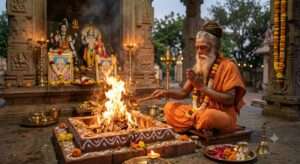
This principle of reciprocity offers an important response to the growing tendency to treat relationships, natural resources, and social institutions merely as instruments of personal advantage. Every individual receives something from the world: nourishment from nature, education from society, knowledge from predecessors, protection from institutions, and support from family and community. These benefits generate responsibilities. To receive without acknowledging one’s obligations is to weaken the relationships upon which existence depends. To receive with gratitude and contribute in return is to participate consciously in the continuing yajna of life.
The ethical implications become especially clear when we consider the Vedic aspiration to speak for a hundred years. Human society possesses extraordinary means of communication, yet the expansion of communication has not necessarily produced a corresponding increase in wisdom. Words can enlighten, but they can also mislead. They can reconcile differences, but they can also intensify hostility. They can defend truth, but they can also manipulate public opinion. The true significance of speech lies not in its volume or reach, but in its integrity, relevance, and consequences.
The prayer may therefore be understood as an aspiration that speech should remain worthy of human dignity throughout life. Truth must not become an instrument of cruelty, and kindness must not become a pretext for concealing injustice. Responsible communication requires the courage to speak when silence would permit wrongdoing, the restraint to remain silent when words would cause needless harm, and the wisdom to distinguish disagreement from enmity. Constructive speech does not eliminate difficult truths; it presents them with clarity, proportion, and an awareness of their effects upon others.
Equally important is the aspiration to hear for a hundred years. Listening is not merely a passive activity but a discipline of intellectual humility. A person who listens sincerely acknowledges the possibility that personal knowledge may be incomplete. Listening allows experience to challenge prejudice, evidence to correct assumptions, and dialogue to reveal dimensions of a problem that individual reasoning may overlook. In family life, it strengthens affection; in institutions, it improves decisions; in public affairs, it creates the possibility of meaningful dialogue across differences.
A society that values speech but neglects listening becomes vulnerable to arrogance and division. Every individual seeks recognition, but few are willing to examine their own assumptions with equal seriousness. The discipline of listening moderates this imbalance. It enables people to distinguish between defending truth and defending ego, between correcting an error and humiliating a person, and between principled disagreement and personal hostility. In this sense, listening itself becomes an offering made to the shared pursuit of understanding.
The expression adīnāḥ syāma deepens the prayer by invoking the aspiration to remain undiminished in spirit. Life inevitably brings changes in health, fortune, relationships, professional circumstances, and social standing. No person can control every external event, but individuals can cultivate the qualities that influence their response to adversity. Emotional resilience, intellectual flexibility, ethical discipline, and the willingness to learn from experience help preserve dignity when circumstances become difficult.
Such resilience should not be confused with stubbornness. A strong person is not one who refuses to reconsider a position, but one who can acknowledge error without surrendering self-respect. Wisdom requires the capacity to distinguish conviction from inflexibility, patience from passivity, and acceptance from resignation. A long life becomes fruitful when experience develops discernment and when difficulties become opportunities for deeper understanding rather than sources of permanent bitterness.
The Upanishadic emphasis on inner transformation is therefore directly relevant to contemporary psychological and social life. Human beings often react to circumstances through habitual patterns of desire, fear, resentment, comparison, and attachment. Unless these patterns are examined, external success may coexist with inner dissatisfaction. The accumulation of wealth, recognition, and authority cannot by itself guarantee peace of mind. When ambition becomes disconnected from ethical reflection, achievement may intensify insecurity rather than resolve it.
Meditation provides one means of examining these patterns. By observing thoughts, emotions, and impulses without immediately surrendering to them, a person can gradually develop a greater capacity for considered action. Devotion, understood as reverence for a reality greater than the individual ego, can cultivate humility and gratitude. Self-inquiry encourages the examination of motives, while disciplined action translates understanding into conduct. Together, these practices can support a life that is more deliberate, balanced, and responsible.
The purpose of such inner work is not to withdraw from society or to escape the practical demands of existence. Its value lies in preparing the individual to participate more intelligently in the world. A person who recognises the limits of personal knowledge is more willing to learn. One who understands the consequences of selfishness is more likely to act fairly. One who has cultivated emotional steadiness is better equipped to respond to conflict without escalating it. Inner discipline becomes socially meaningful when it changes the manner in which people exercise their responsibilities.
The pursuit of peace must likewise be understood in this practical sense. Peace is not simply the absence of disagreement, nor does it demand the passive acceptance of injustice. It is the capacity to confront difficulties without becoming wholly governed by anger, fear, or the desire for revenge. A peaceful mind can still question authority, defend the vulnerable, correct institutional failures, and challenge falsehood. Indeed, such action becomes more effective when guided by discernment rather than uncontrolled agitation.
The social value of this approach becomes evident in every sphere of collective life. Families require understanding and mutual respect. Educational institutions require intellectual honesty and a commitment to inquiry. Organisations require accountability and fairness. Governments require responsibility towards citizens. Economic activity requires recognition that prosperity cannot remain sustainable when the rights and dignity of others are disregarded. The yajna of conscious living is therefore not an abstract spiritual ideal detached from social realities; it is an ethical framework through which daily conduct can strengthen the institutions and relationships upon which human welfare depends.
The ancient aspiration to live for a hundred years can thus be interpreted as a comprehensive philosophy of lifelong responsibility. It asks that perception should remain open to truth, hearing receptive to wisdom, speech committed to constructive purpose, and the mind resilient amid changing circumstances. It encourages the individual to recognise that life is sustained by relationships extending far beyond personal boundaries. The individual is neither entirely independent of the world nor merely an insignificant fragment within it. Human life acquires meaning through the relationship between personal development and participation in the larger order of existence.
This understanding also gives a deeper meaning to the idea of fulfilment. Fulfilment cannot be measured exclusively by the duration of life, the accumulation of possessions, or the achievement of social recognition. It must also be evaluated through the quality of relationships maintained, the integrity of decisions made, the knowledge acquired, the suffering alleviated, and the opportunities created for others. A life that has contributed to the growth of understanding and the welfare of society leaves a legacy that may continue long after its individual duration has ended.
The Vedic prayer does not demand that every person perform extraordinary deeds. It invites each person to bring greater awareness to ordinary responsibilities. A parent who guides a child with patience, a professional who refuses to compromise integrity, a citizen who respects another’s rights, and a teacher who encourages independent thought may all participate in the same moral enterprise. Their contributions differ in scale and form, but their underlying principle remains the same: individual capabilities acquire a higher purpose when exercised with consciousness and responsibility.
The enduring message of the Upanishadic vision is therefore that spirituality and reason need not stand in opposition. Spiritual inquiry can deepen ethical awareness, while rational analysis can protect spiritual interpretation from confusion and exaggeration. Devotion can cultivate humility, while critical thinking tests assumptions. Meditation can develop self-awareness, while responsible action demonstrates whether that awareness has become part of one’s character. The integration of these dimensions offers a more complete approach to human development than either unexamined belief or knowledge detached from moral purpose.
Ultimately, the yajna of conscious living asks each person to become an active participant in the continuity of life. It calls for the transformation of desire into discernment, knowledge into wisdom, privilege into responsibility, and individual success into social contribution. The sacredness of existence is expressed not merely through ceremonial observance but through the manner in which people treat one another, use natural resources, pursue knowledge, fulfil obligations, and respond to suffering.
The ancient prayer may therefore continue to guide humanity through every stage of life: may our eyes behold what is true and beautiful; may our ears remain open to wisdom; may our words illuminate rather than obscure; may our minds retain courage and flexibility; may our actions strengthen the common good; and may our years be filled with awareness rather than merely counted in time.
When existence is approached in this spirit, life itself becomes the altar, consciousness becomes the sacred fire, knowledge becomes the illumination, and responsible action becomes the offering. Every relationship provides an opportunity for understanding; every duty offers an occasion for integrity; every difficulty invites reflection; and every achievement carries an obligation to contribute beyond oneself.
The highest expression of yajna is thus not confined to what is surrendered in a ritual, but is revealed in what the individual is willing to transform within the self for the welfare of the larger world. To live consciously is to recognise that receiving and giving are inseparable, that freedom and responsibility must develop together, and that inner fulfilment becomes most meaningful when it enriches the lives of others.
This is the enduring wisdom of the Vedic aspiration and the Upanishadic vision: to live long, but also to live wisely; to acquire knowledge, but remain humble; to speak with conviction, but listen with openness; to pursue fulfilment, but never forget responsibility; and to transform the ordinary journey of existence into a continuous yajna dedicated to the harmony and welfare of all.

