



अयनेषु च सर्वेषु यथाभागमवस्थिताः ।
भीष्ममेवाभिरक्षन्तु भवन्तः सर्व एव हि ॥
Having surveyed the two armies standing ready for the great war, Duryodhana once again reveals the state of his mind. He has already assessed the strength of the Pandava forces and the formidable warriors assembled on his own side. Yet, beneath his outward confidence, there is an unmistakable sense of apprehension. The immense army gathered under his command is not a single, homogeneous force. It consists of kings, princes, warriors, and contingents from different kingdoms, tribes, and traditions, each with its own loyalties, methods of warfare, and individual ambitions. Numbers alone, therefore, cannot guarantee victory. An army becomes powerful only when its diverse elements act with unity, discipline and a common strategic purpose.
Duryodhana now attempts to rise above his momentary confusion and assumes the authority expected of a king and commander. His words cease to be merely an expression of anxiety and become an instruction to those who command the various divisions. He tells them to remain in their appointed positions and fight according to the battle plan. Above all, he commands them to protect Bhishma, the grandsire and supreme commander of the Kaurava forces.
The instruction to protect Bhishma has a significance far greater than a mere military order. Bhishma is not simply another warrior in the Kaurava army. He is the eldest patriarch of the Kuru dynasty, a warrior of extraordinary experience and a figure whose presence gives the entire Kaurava host psychological strength. His reputation, discipline and authority bind together many of the otherwise diverse elements of Duryodhana’s army. As long as Bhishma stands firmly at the centre of the battlefield, the Kaurava forces possess a powerful symbol of continuity, command and confidence.
Duryodhana therefore understands, perhaps instinctively, that the security of Bhishma is closely connected with the stability of his own army. If the supreme commander is protected, the different divisions can continue to operate under a common command. If he is isolated or seriously threatened, confusion may spread rapidly through the ranks. His order is consequently based on an important principle of warfare: the protection of the central command is essential for maintaining coordination among separate units.
The verse also reveals the difference between numerical strength and organised strength. Duryodhana possesses an enormous military force, but an army composed of many independent rulers and contingents cannot automatically function as one disciplined instrument. Every commander may possess courage, but courage without coordination can become disorder. Every warrior may possess skill, but individual skill without a unified objective cannot necessarily produce victory. Strategy transforms scattered strength into collective power.
This is why Duryodhana asks the commanders to remain attentive to their respective positions and simultaneously directs them towards a single responsibility—the protection of Bhishma. The instruction creates a centre around which the various formations can operate. In modern strategic language, it is an attempt to preserve command integrity and operational coordination. In the Mahabharata’s deeper vision, however, it also becomes a revelation of the fragility that can exist beneath an imposing external structure.
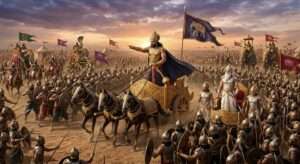
There is an irony in Duryodhana’s command. He has the larger army, many celebrated warriors and the support of powerful kings, yet he feels compelled to remind them to protect their own commander. The very necessity of such an order suggests that outward abundance does not necessarily produce inner security. The Kaurava army may appear vast and invincible, but Duryodhana knows that its strength depends upon the cooperation of many different forces.
Bhishma himself represents another profound dimension of the Mahabharata. He is bound by his vow and by his loyalty to the throne of Hastinapura, even though the moral circumstances surrounding the conflict are deeply complex. His presence on the Kaurava side demonstrates how duty, loyalty and righteousness can become entangled in the affairs of human beings. The epic does not present every warrior as a simple embodiment of good or evil. Instead, it portrays individuals caught between competing obligations, allowing the battlefield to become a field of moral as well as military conflict.
Duryodhana’s words therefore carry an importance beyond battlefield strategy. He is trying to impose order upon circumstances that are already moving towards an enormous confrontation. His command reflects the practical wisdom that discipline must precede action. An army cannot wait for disorder to appear before attempting to control it. Unity must be consciously maintained before the pressure of battle begins to break its structure.
Yet the deeper irony of the scene is that the greatest battle of the Mahabharata is not merely between two armies. It is also a confrontation between different understandings of duty, justice, attachment and power. The battlefield becomes the outward expression of conflicts that have developed within the Kuru family over many years. Duryodhana can arrange formations, issue commands and protect his commander, but no military strategy can resolve the moral disorder that lies beneath the war.
Thus, this verse marks a significant moment before the teaching of the Gita unfolds. Duryodhana is concerned with protecting Bhishma and organising his forces, while Arjuna will soon be overwhelmed by the deeper human consequences of fighting his own relatives, teachers and elders. One is concerned with the external discipline of an army; the other is about to confront the internal crisis of the human soul. The contrast prepares the ground for Krishna’s revelation that true order cannot be achieved merely by controlling circumstances outside oneself.
The battlefield at Kurukshetra therefore becomes a profound metaphor. Duryodhana seeks security through numbers, command and military coordination. Krishna will eventually teach Arjuna to seek clarity through knowledge, disciplined action, detachment and understanding of the Self. The former attempts to organise an army; the latter seeks to restore order within a human being. In that contrast lies one of the enduring strengths of the Gita: the external battle becomes the doorway to an eternal inquiry into how a person should act when duty, affection, fear and conscience appear to stand against one another.

