



Each Independence Day is a reminder to reflect on our nation’s path to the past and contemplate its future. It is my belated attempt to remember some of the changes that Bharat has undergone in the last 80 years of independence. The shift has not just been seen in our economy, our cities, or technology; it’s also been seen in the aspirations, confidence, and outlook of ordinary Indians. The Bharat of today is very different from the “Bharat” that emerged from colonial rule in 1947.
Economically, the most obvious difference is that. Post-Independence, the initial decades were characterized by scarcity, opportunities were limited, and there was the difficulty of providing basic needs to a huge population. Bharat is now one of the world’s great economic powers; modern industries, growing infrastructure, and a new spirit of entrepreneurship, and young people are ambitious. Places and people are closer together thanks to roads, airports, metros, digital networks and better connectivity. A young person can study online, work for a company in another city and even run a business that provides services to people all over the country. It would have been hard to imagine for previous generations what such possibilities would be.
Perhaps technology is the biggest contributor to this change. The mobile phone is no longer just a means of communication. It is a bank, classroom, marketplace, office and source of information. Online payments have revolutionized our daily lives, and numerous public services are available online. Technology has made India more connected and more democratic about information and opportunity, in many ways. But the true indicator of progress is not technology; it is how technology affects the lives of the common man.
The self-confidence of Indians and their nation too has undergone an amazing transformation. A few generations back, there was a general feeling of admiration, and at times of inferiority towards the West. Today, our youth feel that they are able to compare themselves to the best of the world. Indian citizens in the fields of science & technology, entrepreneurship, profession, art & sports are making a mark abroad. Concurrently, the revival of the culture, languages, traditions, and history of India. The idea of modernity and rootedness are no longer juxtaposed.
As we advance, though, our contradictions haven’t gone away. We have world-class airports and digital infrastructure, but some communities are still facing challenges in health, education and sanitation. We have great businesses and skilled staff, and still millions of young people are looking for a stable and productive job. As cities grow, many are beset with pollution, congestion and poor urban planning. Economic growth has brought about tremendous opportunities, but not all citizens are equally benefiting.
It is here that balanced criticism is crucial. It is not possible to love one’s country without being aware of the drawbacks of that country. Indeed, true patriotism ought to make us brave enough to confess what ought to be changed. Disagreement and criticism should be tolerated in a strong democracy. National interest must not be limited to economic growth, military force and international power. It also should involve social harmony, robust institutions, equal opportunity, dignity for all citizens and trust in democratic processes. If the country has a future, it should be confident enough to accept difficult questions.
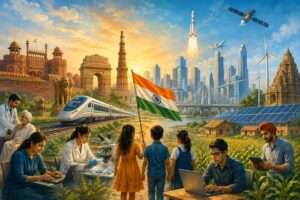
It is a unique concept of Bharat in our eyes as well. Bharat is not only a political entity of the modern era but a civilization with a multi-thousand-year-old history, different traditions, languages, philosophies and cultural influences. It has always been its virtue to accept diversity without requiring uniformity. The task that lies before us is to maintain this civilisational character while at the same time accepting the possibilities of the fast-changing world. There should be a balance between AI, advanced technologies and cultural roots. Modern cities should be built, but with community feeling. There is a need for us to be more integrated into the world, but not insecure about our culture.
Bharat’s greatest success as an independent nation was that it survived and developed a democracy. So far, a nation this diverse, with its people speaking different languages and of different religions, geographic origins, communities and economic status has been able to work out its differences within a constitutional structure. Disagreements can be a strength, despite this being a far from perfect democracy. It could be a sign of a people still debating about the future of their society. The task is to ensure that our differences are not converted into divisions and political competition does not run down the concept of India.
Our next step on the journey will involve our need to consider beyond impressive numbers and visible infrastructure. The Bharat of tomorrow will be judged by the quality of its education, employment, healthcare and environment. There is a need to provide opportunities for our youth, increase the involvement of women in the economy, strengthen the quality of public institutions and promote inclusive development. Demographic dividend will prove to be a boon to us if all the young Indians have equal chances of learning, working and contributing.
Looking at Bharat at 80, I see a country that has come a long way. We have emerged from a newly independent country where poverty and scarcity were problems to a country with significant economic, technological and strategic capabilities. But the road is not yet ended. The next challenge is to become not just richer, more powerful, but also fairer, more cohesive and more confident.
We have been granted political freedom by our forebears. Our job is to provide more opportunity and a sense of belonging to the next generation. We need to create a prosperous Bharat without being indifferent, powerful without being arrogant, modern without losing our roots, and diverse without being divided. The 80th Independence Day should, therefore, be one of celebration of our progress and one of a reminder that we still have a long way to go. Bharat we get is the product of our sacrifice and efforts for generations. The Bharat that we leave behind will be the criterion by which our contribution will be measured.

