



(Continued……. _) Connection between the Harappan and Vedic traditions
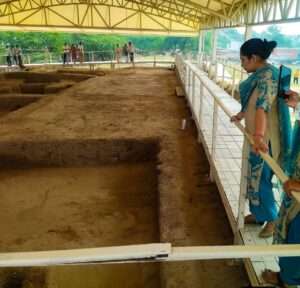
A significant question in Indian history is the relationship between the Harappan civilization and Vedic traditions. Ritual structures, fire pits, and other archaeological remains from various Harappan sites, including Rakhigarhi, have been interpreted in this context. Archaeological accounts from Rakhigarhi also mention structures such as fire altars or fire pits.
However, the mere size of a structure or its possible connection to fire is not sufficient to establish that the same Vedic sacrifices described in later Vedic literature were performed there. This requires an analysis of the structure’s design, associated objects, the dating of the remains, and comparative archaeological evidence.
While studying the possible connections between the Harappan civilization and Vedic traditions is important, it must remain open to the possibilities of both continuity and change. Civilizations do not simply remain the same; they evolve through contact, exchange, local innovation, and changing social conditions over time. Therefore, to understand the historical journey of Indian civilization, it is neither appropriate to consider all traditions completely unrelated nor to declare them completely similar without sufficient evidence.
Dialogue between folk memory and history
Local memories and folklore associated with Rakhigarhi are also part of the site’s cultural identity. Folktales associated with place names, ancient events, or historical figures are passed down from generation to generation. They reveal the local communities’ collective memory, emotional attachments, and ways of understanding the past.
Interpretations linking Rakhigarhi’s name to legends such as the widows of soldiers killed in the Mahabharata War settling here should also be viewed in this context. Such a story would require independent archaeological, epigraphic, or other reliable evidence to be historically substantiated. Until such evidence is available, it should be presented as local folklore rather than established historical fact.
This does not mean dismissing folklore as unimportant. Folk memory is an important means of understanding a society’s cultural experiences and its relationship to the past. The only requirement is to clearly distinguish between historical evidence and folk belief. When both are studied in a balanced way, history becomes more comprehensive and more sensitive to society’s experiences.
The need to bring women to the center of history writing
The most important question raised by the study of Rakhigarhi is how women should be placed in history. For a long time, the mainstream narrative of history focused primarily on dynasties, wars, rulers, and political institutions. Women’s roles in daily life, domestic labor, craft production, childrearing, social relationships, and the formation of cultural traditions received relatively little attention.
Gender-centered historiography attempts to address this imbalance. Its aim is not simply to establish women in stories of glory, but to conduct an evidence-based study of their real-life conditions, rights, labor, social status, and cultural contributions. In this regard, the collaboration of archaeology with anthropology, sociology, genetics, art history, and environmental studies can be crucial.
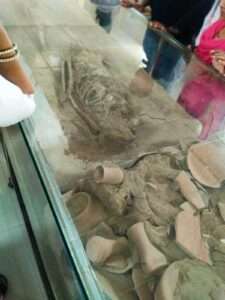
The human remains, jewelry, residential structures, and artifacts found at sites like Rakhigarhi provide a useful basis in this direction. Future research can help understand the division of labor between men and women in ancient communities, the differences in their access to resources, and the foundations on which social identities were formed. Answering these questions requires ongoing research, but incorporating them into the study of history is a necessary step in itself.
Conservation, research and educational responsibilities
Rakhigarhi is not just a relic of the past, but an important source of knowledge for the present and the future. Its conservation, scientific excavation, and systematic documentation are essential. Archaeological sites should be integrated into research, education, and the participation of local communities, rather than simply being developed as tourist attractions.
To achieve this, scientific preservation of excavations, digital archiving, study facilities for researchers, and providing evidence-based information to the general public will be useful. Engaging local women, youth, teachers, and other community members in heritage conservation efforts can establish meaningful connections between archaeology and public life.
When teaching history in schools and universities, students should be taught to analyze evidence rather than simply memorizing ready-made conclusions. The example of Rakhigarhi can help explain how archaeological artifacts are interpreted, the limitations of scientific findings, and why historical assumptions need to be re-evaluated when new evidence is discovered. Including women’s experiences, labor, and contributions in the curriculum should also be part of this process.
Rakhigarhi is an important center for understanding the ancient history of the Indian subcontinent. The planned settlement, artifacts, jewelry, human remains, and genetic studies found here provide new insights into the social and cultural life of the Harappan civilization. In particular, the female remains and associated artifacts have expanded the possibilities for research into the lives of ancient women.
However, it would not be appropriate to definitively declare Harappan society to be matriarchal or entirely female-centered based on the available evidence. Nor can a single woman’s DNA study definitively resolve all controversies related to Aryan migration, language, or cultural continuity. A scientific approach to history demands that we respect the available evidence, acknowledge its limitations, and allow room for new research.
Yet Rakhigarhi points us in an important direction. The story of civilization is not just about kings and cities; it is also about the women whose lives, labor, and cultural experiences are preserved in the soil today. Their bangles, objects associated with their burial rituals, and the artistic traditions of their time inspire us to view the past with a more humane and inclusive perspective.
The true significance of Rakhigarhi lies not in proving any predetermined historical conclusion, but in raising new questions and seeking answers based on evidence. Only when women are recognized in history writing not as mere symbols but as independent subjects of study will the picture of our civilization become more complete. Rakhigarhi is an opportunity for this rereading—an opportunity to explore the lives, culture, and contributions of women from among the layers of the past. (Concluded)


