



Sri Ramanuja stands in the spiritual history of India as a teacher who transformed philosophy from an abstract intellectual pursuit into a living discipline of devotion, service and compassion. His interpretation of Viśiṣṭādvaita did not merely seek to explain the relationship between the individual soul and the Supreme; it also showed how that understanding could shape human conduct. For Ramanuja, devotion was not an escape from life. It was a way of living in which knowledge became humility, faith became service, and love of God became love expressed through action.
Among his distinguished disciples were Dasarathi and Kuresa, both celebrated for their extraordinary loyalty to their teacher. Their devotion was not founded on blind obedience. It arose from a deep conviction that the spiritual path entrusted to them had to be protected through courage, sacrifice and righteousness. Their lives demonstrate an important principle: a true disciple does not merely listen to the words of a guru; he absorbs the values embodied by the guru and stands firm when those values are tested.
According to the traditional accounts, during the period when Vaishnava devotion was flourishing, the Chola ruler Krimikanta was strongly committed to Shaivism and is remembered in Vaishnava tradition as being hostile towards Ramanuja and his followers. The king sought to compel Ramanuja to appear before him. His intention, as preserved in the traditional narrative, was not simply to engage in theological discussion but to challenge the spiritual authority of Ramanuja and suppress the influence of Vaishnavism.
Ramanuja was revered by his followers as an embodiment of Adisesha, the eternal servant of Lord Vishnu. Such reverence was not merely a theological description; it expressed the extraordinary moral and spiritual strength that his disciples perceived in him. His authority did not arise from political power or material wealth. It came from conviction, learning, discipline and an unwavering commitment to devotion. The king could command soldiers, but Ramanuja commanded the hearts of those who believed in him.
When the royal soldiers arrived at the monastery at Srirangam with instructions to take Ramanuja to the king, they found that he was away. Kuresa and Dasarathi immediately understood the danger. They realized that their teacher could be exposed to grave peril if he were brought before the ruler. Their response reveals the depth of their devotion. Rather than allowing their guru to face the danger, they resolved to protect him through their own sacrifice.
Kuresa decided to go to the royal court disguised as Ramanuja, while arrangements were made for the real Ramanuja to remain beyond the reach of the king. In this decision, Kuresa displayed a rare combination of courage, intelligence and selflessness. He did not consider what might happen to himself. His only concern was that the spiritual mission of his teacher should continue unhindered.
At the royal court, in the presence of scholars and officials, the king demanded that Kuresa, whom he believed to be Ramanuja, acknowledge the supremacy of Shiva in terms contrary to his Vaishnava faith. Kuresa refused to surrender his conviction merely to preserve his physical safety. His response, preserved in traditional accounts, was expressed through a metaphor comparing the greatness of Shiva to the relationship between a large vessel and a small measure of grain. The scholars understood the implication and the king became enraged.
The punishment that followed was brutal. Kuresa was deprived of his physical sight. Yet the traditional account gives this moment an extraordinary spiritual dimension. Kuresa did not respond with hatred or curses. Instead, he is remembered as acknowledging the soldiers as instruments carrying out their orders and even addressing them with words of goodwill. His response transforms an episode of violence into a meditation on inner freedom.
The significance of Kuresa’s reaction lies in the distinction between physical sight and spiritual vision. The eyes can reveal the changing forms of the world, but spiritual wisdom seeks that which does not change. Having lost his physical eyes, Kuresa is portrayed as discovering a deeper vision in which the presence of God became more immediate than the objects perceived through the senses. The story therefore asks a profound question: what does it mean truly to see? Is sight merely the ability to observe forms, or can blindness to worldly appearances sometimes lead the mind towards a deeper perception of the divine?
Kuresa’s conduct also demonstrates that devotion, in its highest form, does not produce hatred towards those who oppose it. His physical suffering could have produced anger and revenge, yet the traditional narrative portrays him responding with compassion. This is perhaps one of the most powerful social lessons of the story. Religious conviction becomes spiritually meaningful only when it is accompanied by self-control. A person who protects his faith by destroying his humanity has preserved an argument but lost its moral essence. Kuresa, by contrast, preserved both conviction and compassion.
After the departure of Ramanuja from Srirangam, Dasarathi carried forward the responsibilities of the spiritual community. Ramanuja himself continued his daily religious observances and his association with his disciples. His life remained an example of disciplined simplicity: learning was accompanied by worship, worship by service, and service by concern for the spiritual welfare of ordinary people.
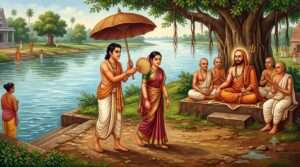
It was during this period that another remarkable episode entered the tradition surrounding Ramanuja. While going towards the River Kaveri with his disciples, Ramanuja repeatedly noticed a young man walking beside a beautiful woman. The young man held an umbrella over her to protect her from the sun and used a fan to keep her cool. His attention remained completely fixed upon her comfort. He walked with care, ensuring that neither the heat nor the wind disturbed her.
The young man was Dhanurdasa, and the woman was his beloved wife. Ramanuja was intrigued by the intensity of his attachment. One day, he asked Dhanurdasa about it. Dhanurdasa explained that he was captivated by the beauty of his wife’s eyes and considered them incomparable. For him, her eyes were the centre of his affection and the source of his happiness. His devotion to her beauty had become so complete that he seemed to have forgotten everything else.
Ramanuja did not ridicule this attachment. This is one of the most subtle aspects of the story. A lesser teacher might have condemned Dhanurdasa’s attraction as worldly and attempted to suppress it. Ramanuja instead recognized that love itself possesses enormous spiritual energy. The question was not whether Dhanurdasa could love deeply; clearly, he could. The question was where that extraordinary capacity for love should ultimately be directed.
Ramanuja therefore approached Dhanurdasa with understanding rather than condemnation. He did not attempt to destroy the man’s love. Instead, he sought to widen it. He asked Dhanurdasa whether he would be willing to behold eyes even more beautiful than those which had captured his heart. Dhanurdasa naturally found the proposition difficult to believe. To him, his wife’s eyes were incomparable.
Ramanuja then introduced him to the divine beauty of Lord Ranganatha. He invited Dhanurdasa and his wife to the temple at Srirangam and directed their attention towards the majestic eyes of the deity. In the traditional telling, Dhanurdasa encountered a beauty that transcended the limitations of physical attraction. The eyes that he had worshipped in his wife had been, for him, an expression of beauty; now he was invited to perceive the source of beauty itself in the divine.
This transformation is philosophically significant. Ramanuja did not teach Dhanurdasa to reject love; he taught him to see its deeper possibility. Human affection can remain confined to possession, attraction and personal gratification, or it can become a doorway to reverence, service and spiritual realization. The same emotional energy that once centred entirely upon one person could now be expanded towards the divine and, through the divine, towards all beings.
Dhanurdasa and his wife became devoted followers of Ranganatha. Their transformation illustrates one of Ramanuja’s most enduring insights: spiritual teaching succeeds not by violently suppressing human nature but by refining and redirecting it. Desire can become devotion; attachment can become dedication; admiration for beauty can become contemplation of the source of beauty.
The two episodes—the sacrifice of Kuresa and the transformation of Dhanurdasa—appear different, yet they illuminate the same principle. Kuresa demonstrates the strength required to remain faithful when devotion is threatened by external power. Dhanurdasa demonstrates the transformation possible when devotion enters the human heart through love. One story is about protecting faith; the other is about elevating love. Together they reveal that spirituality is neither weakness nor withdrawal from life. It is the disciplined refinement of the human personality.
The social significance of these narratives extends beyond the historical or religious setting in which they are preserved. A society requires guiding lights not merely because people need doctrines, but because they need examples of how principles can be lived. Ramanuja represents the teacher who converts philosophy into conduct. Kuresa represents fidelity under suffering. Dhanurdasa represents the possibility of inner transformation. Dasarathi represents continuity of service and responsibility.
Their stories also offer a valuable lesson for a plural society. Genuine spiritual conviction need not depend upon hatred of another person’s belief. Kuresa’s firmness did not require him to abandon compassion. Ramanuja’s teaching did not require him to humiliate Dhanurdasa for his worldly attachment. Instead, the deeper method was persuasion through understanding, transformation through love and steadfastness through moral courage.
The enduring power of Ramanuja’s tradition therefore lies not only in its theological doctrines but also in its vision of human character. Knowledge without devotion can become sterile; devotion without moral discipline can become emotional; power without compassion can become oppressive; and love without spiritual direction can remain confined to the self. Ramanuja’s life and the lives of his disciples bring these elements together into a coherent ideal—knowledge illumined by devotion, devotion expressed through service, and service sustained by compassion.
The guiding lights of society are not always those who occupy positions of worldly authority. They are often those who, through their conduct, show others how to remain truthful in adversity, compassionate in conflict and humble in the presence of greatness. Ramanuja, Kuresa, Dasarathi and Dhanurdasa live in this tradition as figures through whom philosophy becomes human experience. Their stories remind us that the highest form of devotion is not merely to speak about God, but to allow one’s relationship with the Divine to transform the way one sees, loves, serves and lives in the world.

