
धृष्टकेतुश्चेकितानः काशिराजश्च वीर्यवान्।
पुरुजित्कुन्तिभोजश्च शैब्यश्च नरपुङ्गवः॥
Duryodhana continued his introduction of the warriors assembled on the opposing side before his preceptor Dronacharya. His words appear, on the surface, to be a simple enumeration of the principal warriors of the Pandava army. Yet, when examined against the larger historical and psychological setting of the Kurukshetra battlefield, this enumeration reveals a deeper movement within Duryodhana’s mind. He was not merely providing information to his teacher; he was attempting to interpret the strength of the enemy while simultaneously reassuring himself about the impending confrontation.
The warriors whom Duryodhana names were not insignificant figures. Dhṛṣṭaketu was a prominent ruler associated with the Chedi kingdom and a committed ally of the Pandavas. His presence represented not merely the strength of an individual warrior but the political and military support of an important kingdom. Chekitana was another distinguished warrior among the Pandava allies, known for his courage and martial ability. The mention of the king of Kashi was equally significant, because Kashi had long been associated in the epic tradition with powerful rulers and accomplished warriors. By calling him viryavan, Duryodhana explicitly acknowledges his exceptional valour.
He then mentions Purujit and Kuntibhoja, whose names carry a special dynastic significance. Kuntibhoja was connected with Kunti’s family and therefore with the larger familial network surrounding the Pandavas. Purujit too belonged to the circle of their powerful supporters. Their presence on the Pandava side demonstrates that the conflict at Kurukshetra had grown far beyond a disagreement between two branches of one royal family. Through alliances, marriages, dynastic relationships and political commitments, the dispute had gradually drawn numerous kingdoms into its orbit.
Finally, Duryodhana refers to Shaibya as narapungava—a foremost among men. The expression is important. His choice of words indicates that Duryodhana was fully conscious of the stature of the warriors standing against him. He could not dismiss the opposing army as weak or inexperienced. He knew that the Pandava forces contained seasoned rulers, accomplished commanders and warriors whose courage could not be taken lightly.
This makes the psychological dimension of Duryodhana’s speech particularly significant. His words are addressed to Dronacharya, an almost incomparable authority in the science of warfare and the martial education of the Kuru princes. Dronacharya was not merely a teacher standing on the battlefield; he was the preceptor who had trained both the Kauravas and the Pandavas in the arts of combat. Duryodhana therefore knew that his teacher understood the capabilities of these warriors perhaps more deeply than anyone else present. His enumeration could not conceal reality from Drona. Instead, it brought that reality directly before him.
The sequence of Duryodhana’s speech also reveals an interesting tension. He speaks confidently, but the very necessity of emphasizing the strength and distinction of the opposing warriors suggests that the Pandava army has entered his consciousness as a serious threat. His confidence is therefore accompanied by apprehension. The two emotions coexist. Outwardly, he speaks like a prince preparing his commander for battle; inwardly, he appears to be measuring the magnitude of the challenge before him.
This distinction is important for understanding the Gita’s opening movement. The Bhagavad Gita does not begin with philosophical serenity. It begins amid uncertainty, ambition, fear, loyalty, rivalry, and the consequences of long-standing human choices. The battlefield becomes a visible representation of the conflicts that already exist within the minds of those assembled there. Duryodhana’s words are therefore more than military commentary. They reveal how a human mind behaves when circumstances begin to challenge its assumptions.
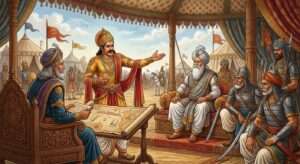
His address to Dronacharya may also be understood as an attempt to awaken the full martial consciousness of his preceptor. By naming the distinguished warriors individually, Duryodhana reminds Drona that the opposition is formidable and that the battle demands complete attention. At the same time, there is an implicit emotional appeal. Drona’s personal history with the Pandavas and his complex relationship with the Kuru dynasty were well known. Duryodhana was therefore speaking not only to a military teacher but to a man whose personal memories and obligations were deeply intertwined with the people standing on the other side.
The irony is profound. The same Drona who had trained Arjuna to become an extraordinary archer was now standing on the opposite side of the battlefield from his former disciple. The same royal house that had nurtured both branches of the family had become divided into opposing armies. The same knowledge of warfare that was once transmitted as a discipline for protecting dharma was now being placed at the service of a fratricidal conflict. The epic thus presents a tragic transformation: knowledge remains unchanged, but the purposes to which human beings put knowledge can alter its consequences completely.
Duryodhana’s reference to these warriors also demonstrates that military strength cannot be measured merely by numbers. Every named warrior carries behind him a kingdom, a lineage, a personal history and a network of loyalties. The Pandava army is therefore not simply a collection of soldiers. It represents accumulated political and familial support. The battlefield is the final expression of a conflict that has been developing through years of rivalry, humiliation, diplomacy, exile, broken agreements and competing claims to sovereignty.
At a deeper level, Duryodhana’s anxiety arises from something more fundamental than the physical strength of his opponents. He is confronting the consequences of decisions that have brought the Kuru family to this point. A person may possess enormous external power and still experience internal uncertainty when confronted by the consequences of his own choices. The epic repeatedly demonstrates this paradox. Material strength does not automatically produce inner security.
That is why this apparently simple verse becomes significant within the philosophical architecture of the Gita. Before Krishna speaks about the eternal Self, action, detachment and dharma, the narrative first exposes the human condition in its most vulnerable form. The battlefield is filled with mighty warriors, yet the atmosphere is not one of uncomplicated confidence. Behind armour and weapons stand human beings carrying memories, relationships, obligations and fears.
Duryodhana’s description of the Pandava warriors consequently serves two purposes. Historically, it identifies important members of the opposing alliance. Psychologically, it reveals the unsettled state of the speaker. He is compelled to acknowledge the excellence of those whom he must confront. His words therefore contain both recognition and resistance, knowledge and anxiety, confidence and uncertainty.
The great irony of the Gita is that the external armies are ready for war while the true philosophical battle has not yet begun. Duryodhana speaks about warriors, weapons and military strength; soon Arjuna will confront a far more profound crisis—the conflict between personal attachment and duty, between emotion and discernment, between immediate sorrow and eternal truth. Thus, the enumeration of warriors gradually prepares the ground for the transformation of the battlefield from a place of physical conflict into a field of spiritual inquiry.
In this sense, Duryodhana’s words before Dronacharya are an early mirror of the central teaching of the Gita. Human beings often see the world through the pressures of the moment. Fear magnifies danger, ambition magnifies victory, attachment magnifies loss, and anxiety can obscure the larger order of reality. The Gita ultimately invites the seeker to move beyond these fluctuating perceptions and discover the steadier ground of knowledge, duty and the eternal Self.
The warriors named in this verse therefore stand not merely as historical figures of the Kurukshetra war but as symbols within a larger epic structure. They represent the accumulated forces that surround every decisive human moment—alliances, obligations, memories, loyalties and consequences. Duryodhana sees them as opponents to be assessed. The Gita invites the reader to see something deeper: before the battle of weapons begins, every great human crisis is first fought within the consciousness of the individual.