Lakshmanrao Upadhyayula
The sage Viśvāmitra stands among the great seers of the Vedic age, offering prayers to many deities through the sacred metres of Triṣṭubh, Jagatī, Anuṣṭubh, Gāyatrī, and Bṛhatī. Each metre possesses its own rhythm and spiritual force, reflecting the cosmic order that governs the universe. His hymns reveal that divine worship is not confined to a single expression but embraces many forms, each harmonizing with the eternal cadence of creation. Through these sacred chants, the gods are invited not merely as celestial beings but as living participants in the sacred sacrifice that sustains the bond between heaven and earth.
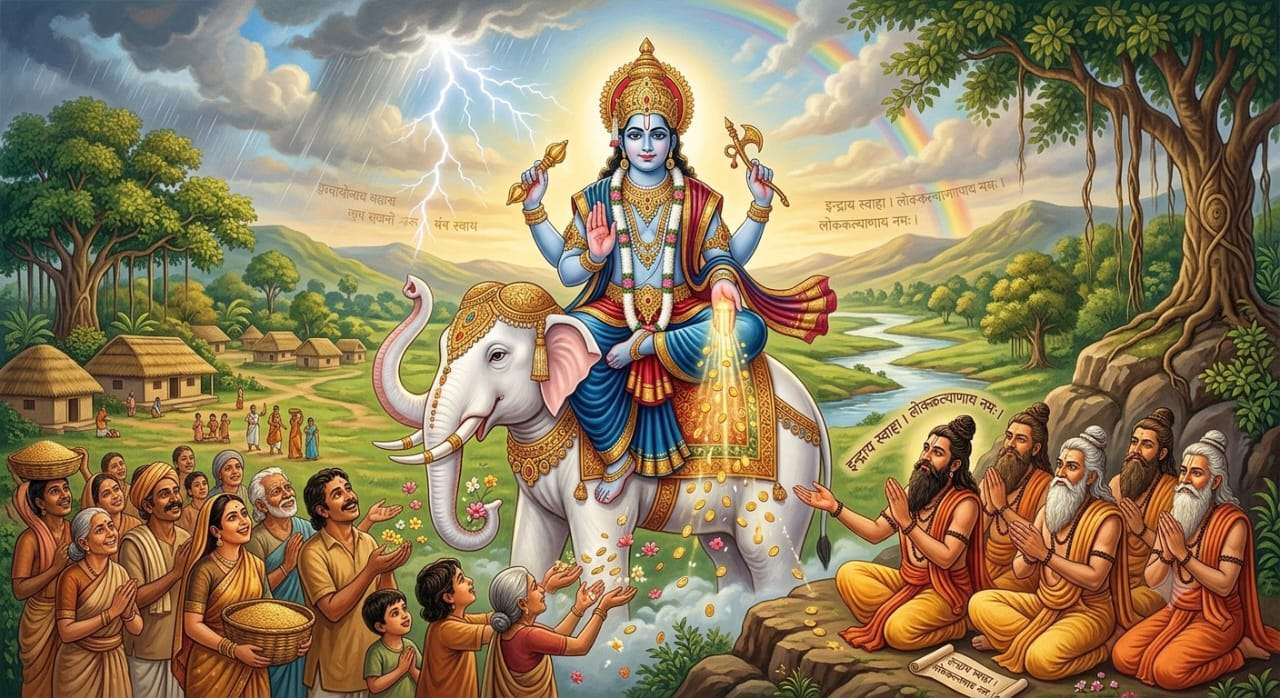
Viśvāmitra invokes Indra together with the mighty mountains, praying that they bestow nourishing, wholesome, and delightful food upon humanity. The mountains are revered as divine reservoirs of life, storing rivers, herbs, minerals, and fertile soils that sustain every creature. Their greatness symbolizes abundance, stability, and the hidden treasures of nature. Thus, Vedic thought recognizes that divine grace often manifests through the natural world, making creation itself an expression of sacred generosity.
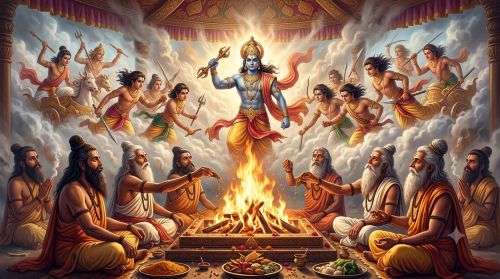
The radiant divine pair are invited upon their magnificent chariot to accept the offerings presented during the holy sacrifice. The seer prays that they be pleased with the sacred obligations performed according to eternal law and that they flourish through the recitation of the Vedic hymns. Worship in the Vedic tradition is understood as a reciprocal relationship in which devotion, gratitude, and righteousness strengthen the harmony between humanity and the divine powers.
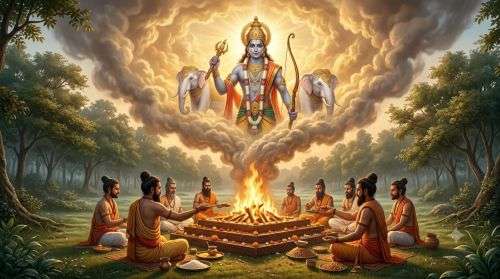
Viśvāmitra earnestly requests Indra to remain present throughout the yajña and not depart before its completion. The fragrant Soma, purified with meticulous care, is offered with reverence. The relationship between the worshipper and the deity is portrayed with tender affection, like a loving father holding the hands of his child with kindness and gentle words. Likewise, the priests symbolically hold the hand of Indra through their sacred chants, expressing complete trust, reverence, and spiritual intimacy.
The Adhvaryu priest addresses his fellow priest, inviting him into a dialogue governed by the rhythmic cadence of the cosmos. Every response must harmonize with the sacred order that permeates creation. The patron of the sacrifice is respectfully seated upon the holy kuśa grass, signifying humility before the divine. The hymns dedicated to Indra are intended not merely for ritual recitation but to gain enduring renown through their truth, purity, and spiritual power.
The household itself is presented as a sacred institution. The wife occupies the central place within the home, becoming the point where family, society, and spiritual duty converge. Vedic wisdom honours woman as the sustaining force of domestic harmony, recognizing her role in preserving lineage, nurturing life, and maintaining the continuity of sacred traditions. Women’s guardianship of the sacrificial enclosure further emphasizes the sanctity entrusted to feminine presence.
The horses yoked to the divine chariot are urged to carry Indra swiftly to the sacred precincts of the sacrifice. As the priests chant the hymns and offer Soma into the sacred fire, Agni, the divine messenger, carries these offerings to the heavenly realms. The yajña itself becomes Indra’s spiritual home, inviting him to turn toward it with delight. Both heaven and the sacrificial ground are equally auspicious because divine presence sanctifies every place dedicated to truth.
The Soma is prepared and awaits Indra’s arrival. The neighing horses are released, and the celestial king is invited to drink the sacred offering before returning to his heavenly abode, where melodious music and his beloved consort await him. Yet the seer lovingly requests him to remain a little longer at the sacrifice, emphasizing that divine presence is the greatest blessing bestowed upon the worshippers.
Viśvāmitra remembers the great sacrifice performed for King Sudās by the priests of the Bhoja people and the descendants of the Aṅgiras lineage, including Medhātithi and other revered sages. The Maruts are praised as surpassing even the celestial hosts in strength and vitality. Confident in the efficacy of his own spiritual realization, Viśvāmitra declares that they will bless his Aśvamedha sacrifice with prosperity, abundant food, and enduring wealth.
Indra is praised as the deity capable of assuming countless forms according to divine will. His manifestations are not restricted by appearance, place, or season. Although the Soma may be offered outside the ordinary cycle of seasons, the sincerity of devotion transcends temporal limitations. Once Indra arrives in response to heartfelt prayer, the three daily sacrificial observances attain their complete fulfillment within the eternal rhythm of sacred time.
Viśvāmitra is celebrated as a luminous seer whose brilliance arises from profound spiritual insight rather than worldly achievement. He serves as teacher to the Adhvaryu, the Ṛtvijas, and other priests. Tradition remembers that through the power of his austerity he restrained the torrential current of the Sindhu River, symbolizing mastery over both external nature and the inner forces of consciousness. During the sacrifice of Sudās, Indra is portrayed as especially affectionate toward the sages of the Kuśika lineage.
The descendants of Kuśika are exhorted to prepare the Soma with disciplined devotion. As the sacred stones press the Soma plant amid the chanting of mantras, the resonant sound is compared to the graceful singing of swans upon tranquil waters. This poetic image reveals the harmony between sacred ritual and the natural world, where every sound becomes an offering to the divine.
The sons of Kuśika are instructed to approach the sacrificial horse with reverence and inspiration. The Aśvamedha symbolizes not conquest for personal ambition but the disciplined sovereignty of righteousness. Indra, the slayer of Vṛtra, who removed the obstruction to the life-giving waters, is praised for securing victory in every direction. Therefore, Sudās is encouraged to perform the great sacrifice upon an elevated place, signifying the ascent of human consciousness toward higher truth.
Viśvāmitra proclaims that he has invoked Indra through both heaven and earth. The priest is entrusted with protecting the Bharata people through the continual recitation of hymns dedicated to the wielder of the thunderbolt. These sacred compositions are offered not for personal glory but for the prosperity, security, and moral strength of the community.
The seer distinguishes between cattle that sustain the sacred sacrifice and those unsuitable for producing the pure milk required for mixing with Soma. His prayer that Indra grant prosperous cattle and wealth from distant lands expresses the ancient aspiration for resources that support righteous living. Such passages should be understood within their historical context rather than as universal judgments upon any people, reflecting the social and ritual concerns of the early Vedic communities.
The divine Word is described as a radiant gift originating from the brilliance of the Sun, illuminating minds by removing ignorance. Sarasvatī, the daughter of the solar radiance and the embodiment of inspired speech, is invoked to provide nourishing food, wisdom, and eloquence surpassing mere sensory pleasure. Vāk, the sacred power of speech, becomes the bridge between divine knowledge and human understanding, sustaining civilization through truth.
The long-lived sage Jamadagni and other enlightened seers are remembered as transmitters of this divine Word. Guided by Vāk, they preserved the eternal wisdom that nourishes humanity just as fresh food sustains the body. In the Vedic vision, speech purified by truth possesses creative and transformative power, shaping both individual character and collective culture.
Following the completion of Sudās’ sacrifice, Viśvāmitra performs the Avabhṛtha, the ceremonial concluding bath that signifies purification and fulfillment. Before departing, he offers prayers even to the chariot and its many parts. The horses are asked to remain steady, the frame strong, the axle secure, the pole firm, and every component protected from failure. Such prayers reveal the Vedic recognition that material craftsmanship deserves reverence because every instrument employed in righteous action participates in sacred purpose.
The seer further prays that the chariot never abandon its riders nor become a source of harm. From the moment the horses are yoked until they are released, every stage of the journey is entrusted to divine protection. These verses demonstrate an early scientific temperament, expressing careful attention to engineering, structural stability, and practical safety while simultaneously acknowledging the sacredness of all human endeavour.
Indra is invoked as the heroic giver of strength, wealth, and secure dwelling. The worshippers pray that they may enjoy vigorous health, long life, and the blessing of children and grandchildren. Their prosperity is sought not merely for personal comfort but for the continuity of righteous generations who preserve sacred knowledge and uphold dharma.
The hymns also contain fervent prayers for victory over hostile forces. The downfall of enemies is described through vivid poetic imagery familiar to ancient warfare and ritual symbolism. Such expressions reflect the historical realities of tribal conflict and should be understood as literary metaphors arising from their age rather than as endorsements of personal hatred. Their deeper spiritual significance points toward the destruction of ignorance, falsehood, injustice, and every obstacle that opposes truth.
Certain verses reveal the tension between Viśvāmitra and the followers of Vasiṣṭha. Viśvāmitra emphasizes the formidable power of mantra born from austerity and suggests that true spiritual strength requires disciplined silence. He compares the superiority of spiritual excellence to the distinction between a noble horse and a humble donkey, illustrating the ancient use of symbolic comparison. These passages preserve memories of rivalry between distinguished priestly traditions while also revealing the human dimension present even among revered sages.
The Vedas themselves transcend the personalities of individual seers. Their wisdom reaches beyond ordinary human intellect and is regarded as eternal revelation perceived by enlightened consciousness rather than invented by human imagination. The ṛṣis are honoured as visionaries who realized truths already present within the fabric of existence. Like scientists discovering laws embedded in nature, they observed realities hidden from ordinary perception and faithfully transmitted them through sacred memory.
As history progressed, some later traditions began attributing authorship of hymns to particular sages. Viśvāmitra himself speaks proudly of his lineage and extols its greatness, at times expressing language that places himself alongside the gods. These declarations reveal the complexity of human personality within the sacred tradition, where profound spiritual attainment could still coexist with strong conviction, personal honour, and historical rivalry.
The narratives concerning Viśvāmitra and Vasiṣṭha remind readers that even exalted sages undertook long journeys toward complete detachment. Their disagreements do not diminish the divine authority of the Veda but rather illustrate the continuing refinement of human character through discipline, wisdom, and grace. The honoured place accorded to women, the reverence shown to mountains and rivers, the respect for skilled craftsmanship, and the integration of observation with spiritual insight collectively demonstrate the remarkable breadth of Vedic civilization.
Ultimately, the Veda shines as an eternal light guiding humanity toward harmony with the Divine, with nature, and with one another. It teaches that true knowledge is not the creation of the human mind alone but the realization of eternal principles woven into the universe by the Supreme Reality. The sages perceived these truths through disciplined contemplation and transmitted them for the welfare of all generations, leaving behind a timeless heritage in which spiritual realization and scientific curiosity stand together as complementary expressions of the quest for truth.