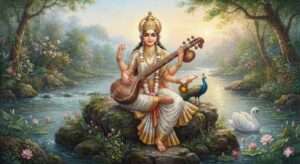
Bhaarati and Sarasvati
This is an article series. Please read all previous articles before reading this article. The URLs for all previous articles are located in the SPECIAL THOUGHTS section.
Previously, we had pondered over the Draupadi Vastra Apaharana attempt by Dushaasana. it had been mentioned about Draupadi’s gory vow to keep her hair untied until her hair was drenched by Dushaasana’s blood. This is apparently not in the original Mahaabhaarata composed by Shree Vedavyaasa. Apparently, Draupadi leaving her hair untied and vowing to wash it in the blood of Dushasana was created by the 8th-century Sanskrit playwright Bhatta Narayana. But yet, while Draupadi’s vow of drenching her hair with Dushaasana’s blood may’ve been introduced by the playwright out of emotional outburst, his sense of outrage over the humiliation that Draupadi was subjected to deserves appreciation. It is actually testimony for his sense of Dharma. On the other hand, despite the embellishment and exaggeration, the symbolism and philosophy behind untied hair that was mentioned is still valid. Let’s elaborate on the topic of hair little further.
The very first verse of Vishnu Sahasra Naama starts as “vishvam vishnur-vashatkaaro…”. When doing Pooja, in the step of offering Naivedya, the Mantra we chant has this line: “tvam yajnah tvam vashatkaarah”. The word/name to note is “Vashatkaara”. What does it mean? The hint lies in the hair. How? Well… read on…
Any time we chant any Mantra, we have been taught and recommended to do it with the following:
- Remembrance of the Rishi who gave us the Mantra, the Chandas of that Mantra and the Devata that the Mantra is in praise of
- Kara Nyaasa, which involves remembrance of Devata-s who are present in each of the 5 fingers, the front and back of the hand
- Anga Nyaasa, which involves remembrance of Devata-s in our Hrudaya (the core center of the chest), Shiras (the head) and Shikhaa (hair). This is the step where we usually say “Shikhaayai Vashat”. As you see… again, we see the word “Vashat”.
- Kavacha Dhaarana – to seek protection during the Mantra Japa and after
- To focus the eyes, we say “Netra trayaayai vashat”… again, we see the word “Vashat”
- To make the Mantra an Astra, we say “astraaya phat”
The very clear hint about the meaning of the word “Vashat” comes from “Netra trayaayai vashat,” which helps us to understand that “Vashat” refers to “focus”, which is the very purpose of any Japa or Dhyaana. Thus, the word “Vashatkaara” refers to Paramaatma as the one who bestows the focus necessary to attain him. Therefore, Vishnu Sahasra Naama starts with remembrance of Paramaatma as “Vashatkaara,” the bestower of focus. Similarly, offering of Naivedya too remembers Paramaatma as “Vashatkaara,” the bestower of focus.
Just like how “Vashat” refers to focus in the context of eyes, it refers to focus in the context of Shikhaa (hair) also. Even if we were to think of hair without any philosophical angle… let’s take the example of a lady surgeon performing surgery. Her untied hair flies around. It comes in front of the eyes, blocking the vision. Hair may fall into the open incision/cut, and there is a risk of surgeon sewing it back up with hair left inside. In case of chefs, there is risk of their hair falling into the food they are preparing. How would you feel when you see long hair fallen into the food you ordered at the restaurant? Hair can even catch fire very easily. One time, I saw a woman with untied hair bend forward and her hair locks came over the lamp flame. It immediately caught fire. This happened at the temple and she almost destroyed the entire Pooja setup while extinguishing the fire. Hair can also fly into a fan and can get stuck. The above are enough reasons to understand why long untied hair is a hazard. And spiritually, untied hair is an impediment for focusing.
All the above pondering about hair may sound excessive… but these nuances are necessary in spiritual pursuit. These nuances don’t matter to those who are not philosophically or spiritually inclined. But if you are philosophically or spiritually inclined, then you very rarely find someone delving into these nuances and explaining it to you compassionately. I’m grateful to the ones above for intuitively offering these nuances to me and to you through me. Hope you’ll take note and benefit from it. To sum it up, from a philosophical and spiritual angle:
- There is nothing good that occurs to me about leaving the hair untied. At best, untied hair is symbolic for a line of thought which is shallow with no commitment to seeking the truth and no effort invested in seeking rationalistic philosophy. And, at its worst untied hair is symbolic for “I don’t care” attitude with no inclination towards philosophy or spirituality.
- Tied hair is symbolic for focus on spiritual matters. It is also symbolic for a seeker’s effort to view all worldly matters in a spiritual way, observe the role played by the Devata-s in every worldly matter, learn and thereby enhance one’s sense of gratitude. This is especially true for women as they are very perceptive. Therefore, they are required to view worldly matters in a spiritual way so as to be able to guide the family in the path of Dharma. As explained earlier, Lakshmi Sannidhaana is at the Agra (tip) of everything, including the tip of women’s hair. Therefore, it is not appropriate for women to cut their hair as it amounts to throwing away the Lakshmi Sannidhaana present at the tip of their hair.
- Traditionally, a Braahmana has partially tonsured hair with a lock of hair kept long on the back side. This is to be taken as symbolic for his withdrawal from most worldly matters to focus on spiritual matters to connect the society with the spiritual world of the Devata-s
- And lastly, a Sanyaasi tonsures his entire head symbolically to convey his withdrawal from all worldly matters and focus entirely on spirituality. The same line of thought holds good for widows who wouldn’t pursue remarriage as well.
The above should help us understand why we say “Shikhaayai Vashat” before sitting down for Japa or Dhyaana.
Lastly, as had been mentioned earlier, yarn becomes cloth with some yarns placed parallel to each and other yarns going across perpendicularly. The criss-cross of is what makes yarn a cloth. This is the cultural “fabric” of society. This “fabric” protects us when it is intact. This is the symbolism behind offering cloth to Paramaatma and the Devata-s. And what we offer to the ones above is what we wear, and it protects us both physically and spiritually. But these days, wearing torn cloth has become fashionable. Torn jeans sell for a very high price in the stores. This is basically a reflection of the cultural fabric of the society itself being torn off gradually. We never offer torn cloths to Paramaatma and/or the Devata-s… because it symbolizes a torn society ridden with conflict. And therefore, it is not appropriate to wear torn cloths.
Another reason for not wearing torn cloths is that it tries to imitate a poor man. I’m reminded of this story I heard some time ago. Long ago, senior RSS leader Shree Nanaji Deshmukh had noticed that Shree Narendra Modi, who is currently the Prime Minister of Bharat, was walking barefoot. Shree Deshmukh gave Shree Modi two rupees specifically to purchase footwear. Weeks later, when Shree Deshmukh saw Shree Modi still without footwear, Shree Deshmukh asked Shree Modi why he hadn’t bought any footwear as suggested. To this Shree Modi explained that he had been without food for two days, so he decided that filling his stomach was a higher priority than protecting his feet. Learning from the above anecdote, we ought to realize that there are people in this world who have to choose between food and clothing and yet do their absolute best to live a life of honesty. One should avoid imitating their poverty, but rather see what he/she could do to help.
I had not anticipated the topic of Draupadi to stretch so elaborately into 4 parts. Let us consider this a great Anugraha of Shree Bhaarati Devi. Next, we’ll try to conclude the topic with a brief overview of Sarasvati, the Devata in Level 4, position 100.
Sarasvati
The word Sara refers to sliding or flowing movement. Thus, Sarasvati means someone who slides a Jeevaatma towards Moksha little by little. As had been mentioned earlier, Sarasvati and Bhaarati are Abhimaani Devata-s for Buddhi. If we can recollect from what we learnt while pondering over Shiva earlier, I had mentioned that what I find interesting about Buddhi is that creation of Buddhi (intellect) happens through Shiva, but the Abhimaani Devata for Buddhi is actually higher than Shiva, and by that I was referring to Sarasvati and Bhaarati who are in Level 4 in the Devataa hierarchy.
I’m reminded of a composition by the great Shree Purandara Daasa in praise of Sarasvati where he writes “kodu bega divya mati sarasvati” which means “bestow the enlightening intellect, O Sarasvati swiftly”. As has been mentioned many times earlier, Shree Krishna states in Bhagavad Gita “naasti buddhi: ayuktasya nacha ayuktasya bhaavanaa” (Chapter 2, Verse 66). Here, Buddhi pertains to rationale, and Bhaavana pertains to emotion and compassion. By default, masculine traits are more oriented towards Buddhi (rationale). Most of us think “Why pray to Sarasvati and beg for intellect when I’m already intelligent?”. This is especially true with men. Some men are always keep trying to prove how smart they are, be it through their language or their body language. For example, you may’ve seen a certain celebrity who is popularly known as “King of Bollywood”. If you observe him posing for pictures, he always frowns a certain way, which makes me think that he is trying very hard to keep a facial expression that shows off that he’s extremely smart.
Little do these men know that the Buddhi (intellect) that we are referring to is the “Saatvik Buddhi” which is adorned with 3 ornaments namely Yathaartha Jnyaana (resourceful knowledge about The Creator and his Creation), Nija Bhakti (reverence to That Creator) and Sad-Vairaagya (detached-attachment to the Lord’s Creation). This Saatvik rationale needed for spiritual upliftment is not a default. It needs to be earnt. Men ought to invest tremendous effort and time to become worthy of it and earn it. Only the deserving receive it, by the grace of Maataa Sarasvati Devi. In the absence of such effort by men in the family, the Saatvik Buddhi necessary for philosophical and spiritual guidance that family needs will not be there. This is a void that men, especially Hindu men, are creating in most (probably 75-80%) of Hindu families. Most men don’t realize the necessity of this Saatvik Buddhi their entire life. When the husband is lethargic about investing in “Saatvik Buddhi”, obviously… the wife has to pick this up as well. For example, when the husband is around, the wife will ask him to open the lid of a jar she needs for her cooking, but can’t get it open herself due to lack of forearm muscular strength. But when the husband is not available, but the jar still needs to be opened, she’ll do something to open the jar which may not be the best. Similarly, when the husband is not investing in building that “Saatvik Buddhi”, the wife will do something on her own, which may not be the best. I see this happening in lots and lots of families (75-80%) these days, where the husband doesn’t care and the wife has drifted away. And when the problems hit, they are clueless about handling them.
There are 3 types of Buddhi. The Buddhi that we use while investing in stock markets or how to run a business successfully or how to advance in career etc. is basically a Raajasa Buddhi. There is another evil Buddhi, which some people use to sketch evil plans to kill innocent people in the name of God and his “messenger of peace”. This is basically Taamasa Buddhi. But Saatvik Buddhi is different from the above two. Saatvika Buddhi makes you feel that you found the basic purpose of your Janma. When you think about it from this perspective, you’ll realize that making huge profits through investing in stocks or running successful businesses or career advancements is not really the purpose of one’s life, because all those accomplishments become a zero the moment one retires. But the same can be the very purpose of your life when guided by Saatvik Buddhi or simply Sad-Buddhi, because Sad-Buddhi has that ability to turn everything we do into Seva of Paramaatma and the Devata-s. And when everything we do becomes Seva of Paramaatma and the Devata-s, we won’t have to worry about our safety, or our job security, or our health… because all these will be taken care of automatically by the ones above. Therefore, we ought to beg Sarasvati Devi to take over our Buddhi and play it like the Veena in her hands.
This is where men struggle. While bowing down comes naturally to women, men have a problem bowing down due to their natural male ego. As has been noted earlier while explaining the concept of Ardha Naareeshvara, all Devata-s in Level 5 and above have all male traits and also all female traits. Thus, Sarasvati has all male traits and all female traits but yet, the depiction is feminine. And thus, a man would have to bow to a Devata in female form to seek Sad-Buddhi or, as Shree Purandara Daasa put it, to seek Divya Mati.
Let’s ponder over Saravati Devi’s form that we see depicted commonly. There are many depictions which show Sarasvati Devi seated on a lotus, which, according to what I was taught, is incorrect. According to what I was taught, Sarasvati Devi should be depicted seated on a rock. But my take is… those who depict Sarasvati Devi seated on a lotus may’ve done so with the thought that she is Brahmaani, that is, Brahma Patni… and Brahma is Abhimaani for the entire universe. Therefore, Brahma is depicted seated on a lotus… and therefore, Saravati Devi too is depicted seated on a lotus. So, it may not be entirely incorrect that some depictions show her seated on a lotus. But we are mere mortals living in our own little worlds. For us, the depiction showing Sarasvati Devi seated on a rock seems to make more sense. Why?
Well, we are not quite there to attain Moksha just yet. In fact, we are far-far away from it. We are currently here in this world, dealing with our daily problems and trying to make ends meet but not knowing how to go about it. We need that Sad-Buddhi and the Yathaartha Jnyaana (useful, resourceful knowledge), which will make us strong and capable of facing the difficulties that hammer us day in and day out. When we do have this Sad-Buddhi and Yathaartha Jnyaana, we become like rocks. Anyone who attempts to hurt us will feel like they punched a rock and we pretty much feel nothing. But in the absence of Sad-Buddhi and Yathaartha Jnyaana, we become their punching bags getting deformed and swinging with each punch.
Further, and more importantly, Sarasvati Devi is depicted holding a Veena in her hand. Let’s ponder a little over this symbolism. Veena is made of wood, which is perishable… and so is this body we live in. Veena has 4 strings, which is symbolic of the 4 Purushaartha-s namely, Kaama, Artha, Dharma and Moksha. The 4 strings are not of the same thickness. The thickest string produces a sound in a very low tone/frequency. This is symbolic for the tone emanating from the Moolaadhaara Chakra, which is red in colour, signifying Kaama, the basic desiring, wanting, or longing with a sense of commitment or fixation. But, like how Saatvik Buddhi is not available to us by default, and needs to be earnt… the Saatvik Kaama, the basic intent/desire to do something good, is not default. In fact, it may not even be possible to earn it because… this basic intent/desire is actually an intrinsic trait of the Jeevaatma. We all have good intent/desires, wasteful desires and bad desires. But to stay committed to the good intent is an effort, which is what may be referred to as Vrata. We see very little of this commitment to good intent among people in society today. Most desires are wasteful. It amounts to nothing and accomplishes nothing useful. This is Raajasik Kaama, which is like the bass guitar playing the low-frequency sounds. There is no scope of the sound frequency going up from there. What’s even more alarming is the rise of evil desires which we get to hear in the name of “Ummah”, “Gazwa-e-Hind” etc. This is Taamasik Kaama. The result of such evil desires and commitments has already conquered a significant portion of Europe and America. In some areas, music is completely banned and not even tolerated. There is no hope for a meaningful presence of Sarasvati Devi in such areas.
Whether Kaama takes a Saatvik or Raajasik or Taamasik turn depends on the company we keep. Taamasik Kaama is associated with Asura-s and especially an Asura by name Kaalanemi. He’s about the same level in strength as Skanda, a Devata in level 8. One need not seek out the company of the Asura-s, because they are constantly attempting to seek and capture us on their own. Similar to Devata-s and Asura-s who are way more powerful than us, there are Raajasik Jeevaatma-s too who are way more powerful than us. They too reach out to us on their own and attempt to keep us occupied in wasteful things. But if we really want Saatvik Kaama, then we have to strive to reach out to the Devata-s. Only when our internal mental faculties are controlled by the Devata-s, there is hope for good intent. This is why Saatvik Kaama is not a default.
As explained earlier, the colour of Kaama is red, which is also the colour of Moolaadhaara Chakra, the Abhimaani Devata for which is Ganapati. And Skanda is the Abhimaani Devata for Kaama. Thus, the first string of Sarasvati Devi’s Veena represents all the Devata-s associated with Saatvik Kaama ranging from Ganapati (level 18) through Skanda (level 8). This Saatvik Kaama originating from the base is necessary for earning a sense of Dharma and also for earning/using Artha (all necessary/available resources) to uphold Dharma. This is symbolic for the next 2 strings of progressively lower thickness so as to produce tones of higher frequency. The 2nd string of Sarasvati Devi’s Veena represents all the Devata-s associated with Artha, such as Kubera (level 18), Soorya, Chandra (both level 12) and so on. The 3rd string of Sarasvati Devi’s Veena represents all the Devata-s associated with Dharma, such as Bruhaspati, Yama, Naarada Muni, Bhrugu Rushi, Sapta Rushi-s and so on.
There are 7 notes in an octave, and there are 7 Chakra-s in our body. A Veena has frets which span 2 octaves, which is 14 notes, and there are 14 Loka-s, while the higher Loka-s such as Maha, Jana, Tapa and Satya Loka-s represent Moksha. This is symbolic for the last string, which is the thinnest and produces tones of the highest frequency, thus representing the higher Loka-s. This last string in Sarasvati Devi’s Veena represents all the Aantarika Prapancha Devata-s below her, mainly Shiva and Paarvati, who are the Abhimaani Devata-s for Manas to which all the Indriya-s are connected. Thus, when our Saatvik Buddhi is in the hands of Maataa Sarasvati Devi, a Jeevaatma will adhere to Saatvik Kaama, use the Artha made available to him/her for upholding Dharma and make steady progress towards Moksha. All the Devata-s subordinate to Maataa Sarasvati Devi will function in unison to give a wonderful meaning to our life. Such an individual’s life on earth will serve a purpose that would please all Saatvik Jeevaatma-s in all 14 Loka-s. This is the philosophical meaning I take from Maata Sarasvati Devi’s Veenaa Naada. This is how, I think, one can earn Maata Sarasvati Devi’s Anugraha.
Shree Krishna succinctly puts this in the Bhagavad Geeta, Chapter 3, Verses 37-43, where he describes how Kaama and Krodha originate from Raja Guna. They cloud an individual’s wisdom. They are situated in our Indriya-s, our Manas, and even in our Raajasik Buddhi. Specifically, in Verse 42, Shree Krishna states:
indriyaani paraanyaahu: indriyebhya: param mana:
manasastu paraa buddhi: yo buddhe: paratastu sa:
Indriya-s are not fully functional in an animal’s body. A fully functional Indriya means a significantly stronger presence of the Indriya Abhimaani Devata-s, which we see in the human body. Thus, we are superior to the animals, and the Indriya Abhimaani Devata-s are superior to us as they have a semblance of control over our Indriya-s in all of us at a time. Further, Manas Abhimaani Devata-s (Garuda, Shesha, Shiva and their eternal consorts) are superior to all Indriya Abhimaani Devata-s. Sarasvati, Abhimaani Devata for our Buddhi, is superior to Manas Abhimaani Devata-s. And Paramaatma is superior to even Buddhi Abhimaani Devata Maataa Sarasvati. Thus, the above verse clearly accepts the hierarchy of the Devata-s.
Let us hope and pray that Maataa Sarasvati grants us that Saatvik Buddhi which plucks the 4 strings of our Purushaartha such that all the holy ones in 14 Loka-s are pleased.
Next, let’s ponder over Devata-s in Level 3.