Poorna Prajnya
This is an article series. Please read all previous articles before reading this article. The URLs for all previous articles are located in the SPECIAL THOUGHTS section.
Let’s now ponder over the third Avataara of Shree Mukhya Praana Devata. The particular verse, said to be from Bhavishyat Puraana, quoted earlier, stated the following about the 3rd Avataara of Shree Mukhya Praana Devataa
poorna prajnya: truteeyastu bhagavat kaarya saadhaka:
So far, we’ve seen what Bhagavat Kaarya was accomplished by Shree Mukhya Praana Devataa in his first Avataara as Hanumaan the Great. We also pondered in good detail over numerous Bhagavat Kaarya-s accomplished in his second Avataara as Bheema Sena the Great. So, why take yet another Avataara? What Bhagavat Kaarya had to be accomplished? What was left to accomplish that he hadn’t accomplished already in his previous Avataara-s? Let’s try to reason with it.
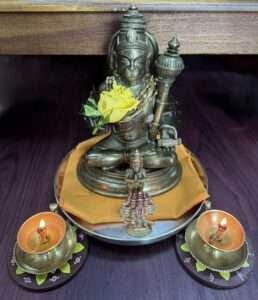
As we may know, the most popular hymn in praise of Hanumaan today is the Hanumaan Chaaleesa by Shree Tulasi Daas. It opens with the line “jai hanumaan jnyaana guna saagara” (meaning “victory be to Hanumaan, who is an ocean of knowledge and benevolent traits”). But soon after it goes on to state “shankara suvana…” implying that Hanumaan is an Avataara of Shiva. Now, having gone over the basics of Vedic philosophy so far… we’ve learnt that there is a difference between Paramaatma and Devata… and that Devata-s are also Jeevaatma-s… and that there is a hierarchy of Devata-s… and that in this hierarchy, Shiva is in Level 5… and Hanumaan is an Avataara of Shree Mukhya Praana Devataa who is in level 3. Therefore, the claim that Hanumaan is an Avataara of Shiva is totally incorrect.
I urge you to look up the Hanumaan Ashtottara Shata Naamaavali (108 names of Hanumaan) on the internet. In that list of 108 names, the 31st name is “bhavishyat chaturaananaaya nama:” What does this mean? bhavishyat = future; chatur = four; aanana = face. Gajaanana = elephant-faced. Similarly, Chaturaanana = chaturmukha = four-faced, which refers to Brahma. In other words, Hanumaan has been referred to as the future Brahma. Now, I ask the readers… in all of the stories you may’ve read about Shiva in any number of Puraana-s or any other scriptures… is there any… ANY reference about Shiva being destined to become the future Brahma? None whatsoever. But Mukhya Praana Devataa is definitely destined to become the future Brahma. So, I ask the readers… rationally, how valid is this claim that Hanumaan is an Avataara of Shiva?
In fact, Mukhya Praana Devataa (whose Avataara is Hanumaan) and Shiva have a Guru-Shishya relationship. There is specific mention in the Vaayu Puraana and Shreemad Bhaagavata that Shiva has to serve as Mukhya Praana’s Shishya (disciple) for a duration of 40 Brahma Kalpa-s. Therefore, referring to Hanumaan as an Avataara of Shiva is like giving credit to Shishya when it is actually owed to the Guru… which amounts to identity theft of the highest order. And this, coming from someone of the stature of Shree Tulasi Daas is just appalling to say the least.
How to correct this? Someone as ordinary as me can’t correct the above blunder. Anyone who speaks against this baseless claim of Hanumaan being an Avataara of Shiva is faced with scorn, ridicule and shunning. Most likely, they will be asked “Do you know that Tulasi Daas Ji composed the Raama Charita Maanas? Have you composed anything like that? Have you even read Raamaayana? Do you know how great a devotee Shree Tulasi Daas was? In what way do you measure up to him?”… and so on. What logic is this? All his benevolent contributions cannot be used to justify his mistake.
When pushed back with the above rationale, most people throw their next defense, which is… “We all have the right to believe what we want to”. This argument has already been shot down several times in the past with numerous examples. Our beliefs bode well only when they align with reality. No one benefits from believing a tiger to be a cat, however strong such a belief may be. You can’t pet a tiger like you pet a cat just because you very strongly believe it is a cat. Such a belief will harm you… and can even be fatal. Even if it is a tiger you raised yourself from its infancy for several years… it can still be dangerous to believe an adult tiger to be a cat. When it is so true from our own experience with most things on earth, why believe in something about the Devata-s that is obviously wrong given the evidence from the very scriptures which introduced us to their existence and greatness?
Please allow me to emphasize on the accuracy of our beliefs with a couple more examples:
Example 1: We’ve all seen the movie “3 Idiots”. For those who haven’t seen the movie, here’s a brief overview of the incident I like to refer to. In the movie, there’s a particular scene involving Chatur Raamalingam, the studious fellow born to, and raised by, parents of Indian origin in a foreign country, because of which his Hindi is not great. Chatur gets selected to read the valedictorian speech on the college annual day, where the education minister is expected to attend. Chatur decides to write up his speech in Hindi. But Rancho, the street-smart student in the same batch, wants to play a prank. He lies to the librarian that the principal was looking for Chatur and asks him to inform Chatur. The unsuspecting librarian informs Chatur about it, and Chatur promptly leaves the computer unlocked and heads to see the principal. Rancho uses this opportunity to update Chatur’s speech. He updates many words with similar-sounding vulgar words. He replaces the word “Dhan” (wealth) with “Sthan” (breast), “Chamatkaar” (miracle) with “Balaatkaar” (use of force or molestation or rape), and so on. Since Chatur doesn’t understand Hindi too well, he neither realizes that the speech has been compromised, nor does he understand the inherent vulgarities. On the annual day, he gets on the stage and starts reading the vulgarized speech in the presence of both the Education Minister and the Principal seated in the front row. Naturally, the Minister and the Principal were shocked and outraged. But all the students, and the audience too, had a good laugh. The point to be noted is that one has to understand what he/she reads and not read something blindly to impress someone.
While the only major flaw in Hanumaan Chaaleesa is the claim of Hanumaan being an Avataara of Shiva, there are many Stotra-s which have been vulgarized deliberately. Now, you may ask “How so? Why would anyone compose vulgar Stotra-s or vulgarize good Stotra-s?”. There are many reasons and we’ll go over them.
But first… Let’s wrap up this critique on the line “shankar suvan kesari nandan” in Hanumaan Chaalisa. What I’ve been told is that this is simply because Shree Tulasi Daas (with all due respect) did delve deep… but not deep enough to understand the difference between Shiva and Mukhya Praana Devataa. OR… there is a good chance that Shree Tulasi Daas, being a great scholar and devotee of Raama and Hanumaan, had written a Doha which everyone can pronounce easily… but as it became popular, some malicious individual or Asura Shakti introduced a malicious update to one of lines in the Doha, which resulted in the above line discrediting Hanumaan and offending both Hanumaan and Shiva. Either way… Hindus should beware of malicious intent by Asura-s and not fall for such pranks and become victims of their evil intent.
The solution I propose is… just update the above line in Hanumaan Chaalisa as follows:
shankara ke guru kesaree nandana
teja prataapa mahaa jaga vandana
Replacing the word “suvana” with “ke guru,” the above line becomes meaningful. The rest of the Doha seems to be fine for daily recitation.
One last thing about Hanumaan Chaaleesa. Have you ever wondered why this Doha is called Chaaleesa? The word Chaaleesa means forty… so, Hanumaan Chaaleesa has 40 verses, and therefore, this Doha is called Hanumaan Chaaleesa. This is the general explanation known to all. But why 40? What’s with specifically having 40 verses in this Doha? Ever wonder about it?
My take is… the number 10 has specific significance with Shree Mukhya Praana Devata as he is specifically endowed with 10 uniquely benevolent traits: Jnyaana (knowledge), Bhakti (devotion), Vairaagya (attached to the creator and detached from his creation), Prajnya (awareness, presence of mind and unison functioning of all Anta: Karana-s), Medhaa (absorption), Dhruti (confidence), Sthiti (conviction), Yoga (balance), Praana (essential life force) and Bala (intrinsic strength). Perhaps considering the importance of the number 10 and its association with Shree Mukhya Praana Devata… a great scholar, who lived in the 13th century, composed a Stotra in praise of Shree Mukhya Praana Devataa‘s original form, and the 3 Avataara-s. If this Stotra were to dedicate 10 verses to the original form and 10 verses each to each of the Avataara-s, this would round up to 40 verses. This Stotra is in Sanskrit and is quite popular. I guess that Hanumaan Chaaleesa too ended up with 40 verses, perhaps for the same reason. However, most commoners find it hard to pronounce Sanskrit verses, and especially the poetic meter of this Sanskrit Stotra is quite hard for most mere mortals to pronounce. Overall, it would be best to chant the Sanskrit Stotra, if possible.
Now let’s go over other heavily vulgarized Stotra-s. They were composed by those who were basically either Avataara-s of Asura-s or had Asura Avesha or Asura Sannidhaana in them. The union of male and female among Devataa-s is always pleasant and yields Aananda to both. For example, the Laasya (union) of Shiva and Paarvati has been explained elaborately in the Puraana-s. But Asura-s are evil. By their very intrinsic nature, they enjoy harming others and especially harming the Devata-s. They enjoy rape. They fancy raping the Devata-s. And therefore, it should not come as a surprise if they compose Stotra-s describing and/or fancying raping the Devata-s. We mere mortals, with almost zero knowledge of Sanskrit, simply take such Stotra-s with malicious content and meaning to be great works simply by assuming that everything composed in Sanskrit must be great… and also assuming that everything composed many centuries ago must be great. We innocently go read these Stotra-s in front of Paramaatma and the Devata-s in temples, at homes and everywhere else thinking that we are chanting praises of Paramaatma and the Devata-s, while not realizing that we were only entertaining the Asura-s. Isn’t this scenario very similar to the above scenario in the movie “3 Idiots”?
Having said all of the above, now let’s ask ourselves. Will Shree Raama like such a belief that Hanumaan is Shiva’s Avataara? No. Will Hanumaan be pleased that the credit for his accomplishments is being given to Shiva? No. Will Shiva be pleased with the above belief? No. Then who are you out to please? Or are you out to urge Shree Raama, Hanumaan, and Shiva that your belief is correct, and that they all better agree with you and make it a reality? How can such a belief be called Bhakti? How can such a belief bode well for you or your family or society at large? If fact, I can go to the extent of stating that believing Hanumaan to be Shiva’s Avataara is what caused Asura-s to get attracted to our places of worship where they can watch, chuckle and enjoy looking at devotees naively say wrong things about Hanumaan. And when Asura-s enter our places of worship… it is only natural that large scale from outsiders followed… the Greeks, the Arabs, the Huns, the Mongols, the Portuguese, the Dutch, the French, the British and so on… they came one after the other… and looted, pillaged, plundered, and destroyed our culture relentlessly and mercilessly.
Example 2: Suppose a man has a dispute with his neighbor over land encroachment. The man takes a strong stance and successfully pushes back the neighbor’s advances. But the neighbor doesn’t relent. He wants to take revenge in some other way. So, the neighbor decides to befriend the man’s 5-year-old innocent child. Please note… no crook will approach any innocent people with horrible-looking fangs, glaring eyes, intimidating horns or any such horrifying appearance. Crooks always approach appearing to be the most lovable characters. So, the neighbor stands outside the child’s school and befriends the child:
Neighbor: “Hello, Sweetie Pie… How are you?!!! Waiting for Dad? He is so sweet, isn’t he? How much do you like your father?”
Child: “A lot”.
Neighbor: “I like him too. When is his birthday?”
Upon learning about the child’s father’s birthday…
Neighbor: “That’s great… what are you planning to do for his birthday?”
Child: “I don’t know”
Neighbor: “You don’t know?!!! Let me help you… How about I write a poem? And you read it for him in front of everyone. But… don’t tell him that I write it for you. Just say that you wrote it yourself. And everyone will be amazed”.
The neighbor then composes an extremely vulgar poem laden with expletives. On the day of the birthday, the child reads that vulgar poem in front of everyone. The neighbor secretly captures a video of it and uploads it to the internet stating “See… take a look at how they’re raising this child. Just appalling!!!”. Next thing… the video goes viral… the government takes note of it and tries to snatch the kid away from the parents and puts the child in foster care.
Similarly, Asura-s are also Jeevaatma-s though they are of the form of Ajnyaana (opposite of correct knowledge) and Anaananda (opposite of Aananda or bliss). By their very nature, they have horrible intentions that are harmful to everyone including themselves. Shree Krishna’s statement “na jaayate mriyate vaa kadaachit” (Bhagavad Geeta, Chapter 2, Verse 20) applies to Asura Jeevaatma-s too. Death does not make an Asura Jeevaatma vanish. It lingers on… and just like in the above example, the Asura Jeevaatma comes back in some other way only to harm. It will not relent, repent or redeem. It will always be evil. All the evil people, who were either Avataara-s of Asura-s or have some Aavesha of Asura-s, they were all killed in the battle. They died a gruesome death… but will come back, in one way or the other, not with any intention to amend… but with an intention to avenge.
The beginning of all the problems happened when Bheema Sena went to fetch Saugandhikaa Pushpa and ended up slaying billions of Asura-s in Gandha Maadana Parvata. If you recall… one of the Asura-s slayed by Bheema Sena was Manimanta, who was the leader of Krodha Vasha Gana of Asura-s. He vowed to return to earth as a Braahmana, learn the Veda-s and misinterpret them, rendering it useless for those who seek knowledge and Moksha. None of these intentions or actions should come as a surprise because this is nothing new. Long ago, Hayagreeva Asura too attempted to abduct the Veda-s and make it unavailable to those who seek knowledge and Moksha. And he succeeded. He was born as the son of a widowed Brahmana woman, learnt the Veda-s and misinterpreted them. Over time, this malicious interpretation spread far and wide. Ultimately, it became so rampant that the correct interpretation just vanished completely from the common teaching methodology.
Now let’s ask the same questions again… Why did Shree Mukhya Praana have to take yet another Avataara? What Bhagavat Kaarya had to be accomplished? What was left to accomplish that he hadn’t accomplished already in his previous Avataara-s? I think you have an idea now. The descendants who inherited the Vedic philosophy who came before us… the so-called “Scholars” and “Great Devotees” did not preserve it well enough for us. They effectively ruined the knowledge that Hanumaan gave us, nor have they preserved even the basic fact about whose Avataara Hanumaan really is. And it has already been elaborately described how Bheema Sena Avataara of Shree Mukhya Praana Devata has been largely reduced to him being a gluttonous ruffian. This is why it became necessary for Mukhya Praana Devataa to take yet another Avataara so as to offer clarity about Vedic philosophy and the Vedic way of life. Let’s learn more about this third Avataara of Shree Mukhya Praana Devataa and the gist of his teachings next.