

U Lakshman Rao
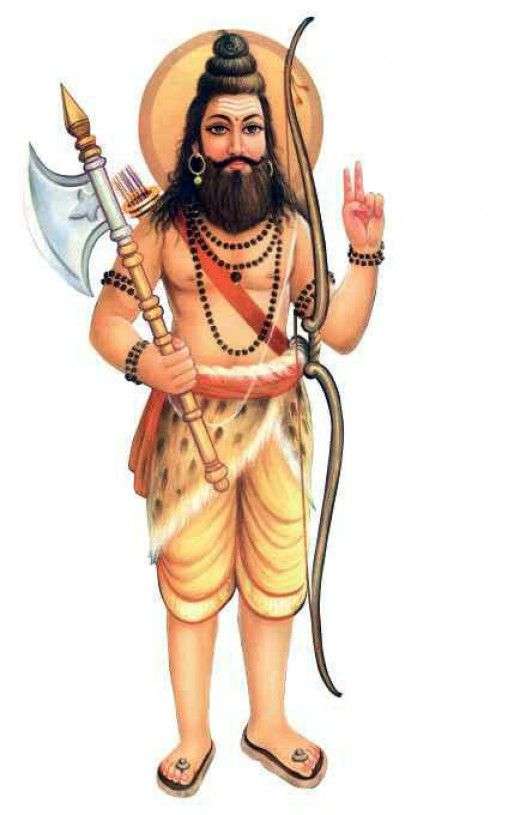
The sacred observance of Parashurama Jayanti marks the divine birth and manifestation of Parashurama, the sixth incarnation of Vishnu. This auspicious occasion falls on Akshaya Tritiya, a day symbolizing eternal prosperity and spiritual merit. The remembrance of Parashurama on this day carries immense philosophical and cosmic significance, for his life is not merely a narrative of divine intervention but a profound embodiment of discipline, justice, and the restoration of moral order.
In ancient times, there flourished a noble lineage beginning with Rantideva, a king celebrated for his boundless compassion, generosity, and unwavering commitment to charity. This illustrious lineage traced its roots to the revered sage Bharadwaja, the son of Brihaspati, the preceptor of the gods. From this sacred lineage emerged the sage Jahnu, who, in a legendary act of spiritual power, drank the descending waters of the Ganga River and released them through his ear, thus giving the river the name Jahnavi. This lineage further gave rise to the illustrious king Gadhi, whose children included Satyavati and the great sage Vishwamitra.
Satyavati was married to the sage Ruchika, and from their union was born Jamadagni, a man of immense spiritual austerity and wisdom. He, in turn, married Renuka, whose virtue and devotion were renowned. From this sacred union was born Parashurama, the divine incarnation destined to alter the course of earthly power. His strength and purpose were extraordinary, and he single-handedly destroyed the vast forces of the tyrant king Kartavirya Arjuna, who had strayed into arrogance and injustice.
Parashurama’s life was shaped by an unyielding devotion to righteousness and obedience to his father. In a profound and unsettling episode, when Renuka momentarily faltered in her mental purity, Jamadagni commanded his sons to execute her as a test of obedience. While his brothers refused, Parashurama, upon returning from the forest, fulfilled his father’s command without hesitation. Pleased by such unwavering devotion, Jamadagni granted him a boon, and Parashurama chose the restoration of his mother and brothers to life. This act revealed not only his obedience but also his compassion and balance. In his profound joy, Jamadagni further blessed him with immortality.
Parashurama’s mission on earth was one of cosmic correction. Born as a Brahma-Kshatriya, he embodied the rare union of spiritual wisdom and martial prowess. When Kartavirya Arjuna unjustly seized the divine cow Kamadhenu and murdered Jamadagni, Parashurama’s purpose crystallized into a vow. He resolved to rid the earth of corrupt and oppressive rulers, and in doing so, he is said to have annihilated the Kshatriya class twenty-one times. These acts, though violent, were guided by the higher principle of restoring Dharma, demonstrating that force, when aligned with righteousness, becomes a sacred instrument rather than mere destruction.
In the aftermath of his campaigns, Parashurama performed ancestral rites by creating sacred pools sanctified through ritual, elevating departed souls to higher realms. Renouncing worldly power, he gifted the conquered lands to sages, exemplifying detachment and humility. In a symbolic and transformative act, he cast his divine axe into the Arabian Sea, causing the waters to recede and giving rise to the land of Kerala, revered as Parashurama Kshetra.
A devoted disciple of Shiva, Parashurama received from him the divine axe and mastery over celestial warfare. His knowledge extended beyond combat into the refined science of martial arts, including the ancient discipline of Kalaripayattu, often regarded as the foundation of many global fighting traditions. His teachings encompassed physical agility, mastery of weapons, control over vital points of the human body, and the integration of martial discipline with Ayurveda, yoga, and meditation. His students included legendary warriors such as Bhishma, Drona, and Karna, whose prowess shaped the epic narrative of the Mahabharata.
Parashurama is counted among the immortals, alongside figures such as Ashwatthama, Mahabali, Vyasa, Hanuman, Vibhishana, Kripacharya, and Markandeya. These eternal beings are believed to remain on earth throughout the age of Kali Yuga, upholding Dharma in subtle and unseen ways.
Unlike other incarnations of Vishnu, Parashurama uniquely coexists across epochs, intersecting with the eras of Rama and Krishna. He is destined to re-emerge as the martial and spiritual preceptor of Kalki, the prophesied future incarnation who will restore righteousness at the end of Kali Yuga.
It is believed that Parashurama continues to reside in deep meditation upon Mahendragiri, immersed in penance and contemplation. His presence symbolizes the enduring vigilance of Dharma, a silent force awaiting the moment when the balance of the world must once again be restored.
The legacy of Parashurama is not confined to mythological memory but lives within the principles of disciplined action, moral courage, and the integration of knowledge with strength. His life teaches that true power is not in domination but in alignment with righteousness, and that the highest purpose of human existence is the harmonization of inner wisdom with outer action. In every pursuit of justice, in every act of disciplined living, and in every effort to rise above selfishness, the spirit of Parashurama continues to guide humanity toward a higher and more purposeful existence.


Just finished the article on Lord Parasurama. Reads well. First article by lakshman that i have read.
He has a good style. Narrates well