



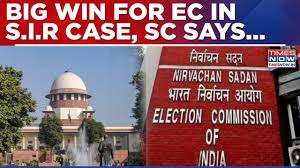
The Supreme Court’s verdict upholding the Election Commission of India’s authority to conduct the Special Intensive Revision (SIR) of electoral rolls is not merely a legal victory for a constitutional institution. It is, in fact, a decisive victory for Indian democracy itself.
At a time when certain frustrated political parties have made it a habit to question every constitutional authority they fail to control, the apex court has drawn a clear Lakshman Rekha. The message is loud and unambiguous — the Election Commission is not a puppet of political convenience, but an independent constitutional body entrusted with protecting the sanctity of the electoral process.
For years, political parties that thrive on appeasement politics and dubious vote-bank arithmetic have resisted any attempt to clean up electoral rolls. Whenever the Election Commission initiated corrective mechanisms to identify duplicate, fake, deceased, shifted, or illegal entries, these very parties rushed to create panic among voters, particularly minorities and economically weaker sections, falsely portraying the exercise as “anti-democratic.”
The Supreme Court verdict has now completely exposed that propaganda.
The finer points of the judgment deserve appreciation. The court rightly recognized that periodic revision of electoral rolls is not optional but a constitutional necessity. A democracy cannot function on manipulated voter lists. Elections lose credibility if illegal entries remain unchecked. The court also acknowledged that the Election Commission possesses both the constitutional mandate and administrative authority to ensure purity of electoral rolls under Article 324 of the Constitution.
This is extremely significant.
The Election Commission is not merely an event manager conducting elections every five years. It is the guardian of electoral integrity. And integrity begins with an accurate voter list.
India, unfortunately, has witnessed serious concerns over illegal immigration in several states. From border states to metropolitan cities, there have been repeated allegations regarding foreign nationals illegally obtaining voter identity cards and becoming part of electoral databases. Political parties blinded by greed for votes ignored the long-term consequences on national security and demographic balance.
The relevance of the Special Intensive Revision becomes even more significant in states like Telangana, particularly Hyderabad and its surrounding regions, where concerns over illegal immigration have repeatedly surfaced in recent years. Multiple police investigations, court proceedings, and media reports have pointed towards the existence of organised networks helping illegal Bangladeshi infiltrators and Rohingya immigrants procure forged Aadhaar cards, voter IDs, ration cards, and even passports.
The Telangana High Court itself recently sought responses from both the Union and state governments on a petition demanding identification and deportation of illegal Bangladeshi nationals and Rohingyas allegedly residing in Hyderabad. Reports placed before the court claimed that nearly 7,000 suspected illegal immigrants were residing in dozens of settlements in the Balapur region alone.
Several arrests over the past two years have further exposed how deeply this problem may have penetrated. Telangana police and central agencies have repeatedly arrested Rohingya nationals found possessing fake Indian identity documents after illegally entering India through Bangladesh. In some cases, investigators found forged voter identity cards being used to secure additional government documentation and welfare benefits. Such developments cannot simply be brushed aside as isolated incidents. No sovereign nation can allow electoral rolls to become vulnerable to manipulation through illegal infiltration and document fraud.
In such a scenario, opposing voter verification exercises is not merely irresponsible — it raises uncomfortable questions about political intent. If electoral rolls are genuinely clean, why fear verification? Why oppose a constitutional exercise meant to ensure transparency? Why create panic before a lawful scrutiny even begins?
The apex court’s observations also reinforce an important democratic principle: genuine citizens have nothing to fear from transparent verification. In fact, honest voters benefit the most when electoral fraud is eliminated. Clean voter lists strengthen democracy, enhance public confidence, and ensure that every legitimate vote carries equal value.
The opposition’s behaviour throughout this issue has been deeply unfortunate. Instead of cooperating with constitutional institutions, they attempted to create unnecessary suspicion around the Election Commission. Ironically, many of these parties routinely preach about “saving democracy.” But democracy cannot survive on selective morality where institutions are respected only when verdicts suit political narratives.
One must appreciate the maturity shown by the judiciary in refusing to succumb to political noise. The Supreme Court examined the issue constitutionally, not emotionally or electorally. That is precisely how institutions should function in a mature republic.
For the BJP and millions of nationalist-minded Indians, this verdict is reassuring because it restores confidence that constitutional mechanisms still possess the strength to resist political pressure.
The Narendra Modi government has repeatedly emphasized transparency, accountability, and system cleansing across sectors — whether through direct benefit transfers, digitization, anti-corruption measures, or electoral reforms. Electoral purification is a natural extension of that vision.
Critics may continue their theatrics. They may continue manufacturing fear. But the ordinary Indian voter understands one simple truth: if democracy matters, voter authenticity matters.
The Supreme Court verdict has reaffirmed exactly that.
India’s democracy becomes stronger not when institutions surrender to politics, but when institutions fearlessly uphold the Constitution. The Election Commission has been empowered to do its duty. The judiciary has defended constitutional balance. And the nation must welcome this moment with confidence and clarity.
Because a clean electoral roll is not an attack on democracy.
It is democracy defending itself.



The Supreme Court’s verdict is a strong endorsement of constitutional integrity and electoral transparency. A clean voter list is essential for a healthy democracy, and genuine citizens have nothing to fear from lawful verification.
It’s the clarion call of righteousness that has ever since been the sinew & spirit of our Democratic India.