



The paradox of devotion, the power of Babas, and justice
Indian society is tangled between prison, parole, and religious influence.
In India, religion is not just a matter of faith; it has also become a major center of social influence, political power, and economic structure. This is why, when a prominent religious leader, a self-proclaimed saint, or the head of a spiritual organization faces serious criminal charges, the matter is not limited to the courts and the law. It erupts into a broader debate on social mindset, devotional politics, the judicial system, and the impartiality of the state. In the past few years, the country has witnessed numerous cases where prominent religious figures have been accused of sexual exploitation, financial irregularities, violence, illegal occupation, and abuse of power. In some cases, the courts have even resulted in convictions, but despite this, their influence, popularity, and number of followers have not diminished significantly. This paradox is one of the most complex realities of Indian society.
When a convicted godman is granted parole, receives a grand welcome upon his release from prison, a convoy of large vehicles follows, thousands of followers gather, and the entire atmosphere resembles a religious festival, a significant question arises before society: has faith become more powerful than justice in India? Under normal circumstances, a criminal’s release from prison is merely an administrative process, but when that same person is the center of faith for millions, his every action takes on political and social significance.
The crisis of Indian democracy is that individuals often become “religious brands.” Even a court verdict against them fails to completely shatter the faith of their followers. A large segment of their followers begins to view every accusation as a conspiracy, a political or religious plot. This is why, even after serious charges are proven against some babas, their camps, ashrams, and institutions continue to operate as before. Their supporters present them not as criminals but as “victim saints.” This situation poses a challenge not only to the justice system but also to democratic consciousness.
The problem isn’t limited to godmen; it also lies within a social structure that prioritizes personality cults over reason. In many parts of India, religious godmen are not merely spiritual gurus but also influence people’s life decisions, economic behavior, social relationships, and political thinking. The poor, the marginalized, and the emotionally broken often seek security, identity, and support in such organizations. Gradually, this faith turns into dependence. This dependence often erodes the ability to question. Instead of accepting the allegations against their guru, devotees begin to distrust the entire system.
It’s also true that not all religious gurus or saints are the same. Many saints also perform important work in the fields of social service, education, health, and spiritual guidance. However, problems arise when an environment of “unlimited power” and “blind devotion” is created around a particular saint, leading him to consider himself above law and morality. History shows that whenever a person is declared “divine” without question, the potential for exploitation and abuse of power increases. In a democracy, no individual or institution, whether political leader, industrialist, or religious guru, can be kept beyond question.
In such cases, the role of the state and politics also comes into question. Large religious organizations command immense public support, which also has electoral implications. This is why political parties often adopt a lenient stance toward such organizations. Often, the perception is created that influential religious leaders receive greater social and political protection than the law. Whether this is entirely true or not, if the public comes to believe that the law is not equal for all, the moral credibility of the justice system begins to weaken.
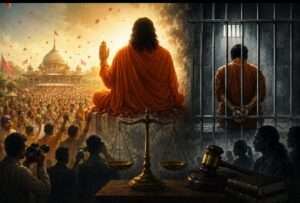
Parole and legal relief are not inherently wrong. Indian law grants every prisoner certain rights. But when the parole of an influential guru becomes a public display of power, it ceases to be merely a legal process. It sends a message to society that mob violence can still shape the language of justice. This is why, after each such release, discontent grows among victims, women’s rights activists, and social organizations. They feel that society quickly forgets the suffering of those who fought long for justice, while celebrating the return of influential figures.
This entire incident also raises serious questions about the role of the media and social media. Today, the image of religious leaders isn’t just built in ashrams, but through cameras, viral videos, fan propaganda, and digital campaigns. Some portray them as “messiahs,” while others portray them as “villains.” In this process, facts are often left behind, and emotions take center stage. This is a dangerous situation for democracy, because the moral balance of any society is not built solely on emotions, but on conscience and truth.
India must now understand that a healthy society is impossible without striking a balance between religious faith and democratic justice. Everyone has the right to be worshipped, but no one has the right to consider any individual above the law. If society cannot draw a clear line between “saint” and “criminal,” justice will always be entangled in emotional conflicts.
Today, the need is not just for courts, but also for social awareness. People must understand that true spirituality lies not in cultivating personalities, but in morality, sensitivity, and a commitment to truth. If any saint, sage, or religious leader wants to be respected in society, they must first set an example of transparency, accountability, and respect for the law.
Ultimately, this isn’t a question about any one godman or any one organization. It’s a question about a society that often suspends reason in the name of faith. Until a balance is struck between devotion and logic in India, such controversies will continue to arise again and again. The strength of democracy lies in respecting religion, but not placing justice below it.

