



The sight of a woman standing at a bus stop in India may seem ordinary, but if we look deeper, she’s more than just a passenger. She carries with her many layers of society, struggles, hopes, and questions. She’s waiting for a bus, but she’s also waiting for her rights, opportunities, and a dignified existence. Ironically, we rarely attempt to understand the social and psychological implications of this scene we witness every day.
In Indian society, there’s still a significant gap regarding the public presence of men and women. If a man is seen walking on the street at night, waiting for a bus, or sitting at a tea stall, it’s considered normal. But if the same scene occurs with a woman, many questions automatically arise. Where is she going? Why is she alone? Why is she staying out so late? Who might be waiting for her? These questions aren’t merely curiosity, but rather a reflection of a social mindset that still hasn’t fully embraced women’s freedom of movement.
This situation isn’t limited to small towns or rural areas. Even in metropolitan areas, women feel more unsafe in public spaces than men. For them, leaving the home isn’t just a physical journey, but also a process of overcoming numerous psychological and social barriers. Therefore, the importance of schemes, facilities, and policies related to women’s mobility is not only economic but also social and psychological.
When governments implement schemes like free or subsidized bus travel for women, the value goes beyond simply saving on fares. It opens new doors of opportunity for women, for whom even small daily expenses influence decisions. In many families, the cost of women’s education, employment, or other activities is still considered an additional burden. In such situations, reduced transportation costs can provide them with greater independence.
It’s important to understand that not every woman who leaves home is simply going to work. She may be pursuing an important purpose in her life. One woman may be moving to another neighborhood or city to care for her ailing mother. Another may be gathering the courage to resume her studies, which she left after marriage. Another may be traveling long distances every day in search of better employment. Another may be taking on extra work to ensure a better future for her children. And it’s also possible that she’s simply leaving home for a few moments of peace of mind, because her unpaid labor within the home never ends.
In Indian society, women’s domestic labor remains largely invisible. Cooking, caring for children, caring for the elderly, cleaning the house, and countless other small and large tasks—these are tasks without which family life is impossible, yet their economic value is not measured. Therefore, when a woman leaves the home, she leaves not just as an individual but also with the burden of numerous responsibilities. She has limited time, limited resources, and high social expectations.
Our social perception of women’s presence in public spaces also reveals many contradictions. While we advocate for women’s education, employment, and self-reliance, we also maintain a tendency to suspect and control their freedom of movement. Families often want to educate their daughters, but worry about their late evening returns. They want women to progress, yet they also place numerous social limitations in their path.
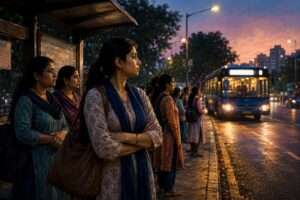
For women, public transport is not just a means of travel, but also a means of social participation. Accessible, safe, and affordable transportation significantly increases women’s education, employment, and social participation. Numerous studies around the world have demonstrated that increased women’s mobility also enhances their economic independence and decision-making. Therefore, women’s mobility should be viewed not simply as a transportation policy, but as a policy of social development.
The issue of safety in public spaces is also crucial. A large number of women in India still remain deprived of opportunities due to a lack of safe environments. Many female students refuse to enroll in distant colleges because travel is difficult or unsafe. Many women forgo better job opportunities because returning home late in the evening is considered risky. Thus, unsafe public spaces not only restrict personal freedom but also impact the country’s economic and social progress.
However, simply discussing safety isn’t enough. Respectful behavior in public spaces is equally important. Women often face stares, unwanted comments, and uncomfortable environments. This experience impacts their self-confidence and often forces them to avoid public life. A civilized society isn’t defined solely by its crime rate, but by how respectful people treat each other.
It’s also worth noting that the issue of public discipline isn’t limited to men. Problems like illegal parking on sidewalks, disregard for traffic rules, littering in public spaces, and misuse of community resources involve diverse segments of society. Therefore, solutions must be collective. Both men and women must fulfill their civic responsibilities equally. Public life can only improve when duties are valued alongside rights.
Women’s needs are also not adequately considered in urban design and development plans. Most cities have developed with a male-centric approach. Roads, transportation systems, public toilets, lighting, and security systems are often not designed with women’s needs in mind. As a result, women face numerous disadvantages. To truly create inclusive cities, urban planning must center women’s experiences and needs.
Women’s freedom of movement is not just a women’s issue, but a question of democracy and equality. In a democratic society, every citizen should have the right to use public spaces without fear or discrimination. If half the population has to struggle extra hard to exercise their rights, it is a collective failure of society.
What’s needed today is not just policies and plans, but a shift in mindset. We must instill in our daughters the belief that public spaces belong to them as much as anyone else. We must teach our sons that women’s freedom is not a privilege but a fundamental right. We must understand that it’s not unusual for a woman to travel alone, return home late in the evening, or take time for herself.
The woman standing at the bus stop is a reflection of a changing India. She wants to make her own decisions about her life. She wants equal access to education, employment, and opportunities. She wants to pursue her dreams not within boundaries, but in the open sky. Her struggle is not merely personal, but a struggle for social change.
Only when women in a society can be considered truly progressive can they travel without fear, be viewed without suspicion, and reach their goals without obstacles. Development isn’t measured solely by tall buildings, wide roads, and modern technologies. The true measure of progress is the dignity and freedom a society provides to its most vulnerable and disadvantaged.
Women standing at bus stops send us a silent message every day. They show us that freedom comes not just from the words of the Constitution, but from the conditions in which individuals can fearlessly exercise their rights. They remind us that equality should not be just a slogan, but a reality felt in everyday life.
The day a woman standing at a bus stop is not worried about what people will think about her, the day there is no question mark on her safety and dignity, the day her journey is considered just that of a normal passenger, only then will we be able to say that we have taken an important step forward towards social equality.
The women standing at the bus stop aren’t just waiting for a bus; they’re waiting for a society that accepts them as full citizens, free individuals, and human beings with equal rights. And this wait is as much theirs as it is society’s. Because a nation’s path to progress is paved only when half its population can move forward without fear, without discrimination, and without obstacles.

