Upadhyayula Lakshman Rao
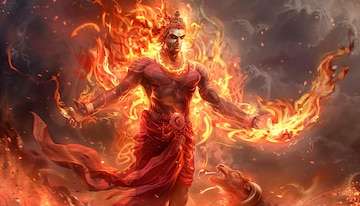
The sage Puruchhepa, immersed in the solemn cadence of Athyasti Chandas, raises his prayer to Agni, the divine mediator who stands at the threshold between the mortal and the celestial. Agni is not merely invoked; he is destined to summon the gods themselves, serving as the luminous bridge that unites human aspiration with divine reception. Born of the sacred friction of the aranis through the disciplined efforts of priests, Agni manifests as the very foundation of all ritual action. In him resides the principle that transforms intention into sacred offering, and offering into divine communion.
The patrons, seeking prosperity and fulfillment, worship Agni with reverence, recognizing him as the source of wealth both material and spiritual. Every ritual act, performed with sincerity and precision, becomes an adornment to Agni, drawing him closer to righteousness. Once enkindled upon the sacred altar, none can hinder or diminish his presence, for he burns with a purity that transcends all obstruction. Around him gather the priests, their voices resonating with Vedic hymns, sustaining the rhythm of the cosmos through sound and sacrifice. Agni, the seeker of spiritual offering, is firmly स्थापित upon the altar, embodying the convergence of devotion and cosmic law.
Agni is invoked to partake of the sanctified oblations—the clarified butter and sacred cakes prepared with utmost purity. Ancient tradition recalls that Vayu once bore this divine fire from the solar realm to the earth for Manu, establishing it as a perpetual presence in human ritual life. Thus, Agni must dwell in the sacrificial hall, blazing brilliantly until he is nourished by offerings worthy of his divine nature. He is the one who responds to invocation, who arrives enriched by oblations, and who bestows the fulfillment of desires upon those who call upon him with faith.
Resounding with crackling vigor, Agni proclaims his presence; he is powerful, radiant, and ever-expanding through the praise of hymns. His flames rise a hundredfold, consuming obstacles and dispelling adversities. As the destroyer of enemies and the protector of the faithful, he resides both upon exalted altars and within the homes of devoted patrons. Ever in motion, he receives offerings and transforms them into subtle essence, carrying them to the divine realms.
Agni himself is the archetypal priest, the supreme performer and organizer of rituals. He dwells in every household that upholds sacred duty, flourishing wherever yajna is conducted with integrity. The patron, through righteous deeds and disciplined offerings, aligns with Agni’s purpose, and Agni, in turn, delivers the fruits of sacrifice. Like an honored guest, he consumes the clarified butter, sanctifying both the offering and the offerer. As the patron gathers and prepares oblations, so does Agni assimilate them, converting physical substance into spiritual merit.
Just as a hungry being is satisfied by food, Agni is nourished by offerings of air, grain, and sacred provisions. The ritual becomes a profound exchange: the patron gives, and Agni purifies. In this sacred reciprocity, Agni removes sin, shielding the devotee from the torment of past transgressions. His flames do not merely burn—they cleanse, refine, and elevate, transforming the human condition into a state of sanctity.
Agni is the embodiment of all existence, radiant and inexhaustible. Ever unsatiated, he symbolizes the perpetual striving of life and consciousness. He holds riches in his right hand, signifying his power to bestow abundance, and shines with the brilliance of the sun. As the sustainer of all beings, he nourishes the hungry and uplifts the needy. As the carrier of oblations, he ensures that every offering reaches its intended divine recipient, thus maintaining the cosmic order.
He is the provider of nourishment, the opener of celestial pathways, and the remover of sin. Agni distances suffering and establishes harmony, presiding as the lord of priests and the beloved of the people. Like a victorious king, he commands reverence and affection alike. Invoked with devotion, he arrives to accept offerings and grant protection, even shielding devotees from the binding forces associated with divine judgment. He is the giver of wealth, the guardian of life, the omniscient witness, and the source of sacred sound and beauty.
Thus, Agni stands as the eternal principle of transformation—ritualistic, spiritual, and even proto-scientific in essence. He represents energy in its purest form: the converter of matter into light, of effort into result, of devotion into transcendence. In this profound vision, the sages perceived not only a deity but a universal law. Therefore, the priests continue their hymns, and the patrons their offerings, seeking in Agni both protection and prosperity, and ultimately, the path to the highest truth.