Lakshmanrao Upadhyayula
Among the luminous seers of the Ṛgvedic age, the venerable sage Śaunaka Gṛtsamada stands as one who perceived the universe as a harmonious interplay of divine intelligence and cosmic order. In a profound hymn composed in the majestic Triṣṭubh metre, he invokes the twin deities Soma and Pūṣan, whose united powers nourish, sustain, and guide the worlds. The mantra is not merely a prayer for material prosperity, but a contemplative vision of the subtle laws governing life, consciousness, and the universe.
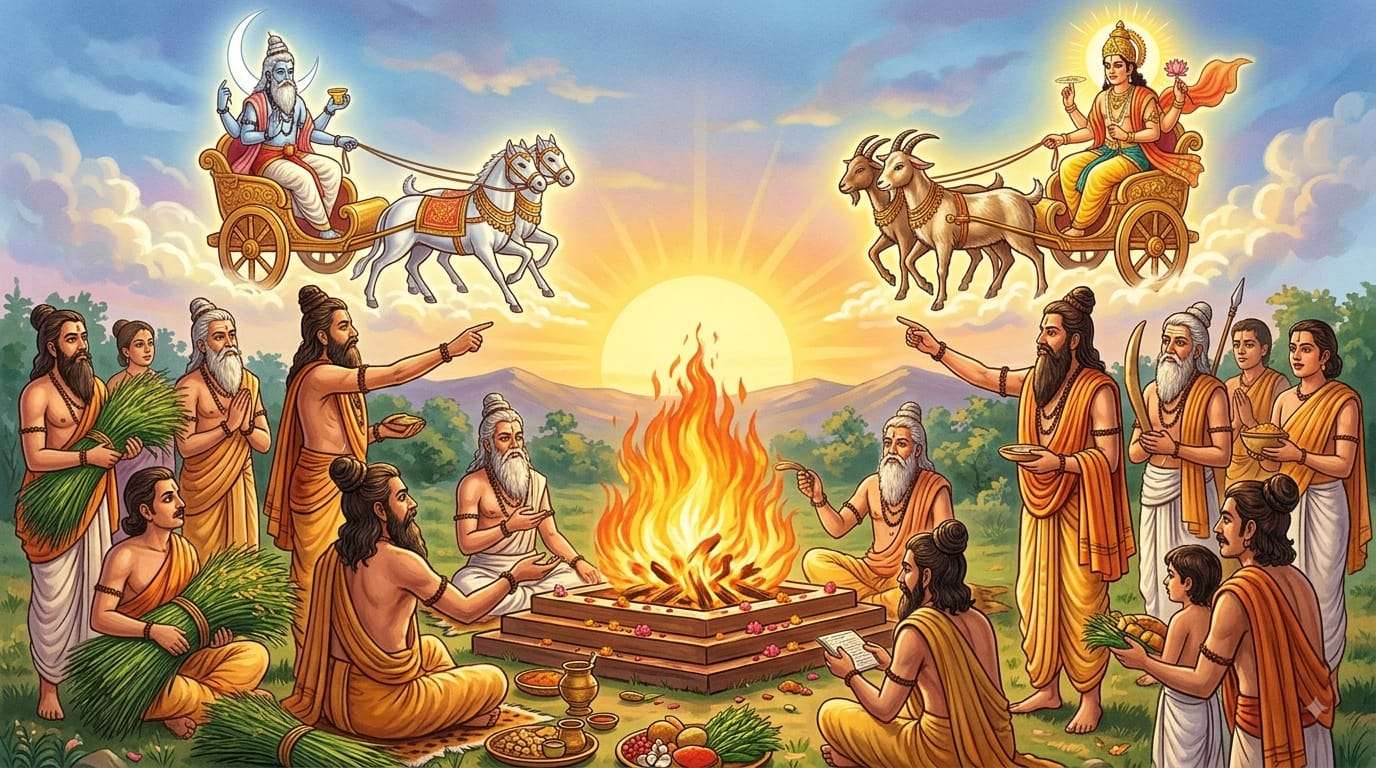
The sage addresses Soma and Pūṣan as the parents of wealth, for all forms of abundance arise through their combined agency. Soma represents the nourishing essence latent in creation—the vital sap in plants, the cooling brilliance of the Moon, and the inward current of bliss that sustains both body and mind. Pūṣan is the divine nourisher and guide, the solar intelligence that directs all beings upon their proper paths and ensures their growth and protection. Together they are the celestial father and mother of prosperity, presiding over heaven and earth, spirit and matter, cause and manifestation.
At the dawn of creation, as soon as they were born into cosmic function, Soma and Pūṣan assumed the guardianship of the universe. The gods established them for the attainment of amṛta, the principle of immortality. This amṛta is not merely an elixir of endless life, but the eternal truth underlying transient existence. Soma bestows the immortal essence hidden within all beings, while Pūṣan leads the soul toward the realization of that undying reality.
Upon their manifestation, both deities shone with self-effulgent radiance. The gods themselves ministered to them, recognizing in them the sustaining forces of the cosmos. Their light dispelled the unpleasant darkness that obscures knowledge. In the Vedic vision, darkness signifies not merely the absence of physical light, but ignorance, disorder, and the forgetfulness of one’s divine origin. Soma illumines the inner consciousness, while Pūṣan reveals the right path; together they remove both outer and inner obscuration.
With the support of Soma and Pūṣan, Indra brought forth the cows, the sacred sources of milk. In Vedic symbolism, cows represent rays of knowledge, streams of nourishment, and the manifold gifts of nature. Milk signifies refined sustenance, both physical and spiritual. Thus, the hymn teaches that divine power, guided by cosmic intelligence, transforms the hidden resources of creation into life-supporting abundance.
The sage further extols Soma and Pūṣan as the lords of the universe, presiding over the seven-wheeled world. The expression saptacakra—“seven-wheeled”—is rich in symbolic meaning. In the cosmological sense, it denotes the cyclical order of time expressed through the six seasons of the Vedic year together with the intercalary month, making thirteen lunar months in all. This sophisticated calendrical insight reveals the scientific precision of Vedic astronomy, which reconciled lunar and solar cycles to preserve ritual and agricultural harmony.
On the inner plane, the seven wheels correspond to the revolving centres of consciousness and the stages through which life evolves. The hymn also speaks of five blazing rays. These may be understood as the five prāṇas—prāṇa, apāna, vyāna, udāna, and samāna—the vital energies that sustain the body. In another interpretation, they refer to the five operative seasons, for Hemanta and Śiśira are often treated as a single cold season in ancient reckoning. Thus, the Vedic seers united cosmology, physiology, and spirituality into one coherent vision.
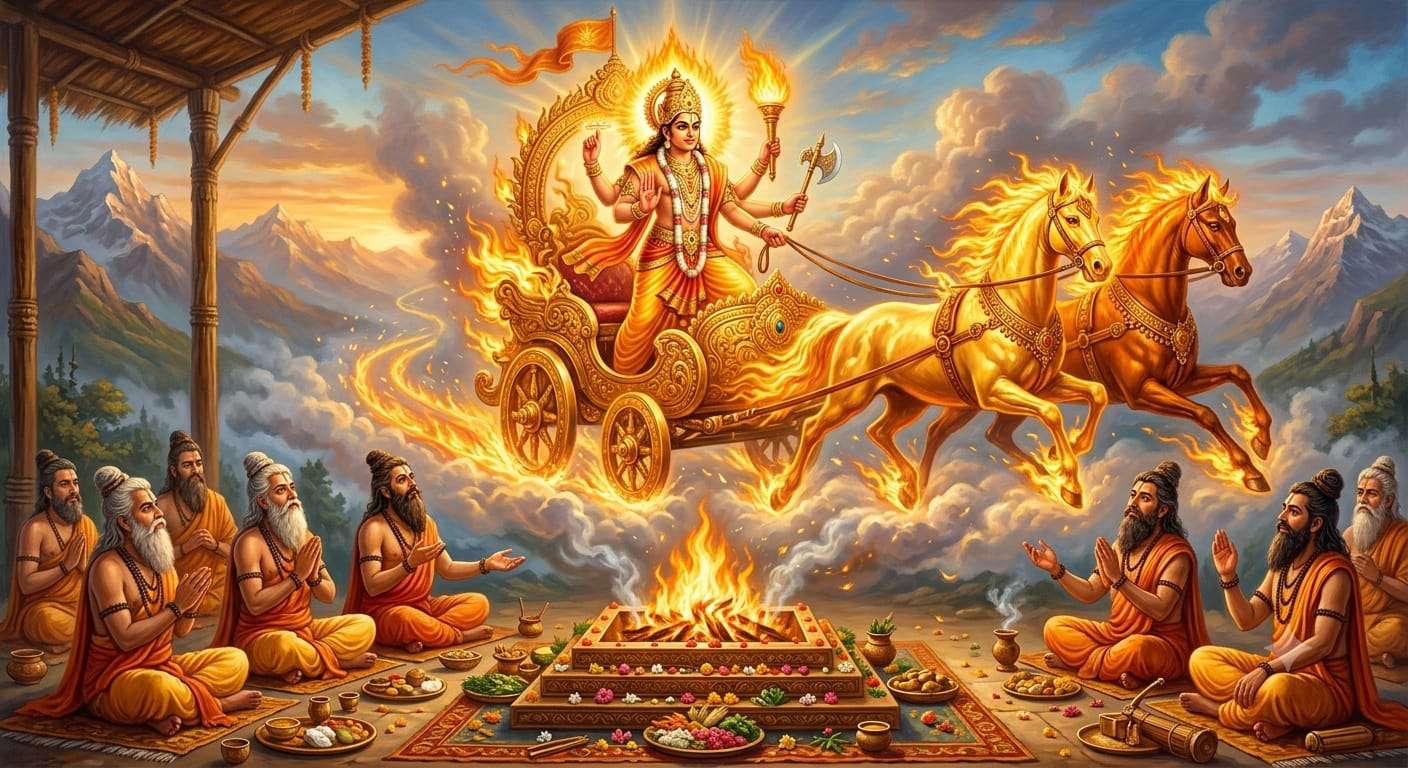
The hymn describes Soma and Pūṣan as ever active, showering blessings throughout the world and mounting their chariot whenever invoked by sincere aspiration. Their movement signifies the responsive nature of divine grace. Whenever the heart turns upward in faith and understanding, the cosmic powers of nourishment and guidance descend to assist the seeker.
Pūṣan abides in the highest resplendent realm, the radiant domain of spiritual illumination. Soma manifests in threefold form: in the heavens as the Moon, in the atmosphere as subtle vitality, and upon earth as the healing essence within herbs and medicinal plants. This vision reflects the Vedic recognition that one principle can reveal itself at multiple levels of existence—celestial, atmospheric, terrestrial, and psychological.
Because these deities operate through countless manifestations, sages and worshippers describe them in many names and forms. Yet all such descriptions point to one underlying reality. Soma and Pūṣan are glorious because they convert the hidden potentials of nature into visible prosperity and inward fulfillment. Hence the sage prays that they may bestow wealth in the form of cattle, which in the Vedic world symbolized food, vitality, knowledge, and enduring prosperity.
The hymn further distinguishes their complementary functions. Soma generates all forms of life, infusing every organism with vitality and regenerative power. Pūṣan supervises and directs the universe, ensuring that each being follows its ordained path. One creates and nourishes; the other governs and protects. Together they preserve both the existence and the order of the cosmos.
Śaunaka Gṛtsamada therefore implores them to safeguard the sacred rites. Yajña, in the Vedic understanding, is not merely ritual offering but the universal principle of reciprocal exchange through which humans, nature, and the divine remain in harmonious relationship. When Soma and Pūṣan bless the sacrifice, all hostile forces—whether external adversaries or internal obstacles such as ignorance, fear, and selfishness—are overcome.
The sage also invokes Pūṣan as the deity who delights all worlds and asks that he be pleased with the offerings of the faithful. The prayer culminates in a vision of continuity across generations: may we, together with our children and grandchildren, continue to chant these sacred hymns within the consecrated precincts of yajña. This aspiration reflects the Vedic ideal that spiritual wisdom, ethical living, and reverence for cosmic order should be preserved and transmitted from one generation to the next.
Thus, the hymn to Soma and Pūṣan reveals the depth of Vedic thought, where poetic symbolism, astronomical insight, biological understanding, and spiritual realization converge. Soma is the immortal essence pervading life; Pūṣan is the guiding intelligence that leads all beings toward fulfillment. Their union sustains the worlds, nourishes the body, illumines the mind, and directs the soul toward the supreme wealth of immortality.