Lakshmanrao Upadhyayula
The venerable sage Śaunaka Gṛtsamada, one of the illumined seers of the Ṛgveda, composed sublime hymns in the sacred metres of Gāyatrī, Anuṣṭubh, and Triṣṭubh. These metres are not merely poetic forms; they are rhythmic patterns attuned to the movements of consciousness and the harmonies of the cosmos. Each syllable, precisely arranged, reflects the Vedic insight that sound is a creative force, and that the universe itself unfolds according to divine vibration. In these hymns, the sage invokes the deities not as distant mythological beings, but as living intelligences governing the powers of nature, mind, and spirit.
To Vāyu, the lord of life-breath and atmospheric motion, the sage offers a resounding invitation. “O Vāyu, possessor of thousands of chariots, come with your celestial hosts borne upon the currents of the air to partake of the Soma.” Vāyu represents the dynamic principle of movement, the unseen force that circulates through the heavens as wind and through living beings as prāṇa. His thousand chariots signify the countless streams of energy that sustain life. The invitation to drink Soma reflects the profound relationship between energy and consciousness, for Soma is the nectar of inspiration, ecstasy, and spiritual illumination.
The hymn further extols Vāyu as the radiant one whose very name shines with splendour. He is invited to the house where Soma is purified, symbolising the human heart and intellect refined by discipline and devotion. Just as air carries fragrance across vast distances, Vāyu carries the subtle offerings of the sacrificer to the divine realms. The imagery also reveals a scientific temperament, recognising the atmosphere as the medium through which life, energy, and communication are sustained.
Indra and Vāyu are then jointly invoked. “O mighty Lords, come today with your celestial retinues. The Soma, purified and blended with the nourishing essence of the cow, awaits your delight.” Indra, the lord of awakened consciousness and victorious strength, joins with Vāyu, the life-force, to illustrate the intimate union of power and vitality. The addition of milk, curds, and clarified butter to Soma signifies the transformation of earthly nourishment into spiritual offering. This synthesis of natural substances reflects the Vedic understanding that matter and spirit are not opposed, but mutually sanctifying.
Mitra and Varuṇa are next invited to partake of the sacred elixir. These divine rulers embody complementary cosmic principles. Mitra governs harmony, friendship, and covenant, while Varuṇa presides over moral order, vastness, and the unseen law of ṛta. “The Soma is prepared for you, O upholders of Truth. Accept our invitation.” Their growth in truth signifies that all stable existence is rooted in fidelity to universal law. Free from enmity, they are enthroned upon the majestic altar supported by a thousand pillars, symbolising the infinite structural order of the cosmos.
The sons of Aditi, Mitra and Varuṇa, are described as generous bestowers of grace. They delight in offerings sanctified with clarified butter, a symbol of purified understanding. As guardians of cosmic and ethical order, they reward the patron of the sacrifice with prosperity, social harmony, and spiritual dignity. Their presence teaches that truth, discipline, and generosity are the foundations of both inner and outer wellbeing.
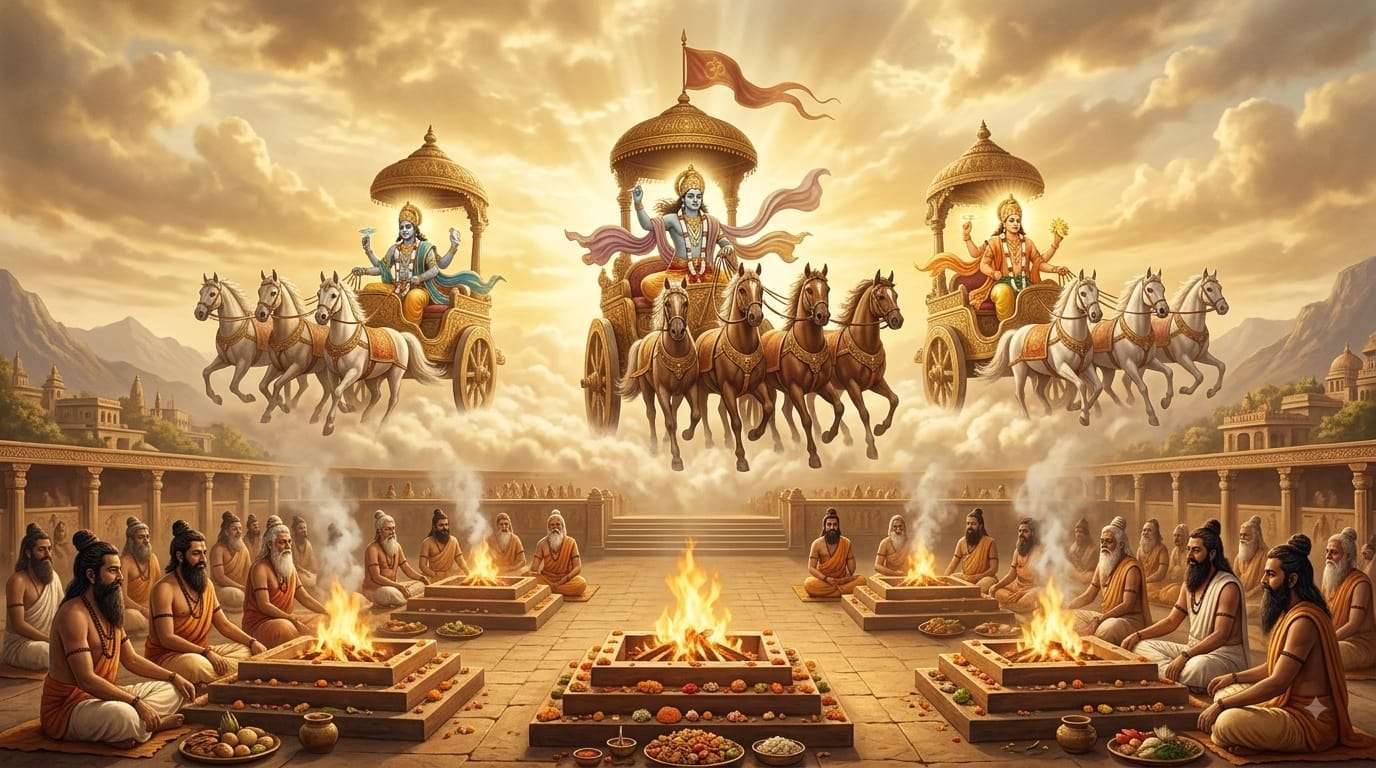
The Aśvin twins are then invoked with reverence. “O divine physicians, embodiments of truth, come in your chariot drawn by horses and enriched with cows. Drink the Soma and shower us with wealth.” The Aśvins represent healing, swift intervention, and the restoration of balance. They are called “my two truths,” for they never deviate from reality. Whether near or far, they arrive promptly to rescue seekers from danger, disease, and decay. Their chariot symbolises the integration of motion, nourishment, and therapeutic wisdom.
The sage prays that the Aśvins bestow irresistible wealth and protect the worshipper from enemies, thieves, and mortality. This wealth includes not only material abundance but also health, knowledge, and spiritual resilience. Their blessings arrive in many forms, revealing the Vedic understanding that divine grace manifests according to the needs and readiness of the recipient.
To Indra, the wielder of the thunderbolt and the conqueror of hostile forces, the sage offers solemn praise. Indra is steady, immovable, and victorious. He removes the fear born of sin and grants comforts that preserve the devotee from harmful actions. In psychological terms, Indra represents the heroic faculty of consciousness that overcomes ignorance, doubt, and inner fragmentation. His protection in all four directions signifies complete security in body, mind, and spirit.
The Viśvedevas, the collective host of deities, are invited to honour the sacrifice and be seated upon the sacred kuśa grass. Before them is placed the intensely sweet and joy-bestowing Soma prepared by the descendants of Gṛtsamada. This universal invocation reflects the Vedic insight that all natural laws and divine powers cooperate in sustaining existence. To worship the Viśvedevas is to acknowledge the interconnectedness of all forces that govern life.
Along with the Viśvedevas, the sage invokes Indra, Pūṣan, and the Maruts. Pūṣan is the nourisher and guide of travellers, both earthly and spiritual. The Maruts, radiant storm deities, embody electrical energy, atmospheric power, and the vigorous impulses of transformation. Their participation in the sacrifice reflects the Vedic appreciation of meteorological phenomena as expressions of divine intelligence and regenerative force.
The hymn to Sarasvatī is among the most profound. “O Sarasvatī, majestic among the Maruts, best of rivers and supreme among the gods, though we are poor, bless us with wealth.” Sarasvatī is simultaneously a sacred river, the flow of eloquence, and the luminous current of intelligence. Her waters symbolise the streaming of inspiration, learning, and spiritual insight. The sage prays for both prosperity and the birth of worthy children, recognising that true wealth includes wisdom and noble lineage.
Sarasvatī is praised as radiant intellect, rich in food and overflowing waters. The offerings of Śaunaka Gṛtsamada are laid before her with devotion. She is asked to accept the Soma and grant satisfaction, abundance, and continuity. In a scientific sense, Sarasvatī reflects the indispensable role of water and knowledge in the flourishing of civilisation. Just as rivers nourish the land, inspired thought nourishes culture and consciousness.
The twin deities Earth and Heaven, Pṛthivī and Dyauḥ, are then invoked. They are the universal parents, the sustaining matrix of all life and all sacrificial activity. “You who delight in the sacred rite, come and bless our worship.” Earth represents stability, nourishment, and embodied existence, while Heaven symbolises expansion, light, and transcendent possibility. Together they reveal the Vedic vision of reality as a harmonious union of material and spiritual dimensions.
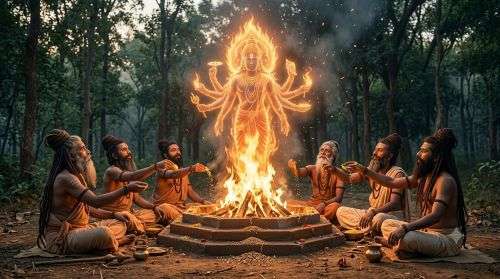
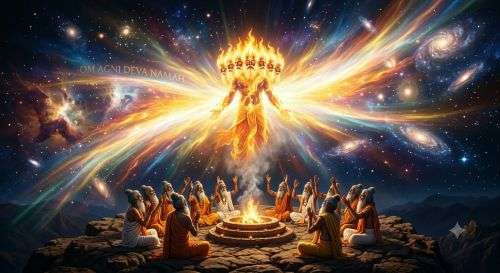
Agni, the divine fire and messenger of the gods, is also invoked. He carries the offerings from Earth to Heaven and transforms visible substances into subtle essences. As combustion releases hidden energy from matter, so Agni reveals the latent divinity within the human being. He is both physical fire and the inward flame of aspiration, intelligence, and purification.
The hymn concludes with a prayer that Earth and Heaven, free from enmity, together with all deities worthy of sacrifice, may sit among the worshippers and partake of the Soma. This final image conveys the highest Vedic ideal: the reconciliation of cosmic forces, the sanctification of nature, and the elevation of human consciousness into communion with the universal order.
Through these majestic hymns, Śaunaka Gṛtsamada demonstrates that the Vedic seers perceived no division between spirituality and scientific observation. Wind, rivers, storms, fire, earth, and celestial order were studied with keen attention and reverenced as manifestations of one intelligent reality. The sacrifice was both an outer ritual and an inner discipline, aligning human life with the eternal principles of truth, harmony, and transformation. Thus the hymns remain timeless revelations, inviting every seeker to recognise the universe as a living yajña in which knowledge, devotion, and natural law converge in sacred unity.