



When all the desires dwelling in the heart are destroyed, then the mortal becomes immortal. He attains Brahman even here.
One attains Brahman when all the desires dwelling in the heart are destroyed; the mortal becomes immortal. The truth is the same in all teachings. That state of perfection is defined as desirelessness. To the extent you have reduced the quotient of desires, the quantity drops and the quality improves. When the desires drop, you attain the illuminated state of Kaivalyam.
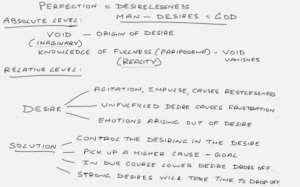
The above chart shows the absolute level, relative level, and the solution to handle the desires.
At the absolute level, the shastras are saying that the cause or origin of desires is due to the void that you experience within. Void is a feeling of emptiness or nothingness felt within you. The masters say the entire void is imaginary, but sadly one experiences the void. To counter that void is the knowledge of fullness, Reality. The moment you realise the paripoorna, the nature of your fullness, cognition of Reality, there is no more void. The void disappears.
Eg: When you are hungry, you have the desire to eat. Once you eat the desire for food disappears. It is temporary until you feel hungry again.
At the absolute level, all the desires arising out of void are arrested when you realise your fullness, which is upon self-realisation.
At the relative level, one has to handle the desire so that it does not become an impediment. There are 3 aspects
- Desire itself is an agitation, an impulse which causes restlessness in the mind.
- When you pursue your selfish desires, those unfulfilled desires cause enormous frustration. Desire causes further agitation and frustration.
- When you operate on desires, there are various emotions like fear, greed, lust, envy, arrogance, anger, etc. that arise out of the desire. All these are very unhealthy to the mind.

The solution at the relative level to handle the desires is:
- Control the desiring in the desire; Bhaja Govindam Verse 2, says the desiring in the desire is the Trishna.
THIRST FOR WEALTH
मूढ जहीहि धनागमतृष्णां कुरु सद्बुद्धिं मनसि वितृष्णाम् ।
यल्लभसे निजकर्मोपात्तं वित्तं तेन विनोदय चित्तम् ॥ २॥
O Fool! Give up your thirst for acquiring and aggrandizing wealth; create the thought of Reality in your mind instead of the thirst. Whatever you get from your action, content your mind with that wealth obtained
One has to give up the thirst for wealth and not the wealth. Trishna is the thirst or desire in the desire. Adi Shankaracharya says, give up the thirst for acquiring but not the wealth. Thirst for acquiring is the obsession. Before we get the object of desire, there is an obsession, an uncontrollable urge to get it. Give up that thirst now and remain calm. It is the first and easiest step to control the desire. When you get a thought for enjoyment, the desire comes. You control that rush or urge. That urge is the desiring in the desire.
- The next step is to pick up a higher cause or goal.
Once you have control over the weakness, you will have to redirect the thought to something higher.
- When you maintain the thought on the stronger, you don’t fall prey to lower desires. This process of getting established in the higher and lower dropping off is a continuous process.
- Once you get established in the higher, there will still be stronger desires that you cannot control. These will take time and will fall away when you get established in higher wisdom.
In the process of conquering and annihilating all the desires, the Self reveals itself. The impurities of desire have to be eradicated for the Self to reveal itself. Presently it is not revealed, because the overwhelming desires are covering it.
All these challenges and the solution to address the problem is possible only with knowledge and intellect.

