I am feeling extremely happy to introduce two of our columnist – Dr Satyawan Saurab and Dr Priyanka Saurab – excellent writers, who take time out to support your Orangenews9 since its early with passion and enthusiasm. For that, Orangenews9, indeed appreciate this ‘writing couple’ for doing what they are doing to support my passion too provide credible and national interest content through Orangenews9 digital media platform, holding brief for none and remain unapologetic if time demands to slam ruling as well as the Opposition alike. – EDITOR
Dr. Satyawan Saurabh and Dr. Priyanka Saurabh, a renowned researcher and literary couple from Barwa, have been tirelessly studying, documenting, and documenting the village’s cultural heritage for the past two decades. They have attempted to connect Barwa’s old mansions, murals, ponds, wells, and architectural remains with local memories and oral history. Their articles on the mansions have been used as references by several PhD researchers. Their aim has been not only to describe these historical structures but also to understand Barwa’s social, cultural, and economic history through them. Their writing and documentation have contributed to elevating Barwa’s heritage from local discourse to a broader literary, cultural, and research focus.
Subhash Panwar
The village of Barwa in south-western Haryana is far more than a rural settlement. With its havelis, murals, ponds, wells and folk memories, it represents a living heritage site where architecture and oral history preserve glimpses of a bygone era. Its architectural traditions reflect a fascinating blend of folk art, social history, Rajasthani influences and the prosperity of an earlier rural society.
Located in the Siwani area of Bhiwani district, Barwa lies amid the dry and often scorching landscape of south-west Haryana. Yet, its old mansions, painted walls, ponds, wells and traditional structures offer a remarkable visual record of the region’s past. Here, buildings are not merely constructions of brick, stone and wood; they are silent witnesses to changing social customs, artistic traditions and economic life.
Havelis that preserve a bygone era
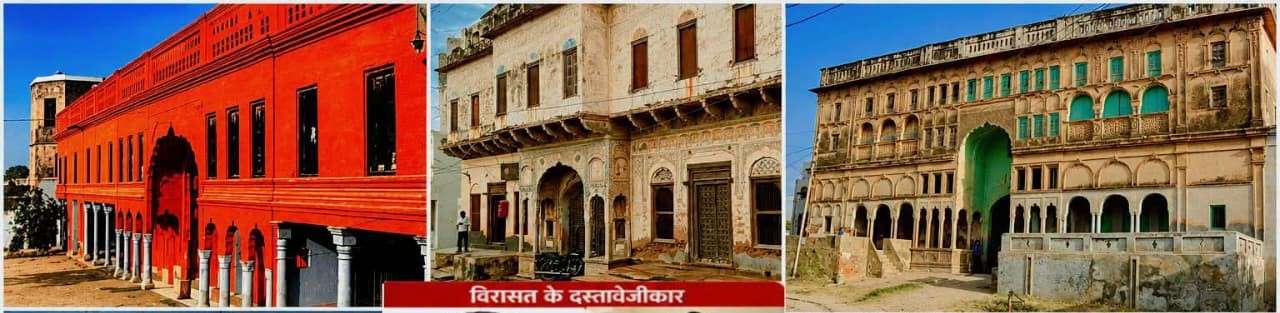
Among Barwa’s most prominent landmarks are its old havelis. Nearly a dozen historic mansions are considered particularly noteworthy, although local estimates suggest that there may be more. The havelis associated with Seth Parshuram, Seth Hukumchand, Lala Sohanlal and Seth Lakshmichand are especially significant for their architecture and murals.
These structures feature lakhori bricks, lime construction, woodwork, massive doors, carved windows, internal courtyards and chhatris. Their architectural vocabulary reflects the cultural links between Haryana and neighbouring Rajasthan and demonstrates how artistic traditions travelled across regional boundaries.
The Thakur’s Garhi, also known as Bransa Bhawan, occupies a particularly important place in Barwa’s historical identity. According to local tradition, the ancestors of Thakur Bagh Singh, belonging to the Tanwar Rajput clan, migrated from the Jeetpura region of Rajputana around six centuries ago and established their social roots in the area.
Local accounts place the construction of the present Garhi around 1938. A popular local tradition holds that its construction was undertaken during a period of inadequate rainfall and agricultural distress, thereby providing employment to villagers. If the account is historically accurate, the Garhi was not merely a symbol of power, prosperity and social prestige, but may also have played a role in the local economy of its time.
The fort’s massive main gate, iron-plated doors, wooden structures, spacious living quarters, storage areas and elephant stables speak of its former grandeur. Despite the passage of time and the damage caused by neglect, the surviving structure continues to offer glimpses into Barwa’s architectural and social past.
Walls that became canvases
The real uniqueness of Barwa’s havelis, however, lies in their murals.
Their walls and ceilings carry paintings depicting Radha-Krishna’s Rasleela, Vishnu-Lakshmi, Sherawali Mata, kings and queens, horsemen, elephants, chariots, soldiers, animals, birds and scenes from everyday folk life.
The artistic influences vary from mansion to mansion. Some murals exhibit the decorative character associated with the Shekhawati tradition, while others show Rajasthani and Kota influences. Elements associated with Mughal and Nathdwara traditions can also be seen. Together, these varying influences suggest a region where artistic ideas and cultural traditions interacted freely.
The paintings in Seth Parshuram’s mansion are particularly noteworthy. According to local accounts, artisans were brought from Pilani to decorate the building. Alongside religious narratives are scenes of kings and queens, chariot processions, music, animals, birds and social life.
The use of red, yellow, blue and green reflects the aesthetic sensibilities of the artists of the period. These murals therefore deserve to be viewed as more than decoration. They can be read as visual records of religious beliefs, social structures and the cultural imagination of the community.
At the entrance of the Seth Hukumchand-Lala Sohanlal mansion, the depiction of an elephant, king and queen is particularly striking. The decorated elephant and royal imagery create a sense of grandeur, while paintings of Vishnu-Lakshmi, Sherawali Mata and Radha-Krishna add a strong religious dimension. The artistic vocabulary again reflects Rajasthani, Mughal and Kota influences.
Lakshmichand’s paintings at Kathare are equally significant for their variety. They include chariot processions, maids, horsemen, gods and goddesses and other scenes from social and religious life. One particularly evocative painting depicts Lord Krishna braiding Radha’s hair, bringing together mythology, intimacy, affection and folk aesthetics.
The clothing, jewellery, crowns and vehicles depicted in these paintings further demonstrate the fusion of Rajasthani and Mughal artistic influences.
When tradition met modernity
One of the most fascinating features of Barwa’s murals is that they did not remain confined to mythology and religion. They also captured the changing world around them.
Paintings from the British era reportedly include trains, postmen and soldiers. One train scene is said to depict the engine, coaches, passengers and even a signalman.
Such imagery provides an intriguing glimpse into how new technology and changing social institutions entered the visual imagination of rural communities. The artists were not merely reproducing inherited religious themes; they were also recording the arrival of modernity.
In that sense, Barwa’s walls preserve a dialogue between tradition and change.
Kesar Talab and the culture of water
Barwa’s heritage extends beyond its havelis. Kesar Talab is another important part of the village’s cultural landscape.
According to local folklore, circumstances surrounding Seth Parshuram’s sister Kesar inspired the pond to be paved and made available for public use. Over time, it became much more than a source of water. It became part of community life and local memory.
The umbrellas and painted structures around the pond illustrate the close relationship between water bodies and folk culture. Murals featuring Radha-Krishna’s Rasleela, musical instruments, peacocks, parrots and other birds further enhance the cultural character of the site.
The pond, therefore, should be seen not in isolation but as part of the larger heritage landscape of Barwa.
Barwa on the silver screen
Barwa’s distinctive architecture and traditional surroundings have also found a place in Haryanvi folk cinema.
According to available accounts, scenes from the well-known Haryanvi films Chandrawal and Bairi were filmed around the village’s ponds, wells and traditional settings. Whether through cinema, literature or research, these visual elements have helped introduce Barwa’s distinctive landscape to audiences beyond the village.
The researchers preserving Barwa’s memory
For nearly two decades, Dr Satyawan Saurabh and Dr Priyanka Saurabh have worked to document Barwa’s heritage. Their research has covered the village’s havelis, murals, ponds, wells, architectural remains and oral traditions.
Their contribution goes beyond simply recording old buildings. Their effort has been to understand the social, cultural and economic history embedded in these structures and the memories associated with them.
Their writings on Barwa’s mansions and cultural heritage have also reportedly been used as reference material by several PhD researchers. Such academic interest demonstrates the potential of local history as a serious field of research.
Their work is important precisely because heritage is often lost first from collective memory and only later from physical structures. By recording stories, architectural details and local traditions, researchers such as the Saurabhs help ensure that Barwa’s history is not confined to fading walls.
A heritage at risk
Barwa’s greatest challenge today is preservation.
Humidity, smoke, weather, neglect and the passage of time are taking a toll on the murals. Some havelis are already showing signs of deterioration. Every damaged wall means the possible loss of a piece of visual history that may never be recreated.
Scientific surveys, professional conservation, high-quality photodocumentation and digital archiving are therefore urgently needed. Conservation should be undertaken with the assistance of heritage experts while respecting traditional construction techniques, local materials and the original architectural character of the structures.
This is not simply about saving old buildings. It is about preserving the evidence of a society that once expressed its faith, prosperity, social relationships, artistic imagination and encounters with a changing world through architecture and painting.
Turning heritage into opportunity
Barwa also possesses considerable potential for heritage tourism.
A carefully designed heritage trail could connect its havelis, Thakur’s Garhi, Kesar Talab, wells and important mural sites. Information boards, trained local guides, digital archives, a virtual or physical museum, cultural maps and research-based tourism material could help visitors understand the significance of what they are seeing.
Such an initiative could also create employment for local youth by involving them in heritage conservation, guiding, documentation and cultural tourism.
But tourism should follow conservation, not replace it. Commercialisation without preservation could ultimately damage the very heritage that attracts visitors.
Barwa’s havelis remind us that history does not reside only in grand palaces, monumental forts and famous cities. It also survives in the walls, wells, ponds, courtyards and painted ceilings of villages.
The murals of Barwa are the visual language of a bygone society. Its havelis bear witness to generations of labour, faith, prosperity, artistic expression, social relationships and technological change.
If the administration, universities, heritage experts, local communities and the heirs of these havelis come together with a concrete conservation plan, Barwa could emerge as an important rural heritage destination in Haryana.
The long-standing documentation and writings of researchers such as Dr Satyawan Saurabh and Dr Priyanka Saurabh can provide valuable groundwork for such an effort.
Ultimately, saving the havelis of Barwa is not merely about preserving old walls. It is about preserving a collective memory, a living folk-art tradition and a chapter of rural India’s history for generations yet to come.