



The future of any nation lies in the hands of its children, and their future depends on their education, values, and imagination. This is why children’s literature is considered a cultural heritage of any civilized society. Children’s literature is not merely a medium of entertainment; it also shapes a child’s personality, language, sensitivity, morality, imagination, and thinking. Stories, poems, children’s songs, puzzles, comics, and children’s magazines foster curiosity and creativity in children.
The irony is that excellent children’s literature is being written today and many prestigious children’s literary magazines are being published regularly, yet it is failing to reach children. This is a serious cultural crisis. If children’s literature doesn’t reach children, how will it fulfill its purpose? This question is not only for publishers, but also for society, the education system, and parents as a whole.
Today’s children are spending more time immersed in the world of mobile phones, the internet, video games, and social media. They are less likely to hold a storybook or children’s magazine, and more likely to hold a mobile phone. Technology itself isn’t a problem, but when it begins to replace book culture, concern is natural. Unfortunately, literary magazines for children haven’t been able to generate the necessary traction and reach.
There was a time when children eagerly awaited magazines like Nandan, Champak, Bal Bharti, Balhans, Devputra, and Chakmak. When the postman brought the magazines, they would eagerly read them, look at the pictures, solve the puzzles, and dream of submitting their own works. These magazines have nurtured countless writers, scientists, teachers, and sensitive citizens. Today, that tradition is slowly fading.
The biggest reason for this problem is the weak distribution system. Most children’s literary magazines are published in limited copies. They manage to reach large cities, but they fail to reach children in small towns and rural areas. Children’s literary magazines are not a major source of profit for booksellers, so they are not particularly interested in purchasing them.
The role of schools has also been disappointing in this regard. Most government and private schools have libraries, but new children’s literary magazines are not regularly available. Even if libraries exist, children rarely have the opportunity to read independently. The exam-oriented education system has virtually eliminated the culture of reading beyond textbooks.
Parents’ mindsets have also changed. They spend thousands of rupees on expensive toys, mobile phones, and coaching for their children, but show no interest in subscribing to a children’s magazine for the entire year. They believe that textbooks are sufficient for scoring marks in exams. They forget that language, imagination, sensitivity, and personality are essential for success in life, not just marks.
The media’s indifference to the promotion of children’s literature is also a factor. Newspapers and TV channels are full of films, sports, and entertainment, but discussions on children’s literature are rarely seen. When a field lacks adequate public attention, its popularity will be limited.
In today’s digital age, children’s literary magazines need to adapt with the times. Printed editions alone are not enough. If magazines reach children through mobile apps, e-magazines, audio stories, animated poems, and interactive content, their utility and popularity can increase. Technology should be made an ally, not a competitor.
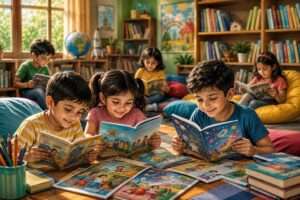
The question of language is also important. Children’s language should be simple, interesting, and conversational. Sometimes the content of children’s magazines can be overly didactic or difficult, making them uninteresting. It’s also important to creatively incorporate topics that appeal to the modern child’s curiosity, including science, the environment, space, robotics, sports, folklore, and contemporary themes.
Serious efforts are also needed at the government level. The Education Department could ensure mandatory subscriptions to selected children’s literary magazines in every school library. Children’s literature should be prioritized in national and state library plans. If mid-day meals are essential for children’s physical nutrition, children’s literature is equally essential for their intellectual and cultural nourishment.
Writers and editors also have no less responsibility. They must understand the changing psychology of children and create content that is both entertaining and informative. Children’s literature should not be a medium for preaching to children, but rather a medium for friendly dialogue with them.
Developing a reading culture in society is also the need of the hour. If parents read books themselves, children will be inspired to read as well. Programs like “One Period in the Name of the Library,” “Monthly Magazine Day,” “Story Reading,” “Conversation with a Child Writer,” and “Book Friend Campaign” can be initiated in schools.
It’s also essential that children’s literature isn’t limited to competitions. Children should have opportunities to publish their poems, stories, drawings, and letters in magazines. When a child becomes a part of a magazine, their emotional connection to it is strengthened.
This need is even more critical in rural India. Many children there have limited digital resources. If quality children’s magazines reach schools and panchayat libraries regularly, they can bring positive changes to children’s lives.
Children’s literature strengthens the cultural roots of any nation. It teaches children not only language but also the art of living, human values, love of nature, a scientific outlook, and social responsibility. If our future generations continue to drift away from books and magazines, it will have a detrimental effect not only on literature but also on the intellectual and moral development of society.
Ultimately, the question isn’t why children’s literary magazines are being published; it’s why they aren’t reaching children. Until writers, publishers, schools, parents, the government, and society make serious efforts in this direction, quality children’s literature will remain confined to a limited scope.
The need today is not just to publish new magazines, but to make them accessible to children. Because the day every child once again has a good children’s literary magazine in their hands, the culture of reading, imagination, and human sensibilities will return with renewed vigor. This will be the strongest foundation for an aware, sensitive, and empowered India of the future.

