

For decades, critics of India’s economy have measured success largely through the prism of consumption, often overlooking the foundation upon which every developed economy has been built—investment. Yet the latest indicators tell a compelling story. India’s Gross Capital Formation (GCF) as a share of GDP continues to remain robust, underlining a quiet but decisive transformation in the country’s economic architecture. A high Gross Capital Formation to GDP ratio is not merely another economic statistic to be celebrated in official presentations. It is a reflection of a nation investing heavily in its future. It means that a substantial portion of what India produces today is being channelled into creating productive assets—roads, railways, airports, ports, power plants, factories, machinery, warehouses, digital infrastructure and industrial corridors—that will generate income and employment for years, even decades, to come. This is precisely how successful economies have historically climbed the development ladder. Japan, South Korea, Singapore and, more recently, China all witnessed prolonged periods of high investment before emerging as industrial powerhouses. India appears determined to follow a similar path, albeit through democratic institutions and a market-driven framework. The significance of high capital formation extends far beyond GDP numbers. Every new highway, freight corridor, metro rail project, semiconductor plant, defence manufacturing unit or renewable energy installation triggers a chain reaction across the economy. Cement, steel, engineering goods, logistics, financial services and construction industries all receive a boost. Millions of workers find employment during construction, while permanent jobs emerge once these assets become operational. Unlike consumption, which provides only a temporary boost to economic activity, investment creates productive capacity. A factory established today continues producing goods for years. A highway built today reduces logistics costs for generations. A modern port enhances exports long after the ribbon-cutting ceremony is forgotten. This is wealth creation in its truest sense. Equally important, a healthy investment ratio reflects confidence. Businesses do not invest thousands of crores unless they believe demand will grow. Foreign investors do not establish manufacturing facilities unless they see long-term stability. Banks lend more comfortably when productive assets are being created. High capital formation therefore signals optimism across the economic ecosystem.
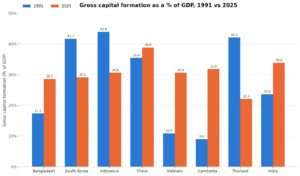
The Narendra Modi government’s emphasis on capital expenditure deserves attention in this context. Public investment in highways, dedicated freight corridors, railway modernisation, defence manufacturing, digital infrastructure, airports, inland waterways and renewable energy has created a multiplier effect that is now encouraging private investment as well. Complementary initiatives such as the National Infrastructure Pipeline, PM Gati Shakti, Production Linked Incentive (PLI) schemes, industrial corridors and logistics reforms have sought to make investment more efficient while lowering the cost of doing business. The economic logic is straightforward. Infrastructure investment reduces transportation costs, improves supply-chain efficiency, enhances productivity and increases India’s competitiveness in global manufacturing. Better logistics also strengthen exports, improve farm-to-market connectivity and attract multinational companies looking to diversify supply chains. Critics often demand higher government spending on welfare while questioning capital expenditure. The debate, however, need not be framed as one versus the other. Sustainable welfare itself depends on sustained economic growth. Without expanding the productive base of the economy, governments eventually run out of resources to finance social programmes. Investment today generates the revenues that fund tomorrow’s education, healthcare, social security and poverty alleviation schemes. Of course, investment alone is not sufficient. The quality of capital expenditure matters as much as its quantity. Projects must be completed on time, avoid cost overruns, remain environmentally sustainable and deliver measurable economic returns. Equally, the momentum in public investment must increasingly crowd in private sector participation to sustain high growth over the long term. India’s demographic dividend offers a narrow but historic opportunity. Millions of young Indians are entering the workforce every year. They require productive employment, not merely temporary income support. High Gross Capital Formation lays precisely that foundation by creating industries, expanding manufacturing and improving infrastructure that can absorb this growing workforce. Economic history repeatedly demonstrates that nations become prosperous not by consuming more, but by investing wisely. India’s strong capital formation ratio therefore represents more than an encouraging economic indicator—it signals confidence, ambition and preparation for a future where the country seeks not merely to grow, but to emerge as one of the world’s leading economic powers. The assets being built today are, in many ways, the prosperity of tomorrow.